
Where Mindful Learning Begins
Where Mindful Learning Begins
Class 9 Science Exploration NCERT Solutions Chapter 5 (CBSE 2026-27) — every Think It Over, Activity, Pause & Ponder, Worked Example, Revise Reflect Refine, and Journey Beyond question on this one page, with full step-by-step working for every numerical.
This chapter moves from physics back into chemistry, classifying every mixture you'll ever meet — true solutions, colloids, and suspensions — by particle size and behaviour, and building up the full toolkit for separating them: evaporation, distillation, chromatography, the separating funnel, sublimation, and centrifugation. You'll also learn to calculate concentration precisely using % m/m, % m/v, and % v/v, and see how solubility curves predict exactly how much solid crystallizes out on cooling — all frequently tested numerical skills for Class 9 exams.
Exploring Mixtures and their Separation moves from physics back into chemistry, classifying every mixture you'll ever meet — solutions, suspensions, and colloids — by particle size and behaviour, including the Tyndall effect that separates them. It covers how to express concentration precisely (% m/m, % m/v, % v/v), how solubility changes with temperature and drives crystallization, and the full toolkit of separation techniques: evaporation, distillation, paper chromatography, the separating funnel, sublimation, and centrifugation. Every question is solved here, section by section, exactly as the textbook presents them.
Particle size, settling behaviour, and the Tyndall effect — why milk scatters light but salt water doesn't.
% m/m, % m/v and % v/v calculations, plus how solubility curves predict how much solid crystallizes on cooling.
Choosing the right method — distillation, chromatography, sublimation, or centrifugation — based on what the mixture actually is.
Types of mixtures
| Property | Solution | Colloid | Suspension |
|---|---|---|---|
| Particle size | < 1 nm | 1 – 1000 nm | > 1000 nm |
| Appearance | Clear, transparent | Often clear or translucent | Opaque, cloudy |
| Settling | No | No | Yes (over time) |
| Tyndall effect | No | Yes | Yes |
| Filtration | Passes through | Passes through | Retained by filter |
| Examples | Salt/water, brass | Milk, blood, fog | Sand/water, muddy water |
Key formulae
Separation methods summary
| Method | Type of mixture | Principle | Example |
|---|---|---|---|
| Crystallization | Homogeneous (solid in liquid) | Solubility decreases on cooling | CuSO₄ from water, salt from brine |
| Distillation | Miscible liquids or liquid + solid | Difference in boiling points (≥25°C) | Acetone-water, water from salt |
| Paper chromatography | Homogeneous (mixed dyes etc.) | Different rates of movement in solvent | Ink dyes, flower pigments |
| Separating funnel | Immiscible liquids | Difference in density | Oil and water, mustard oil |
| Sublimation | Solid + non-sublimable solid | One solid sublimes, the other doesn't | Camphor + sand, naphthalene + salt |
| Centrifugation | Suspension/colloid | Centrifugal force separates by density | Blood components, clay from water |
| Coagulation | Suspension (fine particles) | Coagulant makes particles clump | Alum + muddy water, cheese making |
30 key terms from Chapter 5, defined in one line each — a quick glossary to refer back to as you work through the solutions below.
A combination of two or more substances that are not chemically combined.
Maximum amount of solute that can dissolve in a solvent at a given temperature.
A mixture with uniform composition throughout (e.g., salt solution).
A solution that cannot dissolve more solute at a given temperature.
A mixture with non-uniform composition (e.g., sand and water).
Process of forming pure solid crystals from a solution.
A homogeneous mixture of solute and solvent.
A solid with a regular geometric arrangement of particles.
The substance that gets dissolved in a solution.
Method of separating liquids based on different boiling points.
The substance that dissolves the solute.
Separation of liquids with small differences in boiling points.
The amount of solute present in a given amount of solution.
Technique used to separate components based on their movement through a medium.
Grams of solute present in 100 g of solution.
Liquids that do not mix (e.g., oil and water).
Grams of solute present in 100 mL of solution.
Apparatus used to separate immiscible liquids.
Volume of solute present in 100 mL of solution.
Direct change of a solid into vapour without becoming liquid.
Change of vapour directly into solid.
A heterogeneous mixture where particles are visible and settle down on standing.
Separation method using rapid spinning to separate heavier particles.
Process in which small particles clump together to form larger particles.
A mixture where particles are intermediate in size and do not settle.
The particles present in a colloid.
The medium in which particles are dispersed.
Scattering of light by particles in a mixture.
A colloid where both dispersed phase and medium are liquids.
A homogeneous mixture of two or more metals.
Answer: muddy water is a suspension — the solid mud particles are large (>1000 nm in diameter) and heavy enough that gravity pulls them down over time. Milk, on the other hand, is a colloid. Its fat droplets are much smaller (1–1000 nm) and are stabilised by proteins acting as emulsifying agents. These tiny particles remain uniformly dispersed and do not settle under normal conditions.
This is also why the Tyndall effect is visible in milk (a colloid) but not in a true salt solution.
Answer: evaporation is a surface phenomenon — molecules with enough kinetic energy escape from the liquid surface at any temperature below the boiling point. Boiling occurs throughout the bulk of the liquid when its vapour pressure equals atmospheric pressure — it requires a specific temperature (e.g., 100°C for water at sea level). Evaporation is slow and occurs at room temperature; boiling is rapid and requires external heat.
Answer: this is the Tyndall effect. The atmosphere in a forest contains fine dust particles, water droplets, and other colloidal particles. When a beam of light passes through these particles, it gets scattered in all directions, making the path of the light beam visible as bright rays. This scattering occurs with colloids and suspensions, not with true solutions.
| Observation | Group A: Salt + Water | Group B: Chalk + Water | Group C: Milk + Water |
|---|---|---|---|
| Visibility of particles | No visible particles — clear | White particles clearly visible | No visible particles — milky white |
| Laser beam path | Not visible — no scattering | Clearly visible — scatters strongly | Visible — faint scattering (Tyndall effect) |
| After standing undisturbed | No change — remains clear | Chalk settles to the bottom | No change — remains milky |
| Filtration (filter paper) | No residue — passes through | White chalk residue remains | No residue — passes through |
| Type of mixture | Solution (homogeneous) | Suspension (heterogeneous) | Colloid (intermediate) |
Conclusion: the three mixtures are different types. Salt solution is a true solution (homogeneous, no scattering). Chalk water is a suspension (heterogeneous, settles, filters). Milk water is a colloid (appears homogeneous, shows the Tyndall effect, does not filter or settle).
(i) The solubility of compound A in water at 20°C is less than its solubility at 60°C. Compound A's solubility increases with temperature (from the graph), so it dissolves less at 20°C than at 60°C.
(ii) The solubility of compound B at 20°C is less than its solubility at 60°C. Compound B's solubility also increases with temperature, and much more steeply than compound A.
(iii) The solubility of compound B increases more than that of compound A with an increase in temperature. From the graph, B's curve rises steeply (from ~50 g to ~350 g per 100 g water as temperature increases from 10–80°C), whereas A rises only slightly.
Observations: blue copper sulfate crystals form on the watch glass/filter paper after the hot saturated solution cools. The crystals are shiny, well-shaped, and blue-coloured.
Why slow cooling? Slow cooling gives particles in the solution more time to come together in an organised, regular geometric pattern, producing larger, better-formed crystals. Rapid cooling (in ice water) produces small, poorly-formed crystals because the particles solidify too quickly to arrange themselves properly.
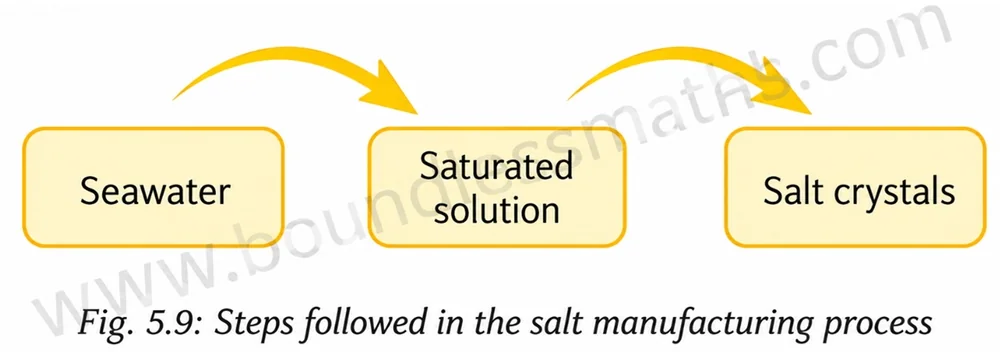
Answer: seawater is collected in shallow pans and left in the sun. As the water evaporates, the dissolved salt becomes more and more concentrated, until the solution becomes saturated — unable to dissolve any more salt. With continued evaporation, the salt can no longer stay dissolved and separates out as solid salt crystals, which are then collected. This is essentially large-scale evaporation/crystallization, using solar heat instead of a laboratory burner.
Observation: as water rises up the chromatographic paper, the black ink spot separates into distinct coloured spots (bands) at different heights — typically showing blue, red, yellow, or green pigments that make up the black ink.
Inference: black ink is a mixture of several coloured dyes/pigments. Different components have different affinities for the paper (stationary phase) and for water (mobile phase). Components that interact more strongly with the paper move slower; those that interact more with water move faster. This difference in movement separates them into distinct bands.
Observation: two distinct layers form — yellow mustard oil on top and colourless water at the bottom.
Reason: mustard oil and water are immiscible (they do not dissolve in each other). Oil has a lower density (~0.91 g/mL) than water (1.0 g/mL), so it floats on top, while the denser liquid (water) sinks to the bottom. This density difference causes the two liquids to separate into distinct layers.
Observation: white, solid camphor deposits appear on the inner walls of the inverted funnel. The sand remains in the china dish.
Explanation: camphor undergoes sublimation — it changes directly from solid to vapour on heating, without passing through the liquid state. The vapour rises and, on cooling at the funnel walls, undergoes deposition (converting directly back to solid). Sand does not sublime, so it stays in the dish — this difference allows the complete separation of camphor from sand.
∴ 12 g of zinc oxide is present in 300 g of talcum powder.
Volume of concentrate = 2 × 15 mL = 30 mL. Total volume of juice = 150 mL.
∴ The orange juice concentrate is 20% v/v in the mixture.
Answer: take 5 mL of glacial acetic acid and add sufficient water to make the total volume 100 mL.
Verification: % v/v = (5 mL / 100 mL) × 100 = 5% v/v ✓
Always add acid to water, never water to acid, when diluting concentrated acids. This prevents violent exothermic reactions.
Answer: Compound B will deposit more solid. From the solubility curves: B at 80°C ≈ 350 g per 100 g water, and at 60°C ≈ 287 g per 100 g water, depositing ≈ 63 g per 100 g water. Compound A shows very little change between 80°C and 60°C, so it deposits very little.
Since B shows a much steeper change in solubility with temperature, cooling it deposits far more crystals than cooling A over the same temperature range.
Answer: Yes. Slower evaporation → larger, better-formed crystals. Faster evaporation → smaller, irregular crystals.
When evaporation is slow, ions have more time to arrange themselves into an orderly, repeating crystal lattice, producing larger and more regular crystals. Rapid evaporation forces too many particles to crystallise simultaneously, resulting in small, poorly-shaped crystals — this is why industrial salt production and lab crystallizations use controlled, slow evaporation.
(i) Salt can be separated from a salt solution by evaporation or distillation. — TRUE. Evaporation removes water to leave behind solid salt; distillation can also separate the water (distillate) and leave salt in the flask.
(ii) Distillation can separate two liquids even when they have the same boiling point. — FALSE. Distillation only works when two miscible liquids differ in boiling point by at least about 25°C. If boiling points are the same, both liquids vaporise simultaneously and cannot be separated this way.
(iii) In paper chromatography, the solvent level should be above the sample spot at the beginning. — FALSE. The solvent level must be below the sample spot — if the spot is submerged, the sample dissolves directly into the solvent instead of being carried up the paper by capillary action.
(iv) Evaporation and crystallization are the same process. — FALSE. Evaporation removes the solvent (usually by heating), leaving the solute behind. Crystallization uses controlled cooling of a hot saturated solution to form pure crystals of the solute. Evaporation can yield a crude, dry solid; crystallization yields pure, well-shaped crystals, and is often preceded by evaporation to concentrate the solution.
Answer: immiscible liquids do not mix because their intermolecular forces are not compatible ("like dissolves like"). When placed together, they remain as separate phases, and gravity then separates them into distinct layers based on density — the denser liquid sinks to the bottom and the less dense liquid rises to the top. In a separating funnel, these layers remain stable, allowing each liquid to be drained separately through the stopcock.
Answer: Yes, they are different.
| Feature | Evaporation | Sublimation |
|---|---|---|
| Phase change | Liquid → Gas | Solid → Gas (directly) |
| Passes through liquid? | Yes | No (liquid phase skipped) |
| Temperature | At or below boiling point | Below melting point |
| Examples | Water → water vapour | Camphor, naphthalene, dry ice |
Answer: clouds are colloids (specifically, aerosols — liquid droplets or solid particles dispersed in a gas). The tiny water droplets or ice crystals (1–1000 nm) are the dispersed phase, and air is the dispersion medium. Like all colloids, cloud particles do not settle under gravity and scatter light — this is why you can sometimes see shafts of sunlight passing through clouds (the Tyndall effect). They're too small to filter out and do not settle, unlike suspensions.
Answer: smoke and dust particles create colloidal mixtures (aerosols) in the air. These colloidal particles scatter sunlight in all directions (the Tyndall effect). This multiple scattering reduces visibility — instead of light travelling in straight lines to your eyes from distant objects, scattered light from all directions reaches you, making the atmosphere appear hazy or murky. The more colloidal particles present, the greater the scattering and the worse the visibility.
Given: mass of salt (solute) = 10 g; mass of water (solvent) = 90 g. Total mass of solution = 10 + 90 = 100 g.
Given: mass of glucose = 5 g; volume of solution = 100 mL.
Given: volume of pesticide (solute) = 1 mL; total volume of solution = 100 mL.
At 60°C, 287 g of B is dissolved in 100 g water (saturated). At 40°C, only 241 g can remain dissolved in 100 g water.
∴ 46 g of compound B crystallises out as pure solid when the solution is cooled from 60°C to 40°C.
Answer: Muddy water — Ht, Milk — Ht, Blood — Ht, Brass — Hm is the correct option.
Answer: (a) and (c).
| Property | Solution | Suspension | Colloid |
|---|---|---|---|
| Nature | Homogeneous | Heterogeneous | Appears homogeneous (actually heterogeneous) |
| Particle size | < 1 nm | > 1000 nm | 1 – 1000 nm |
| Visibility of particles | Not visible | Visible to the naked eye | Not visible to the naked eye; seen with an electron microscope |
| Settling on standing | Does not settle | Settles over time | Does not settle |
| Filtration (filter paper) | Cannot be separated | Can be separated | Cannot be separated by ordinary filter paper |
| Tyndall effect | Absent | Present | Present |
| Examples | Salt solution, brass, vinegar | Sand in water, muddy water, mud | Milk, smoke, blood, butter, starch solution |
% m/m of sugar = (75/500) × 100 = 15% m/m. % m/m of flour = (420/500) × 100 = 84% m/m. % m/m of NaHCO₃ = (5/500) × 100 = 1% m/m. Verification: 15 + 84 + 1 = 100% ✓
(ii) Brass alloy — 70% copper by mass, 120 g totalMass of copper = 70% of 120 g = 84 g. Mass of zinc = 120 − 84 = 36 g.
Answer: yes, oil and water are immiscible and will form two separate layers.
Which layer is on top? cooking oil has a density of ~0.91 g/mL (910 g per litre), which is less than water's density of 1.0 g/mL — so oil forms the upper layer and water the lower layer.
Method of separation: a separating funnel. Pour the mixture in, allow layers to form undisturbed, then open the stopcock slowly to drain water (the lower layer) into a beaker. Close the stopcock when the interface reaches the tap, then pour the oil out separately from the top.
Apparatus: separating funnel, retort stand, beaker, glass stopper. The stopcock controls the outflow of the lower liquid.
Answer: A is true, but R is false.
The assertion is true — solutions do not show the Tyndall effect because their solute particles are too small to scatter light. The reason is false — the correct statement is that solution particles are smaller than 1 nm, not larger than 100 nm. It's precisely because particles are too small (below the wavelength of light) that they cannot scatter light — colloid particles (1–1000 nm) are in the right size range to scatter visible light.
| Mixture | Method | Reason |
|---|---|---|
| Mud from muddy water | Centrifugation, or coagulation (add alum) + filtration | Mud forms a suspension; alum coagulates fine particles; centrifugation forces heavier particles outward. |
| Plasma from blood | Centrifugation | Blood is a colloid; centrifugation separates heavier RBCs from lighter plasma. |
| Naphthalene and sand | Sublimation | Naphthalene sublimes on heating; sand does not — vapour deposits on cool funnel walls. |
| Chalk powder and salt | Dissolve in water → filter → evaporate | Salt dissolves, chalk does not; filtration removes chalk, evaporation of filtrate gives salt. |
| Common salt and water | Evaporation or distillation | Evaporation recovers salt; distillation recovers both salt and pure water. |
| Oil from water | Separating funnel | Immiscible liquids form two layers, separated by density difference. |
| Pigments of a flower | Paper chromatography | Different pigments have different affinities for paper and solvent, separating into bands. |
Method: Simple distillation. The boiling points differ by 30°C (>25°C), so distillation is suitable.
Procedure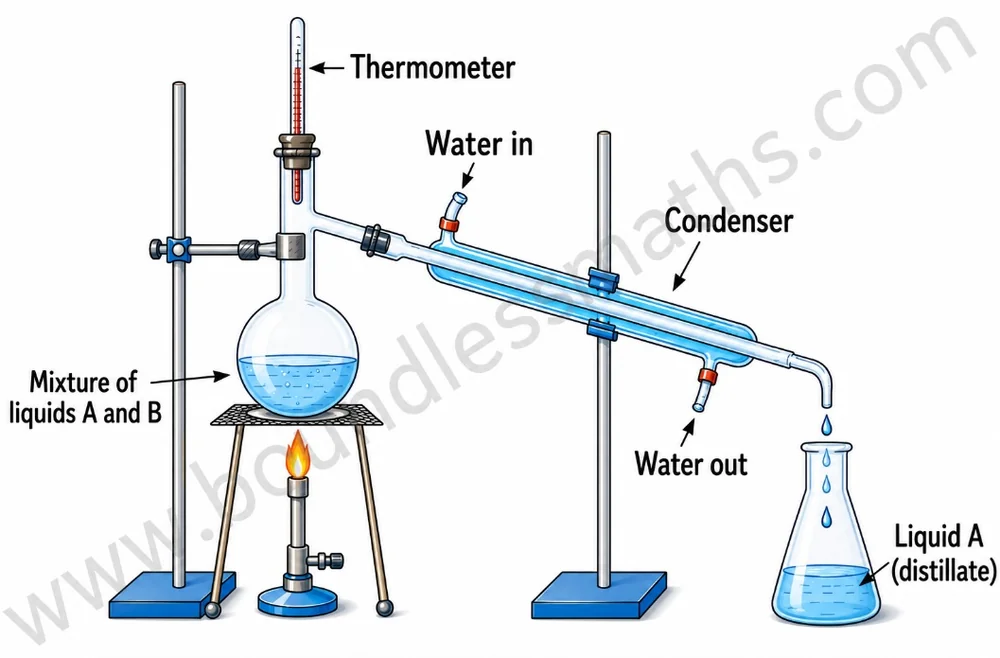
Apparatus (labelled): distillation flask → wire gauze on tripod → burner → thermometer (in the vapour space) → water condenser (water inlet at bottom, outlet at top for counter-current cooling) → conical flask (receiver).
The thermometer bulb should be level with the side arm of the flask, to accurately record the temperature of the vapour, not the boiling liquid.
| Aspect | Evaporation | Crystallization | Distillation |
|---|---|---|---|
| Process | Solvent vaporises from surface | Cooling saturated solution to form crystals | Vaporisation then condensation |
| What is recovered | Solute (solid) only | Pure solid solute (crystals) | Both solvent AND solute (in separate vessels) |
| Temperature required | Below boiling point (gentle heat) | Heat first, then cool slowly | At/above boiling point |
| Best for | When only solute is needed (e.g. sea salt) | When pure solid crystals are needed; removing impurities | When the solvent is valuable, or for two miscible liquids with different boiling points |
| Example | Salt from brine, jaggery | Copper sulfate crystals, sugar purification | Acetone-water, crude oil refining, pure water from saline |
(i) If blood were a true suspension:
(ii) In blood: the dispersed phase is blood cells (red blood cells, white blood cells, platelets) and proteins; the dispersion medium is plasma — the liquid component (~55% of blood), consisting of water with dissolved salts, proteins, and nutrients.
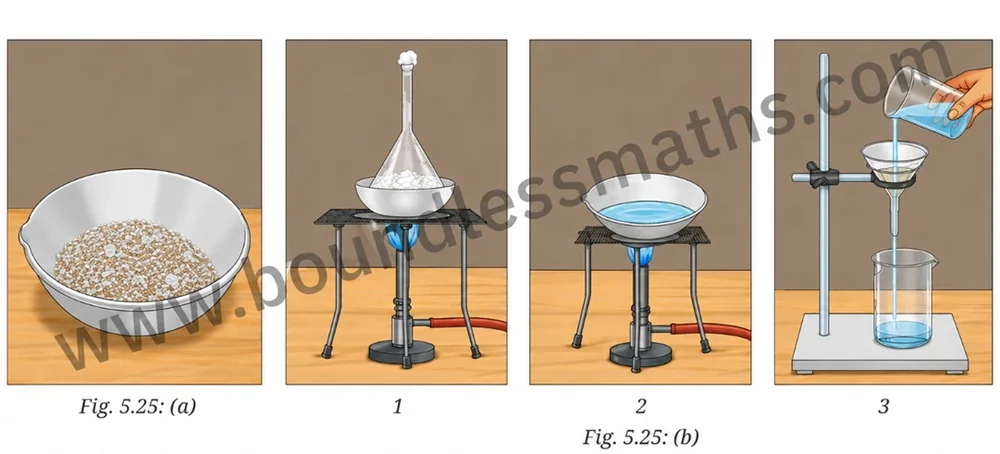
Correct sequence:
Result: three pure components — naphthalene (from the funnel), sand (filter paper residue), and common salt (evaporation dish).
Solubility of KCl at 80°C = 54 g per 100 g water; at 20–25°C ≈ 35 g per 100 g water. Mass crystallising out = 54 − 35 ≈ 19 g per 100 g water. As the solution cools, it becomes supersaturated, and white KCl crystals slowly deposit at the bottom of the container.
(iii) Effect of temperature on solubility — comparing four salts (10°C to 80°C)Solubility of solid solutes in water generally increases with temperature, since higher temperatures give more kinetic energy to solvent and solute particles, breaking solute-solute interactions and increasing solvation.
| Salt | At 10°C (g) | At 80°C (g) | Change (g) | % increase |
|---|---|---|---|---|
| Potassium nitrate | 21 | 167 | +146 | ~695% |
| Sodium chloride | 36 | 37 | +1 | ~3% |
| Potassium chloride | 35 | 54 | +19 | ~54% |
| Ammonium chloride | 24 | 66 | +42 | ~175% |
Conclusion: KNO₃ shows the greatest increase in solubility with temperature (+695%), ideal for hot-solution crystallization. NaCl shows almost no change and cannot be effectively purified by recrystallisation. KCl and NH₄Cl show moderate increases.
(i) Student A: 20 g sugar in 80 g water — total mass = 100 g. % m/m = (20/100) × 100 = 20% m/m.
Student B: 20 g sugar in 100 g water — total mass = 120 g. % m/m = (20/120) × 100 = 16.67% m/m.
Student C: 30 g sugar in 80 g water — total mass = 110 g. % m/m = (30/110) × 100 = 27.27% m/m.
(ii) Student C has the most concentrated solution (27.27% > 20% for A > 16.67% for B). C dissolves more sugar (30 g) in the same mass of water (80 g) as A — more solute per unit mass of solution means higher concentration. B is the least concentrated, since the same amount of sugar is dissolved in more water (100 g vs 80 g).
(i) The technique 'S' is distillation (specifically simple distillation) — the apparatus shows a distillation flask, a condenser, and a collection flask, the standard distillation setup.
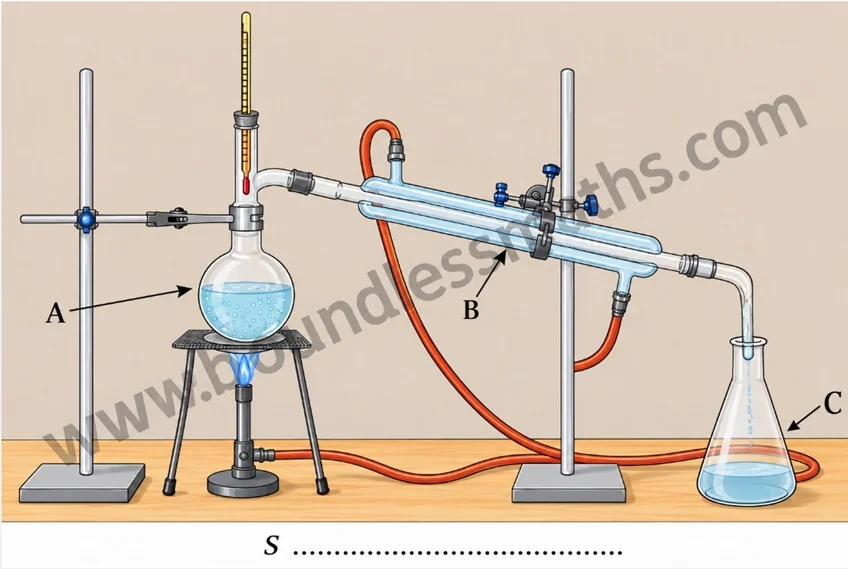
(ii) A = distillation flask (contains the mixture being heated); B = water condenser/Liebig condenser (cools the vapour back to liquid); C = conical flask/collection flask (receives the distillate).
(iii) Using boiling point data:
| Mixture | Boiling points (°C) | Difference (°C) | Distillation possible? |
|---|---|---|---|
| (a) Water — Acetone | 100, 56 | 44 | Yes ✓ (diff > 25°C) |
| (b) Water — Salt | 100, very high (solid) | — | Yes ✓ (salt doesn't boil; distillation recovers water) |
| (c) Acetone — Alcohol | 56, 78 | 22 | Not ideal ✗ (diff < 25°C; needs fractional distillation) |
| (d) Sand — Salt | Solid + solid | — | No ✗ (use dissolution + filtration instead) |
| (e) Alcohol — Chloroform | 78, 61 | 17 | Not ideal ✗ (diff < 25°C; needs fractional distillation) |
| (f) Alcohol — Benzene | 78, 80 | 2 | Not suitable ✗ (almost same boiling points; fractional distillation only) |
Conclusion: simple distillation is effective for (a) and (b). Mixtures (c), (e), (f) require fractional distillation. Mixture (d) is not separated by distillation at all.
Hypothesis: rapid cooling produces smaller, less well-formed crystals; slow cooling produces larger, well-shaped crystals.
Experiment designExpected result: Beaker A (rapid cooling) → many small, irregular crystals. Beaker B (slow cooling) → fewer but larger, well-formed blue rhombic crystals.
Scientific reason: slow cooling allows ions to arrange themselves gradually into an ordered crystal lattice. Rapid cooling causes sudden supersaturation — too many nuclei form simultaneously, competing for solute, resulting in small crystals.
Principle: Distillation (steam distillation/hydro-distillation). Flowers or plant material are placed in a Deg (copper pot/still) with water. On heating, steam carries volatile fragrance molecules (essential oils) upward through a bamboo pipe into the Bhapka (receiver pot), which is cooled in water. The vapour condenses, and the perfume (ittar) separates.
Significance: this centuries-old traditional distillation technique produces ittar (e.g., Mitti ka Ittar — an earthy fragrance after rain) that cannot be replicated by synthetic chemistry with the same complexity and depth. It represents India's scientific heritage in chemical separation — Kannauj is known as the perfume capital of India.
Physical principle: Centrifugation, using centrifugal force. When the paperfuge disc (with blood samples attached) spins rapidly as strings are pulled, it generates high rotational speed. The centrifugal force (outward force on a rotating body) pushes heavier particles (red blood cells) outward, where they settle at the tip of the sample tube, separating from the lighter components (plasma, platelets).
Healthcare importance: traditional centrifuges require electricity, which is unavailable in many remote or resource-poor areas. The paperfuge costs very little (~20 cents) and needs no electricity — it works purely by hand, separating blood components in 15 minutes to help diagnose diseases like malaria and anaemia, making life-saving diagnostics accessible anywhere in the world.
Answer: this is an active area of research. Key challenges include:
Status: no complete artificial blood exists yet. Research continues on synthetic RBCs using nanotechnology, stem cell-derived blood, and xenotransfusion (from animals) — this remains a frontier of biotechnology and chemistry.
Every mixture can be classified by particle size — solution, colloid, or suspension — and once you know which one you're dealing with, along with how its components differ in solubility, boiling point, density, or size, there's always a matching separation technique that can pull it apart cleanly.
Seven extra questions in the style of the textbook's own activities and examples, for independent practice once you've gone through everything above. Attempt each one on paper first, then tap to check.
(a) Sugar in water — true solution. Sugar dissolves completely, the particles are too small to scatter light or settle, and the mixture is clear and stable.
(b) Starch in water — colloid. Starch particles are larger than in a true solution but too small to settle; the mixture looks slightly cloudy and shows the Tyndall effect (scatters a beam of light).
(c) Chalk powder in water — suspension. Chalk particles are large enough to be seen, the mixture looks cloudy/opaque, and the particles settle down on standing.
Answer: extra amount that can dissolve = solubility at 60°C − solubility at 20°C.
So raising the temperature from 20°C to 60°C allows an extra 40 g of the compound to dissolve in the same 100 g of water.
(i) Oil from water — separating funnel. Oil and water are immiscible liquids that form two distinct layers, so they can be separated by opening the stopcock and draining the lower (denser) layer first.
(ii) Sugar dissolved in water — distillation (or evaporation/crystallization). To recover the sugar as a solid, the water must be evaporated off, leaving the sugar behind.
(iii) Sand from water — filtration. Sand is an insoluble solid suspended in water; filter paper lets the water pass through while trapping the solid sand particles.
Answer: since the green ink separates into two distinct spots (blue and yellow), it is a mixture of at least two different coloured dyes, which travel up the paper at different rates depending on their solubility and how strongly they stick to the paper.
If only one spot had appeared (however far the solvent travelled), it would suggest the ink is likely a pure substance (or made of components that happen to travel together), since there would be no separation into distinguishable components.
Answer: this needs fractional distillation, not simple distillation. Simple distillation works well when the boiling points of the liquids differ by a large margin (roughly 25°C or more) — but here the difference is only 22°C, which is too close for simple distillation to cleanly separate the two vapours.
Fractional distillation uses a fractionating column packed with obstacles that provide repeated opportunities for vapour to condense and re-evaporate, effectively performing many small separations in a row. This gives the sharper separation needed for liquids with closer boiling points, like alcohol and water.
Answer: simple evaporation involves heating the solution until all the water boils off, which requires the solution to be heated strongly and continuously — this can decompose heat-sensitive compounds, and often produces small, poorly-formed, impure crystals mixed with any other dissolved impurities that get left behind indiscriminately.
Crystallization only evaporates the solution until it becomes saturated, then lets it cool slowly without further strong heating. Slow cooling gives the compound's own particles time to arrange into large, well-formed, pure crystals, while impurities (present in smaller amounts) mostly stay dissolved in the remaining liquid rather than being trapped in the crystal structure. This avoids the risk of decomposition and gives a purer solid.
Answer: heat the mixture gently in a china dish covered with an inverted funnel (with a cotton plug at the stem, or a filter paper wrapped over the funnel's mouth to catch the escaping vapour).
Ammonium chloride undergoes sublimation — it turns directly from solid to vapour without melting. This vapour rises and touches the cooler walls of the inverted funnel, where it undergoes deposition — converting directly back into solid ammonium chloride, which collects on the funnel's inner walls.
Common salt does not sublime, so it remains behind as a solid residue in the china dish. This cleanly separates the two solids using sublimation followed by deposition.
Next up is Chapter 6 — How Forces Affect Motion. Or explore the full chapter list, browse the Class 9 Science hub, or book a free demo class for personalised coaching.
 Expert CBSE Coaching · Class 9–12
🥊 Festive Offer · Ends 25 Sep
Expert CBSE Coaching · Class 9–12
🥊 Festive Offer · Ends 25 Sep