Where Mindful Learning Begins
Where Mindful Learning Begins
Your Complete Study Hub — Free Resources, AI Practice & Live Coaching
This page brings everything together — the full CBSE syllabus, 200+ free practice questions across all 8 units, CBSE sample papers & school papers, video tutorials, a formula deck, an AI-powered question bank that adapts to your weak areas, and personal coaching from an expert with 13+ years of experience. Whether you're just starting Class 11 or in your final weeks before the Class 12 board exam, every resource you need is here — in one place, in the right order.
But resources alone are not enough. What truly separates students who score 90+ from those who don't is the right mindset, a structured approach, and guidance that helps you understand why — not just how. Knowing which chapters to prioritise, how to present step-wise answers, when to switch from practice questions to full mock tests, and how to manage exam-day stress — these are the things that make the real difference. That's exactly what Boundless Maths coaching is designed to build. Explore Boundless Maths coaching to see the approach first-hand. These resources can help you prepare smarter and score well in your upcoming Board Exam. All the best.
The Applied Mathematics syllabus is divided into two parts – Theory (80 marks) and Internal Assessment (20 marks). CBSE Applied Mathematics Class 12 for 2026-27 is structured across 8 units covering Numbers & Quantification, Algebra, Calculus, Probability Distributions, Inferential Statistics, Time-based Data, Financial Mathematics, and Linear Programming. Designed specifically for commerce students, the subject replaces abstract theory with real-world applications — from EMI and bond valuation to binomial distributions and linear programming problems. It is an ideal choice for students planning to pursue CA, CS, BBA, BCom, Economics Honours, or Business Analytics after Class 12.
| Unit | Topics Covered | Marks |
|---|---|---|
| I. Numbers & Quantification | Modular Arithmetic, Congruence Modulo, Alligation & Mixture, Boats & Streams, Pipes & Cisterns, Races & Games, Numerical Inequalities | 11 |
| II. Algebra | Matrices, Determinants, Solving Linear Equations | 10 |
| III. Calculus | Differentiation & Its Applications, Integration & Its Applications, Differential Equations | 15 |
| IV. Probability Distributions | Probability Distribution Table, Binomial, Poisson, Normal Distribution | 10 |
| V. Inferential Statistics | Sampling, Hypothesis, One-Sample t-Test | 5 |
| VI. Time-based Data | Index Numbers, Time Series – Moving Averages & Least Squares | 6 |
| VII. Financial Mathematics | Perpetuity, Sinking Funds, EMI, CAGR, Depreciation, Bonds | 15 |
| VIII. Linear Programming | LPP Formulation, Corner Point Method | 8 |
Get the official CBSE Applied Mathematics Class 12 syllabus with unit-wise marks distribution, deleted topics, and exam pattern.
Complete guide to score 90+ marks in CBSE Class 12 Applied Mathematics Board Exam 2026-27. Learn which topics carry maximum weightage, chapter-wise preparation strategy, formula mastery techniques, how to use the right practice papers at the right time, and common mistakes to avoid. Whether you prefer self-study or are looking for an Applied Maths online tutor or after-school coaching classes, this guide will help you build a winning preparation plan.
Focus heavily on EMI calculations, sinking funds, bonds valuation, and depreciation. This unit alone contributes 15 marks and is highly scoring if you practise regularly.
Master differentiation applications (maxima-minima, marginal cost) and integration applications (area under curve, consumer surplus). Practise mixed problems.
Matrices and determinants are straightforward if you practise regularly. Focus on matrix operations, inverse, and solving equations using both methods.
Learn distribution formulas thoroughly. Practise identifying which distribution to use in a given problem. Normal distribution questions are very scoring.
Time Based Data (6 marks): Easiest unit! Moving averages and least squares are formula-based and straightforward. | Linear Programming (8 marks): Graph-based questions are scoring if you practise the graphical method properly. | Inferential Statistics (5 marks): t-Test questions follow a fixed format. Practise the steps thoroughly.
Don't create random flashcards — use the Formula Deck which has every formula for all 8 units organised chapter-wise. Revise daily, not just before exams. Understanding when to apply each formula matters more than memorising it.
Always show complete step-wise working in every answer. CBSE awards method marks even if your final answer is wrong — a well-presented incomplete solution can still earn you 3 out of 5 marks. Never skip steps in Calculus or Financial Maths.
Allocate 25–30 minutes daily for each high-weightage unit (>10 marks) — Financial Maths, Calculus, Algebra, and Probability together carry 50 marks. Consistent daily practice beats last-minute cramming every time.
Don't jump straight to board papers. Build up: start with free chapter-wise questions on this site, then CBSE sample papers, then previous year board papers. Each layer adds difficulty — this is how you build real exam confidence.
Use school question papers matched to your current exam stage — UT papers while preparing for unit tests, Half-Yearly papers for term exams, and Pre-Board papers in the final weeks before boards. Don't waste Pre-Board papers too early.
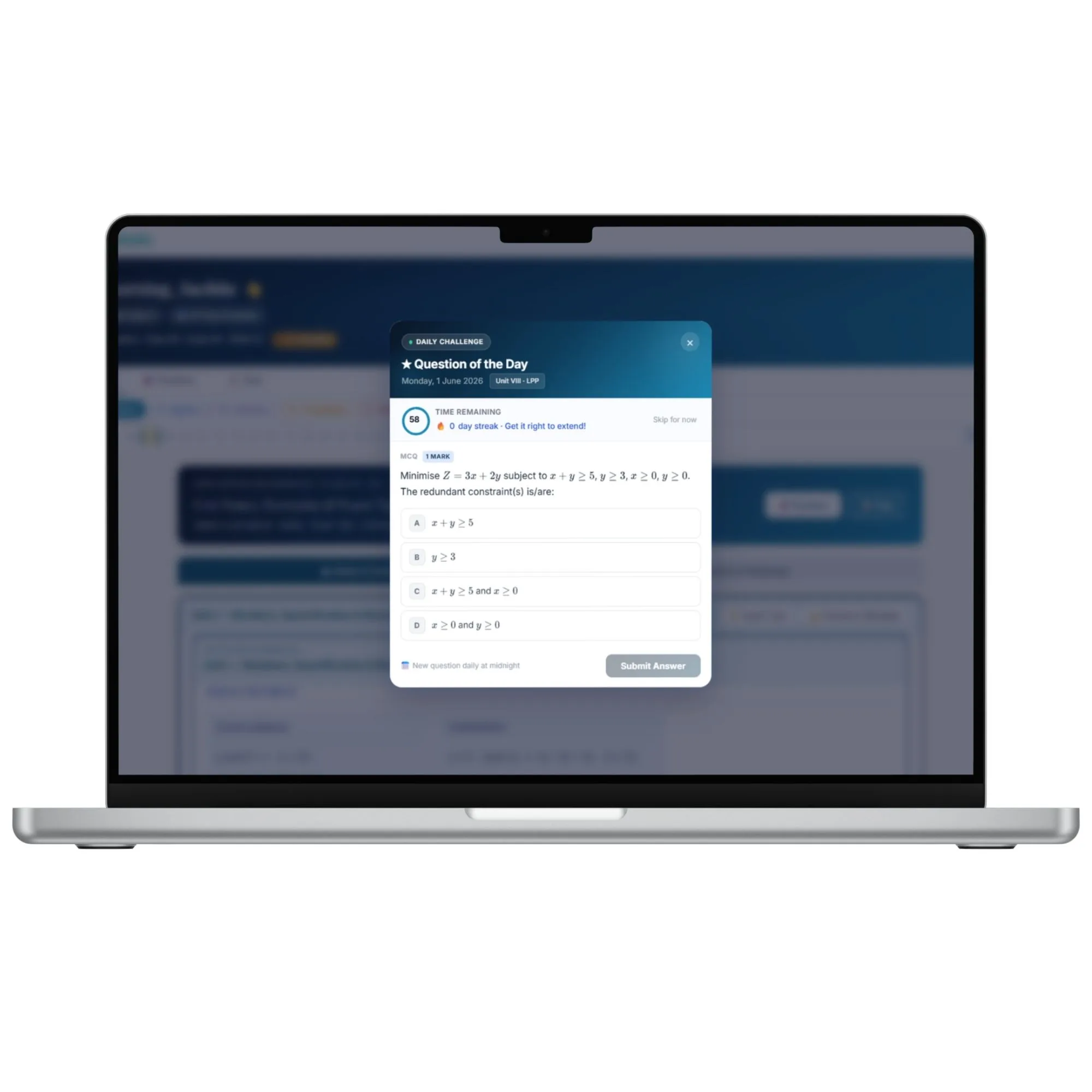
The AI Question Bank includes adaptive AI practice — instant feedback, personalised weak-area targeting, and timed board exam simulation. Use it in the final weeks to consolidate everything you've studied. Practice smarter.
Attempt all MCQs — don't overthink. Move on if stuck; return at the end. These 20 marks are the quickest to secure.
Complete 2-mark and 3-mark questions. Show all steps even for short answers — method marks matter throughout.
Solve Case Studies — these follow predictable patterns and are very scoring if you have practiced them beforehand.
Attempt 5-mark questions with complete step-wise solutions. Reserve 10-15 minutes for reviewing all answers.
Two textbooks, free practice questions, a formula deck, and an AI-powered question bank — your complete toolkit to score 90+. This section compares the best books for Applied Maths Class 12, including M.L. Aggarwal Applied Mathematics solutions and the official CBSE Applied Maths Handbook PDF, so you know exactly which to prioritise and when. Whether you're searching for a class 12 applied maths formula sheet, a free CBSE Applied Maths question bank, or an affordable applied maths study material list for board exam 2026-27, you'll find it organised by purpose below.
Step 1 — M.L. Agarwal (Primary Textbook): Your main resource for building concepts and thorough practice. Work through it chapter by chapter — it gives comprehensive coverage of all topics with detailed theory, solved examples, and extensive practice questions.
Step 2 — CBSE Handbook: Go through it at least once alongside M.L. Agarwal. Concise and focused — useful as a second read-through of concepts and to ensure no CBSE topic has been missed. Free to download on this page.
Step 3 — Free Practice Questions (Boundless Maths): After finishing each chapter, practise with free MCQs, solved examples & case studies on this website — especially for units carrying 10+ marks.
Step 4 — Formula Deck: Revise all formulas daily. Keep the Formula Deck handy throughout the year and do a quick scan just before any assessment.
Step 5 — School Question Papers & AI Question Bank: Practice with papers matched to your exam stage — UT papers for unit tests, Half-Yearly papers for term exams, Pre-Board papers in the final weeks. Use the AI Question Bank alongside for adaptive practice — it targets your weak areas automatically, gives instant feedback, and simulates the board exam experience.
Comprehensive free practice questions for all 8 units of CBSE Applied Maths Class 12 2026-27 — solved examples, MCQs, assertion-reason, short and long answer questions, and case studies for board exam practice. From Numbers & Quantification and Modular Arithmetic through Calculus, Financial Mathematics, and Linear Programming. Search terms like "Applied Maths class 12 MCQ questions with answers PDF" or "Applied Maths case study questions with solutions" lead many students here — every unit below is organised chapter-wise so you can jump straight to the topic you're revising.
Numbers & Quantification, Algebra, Calculus, Probability Distributions, Inferential Statistics, Time-based Data, Financial Mathematics, and Linear Programming — MCQs, solved examples, and case studies for every unit, completely free with no sign-up.
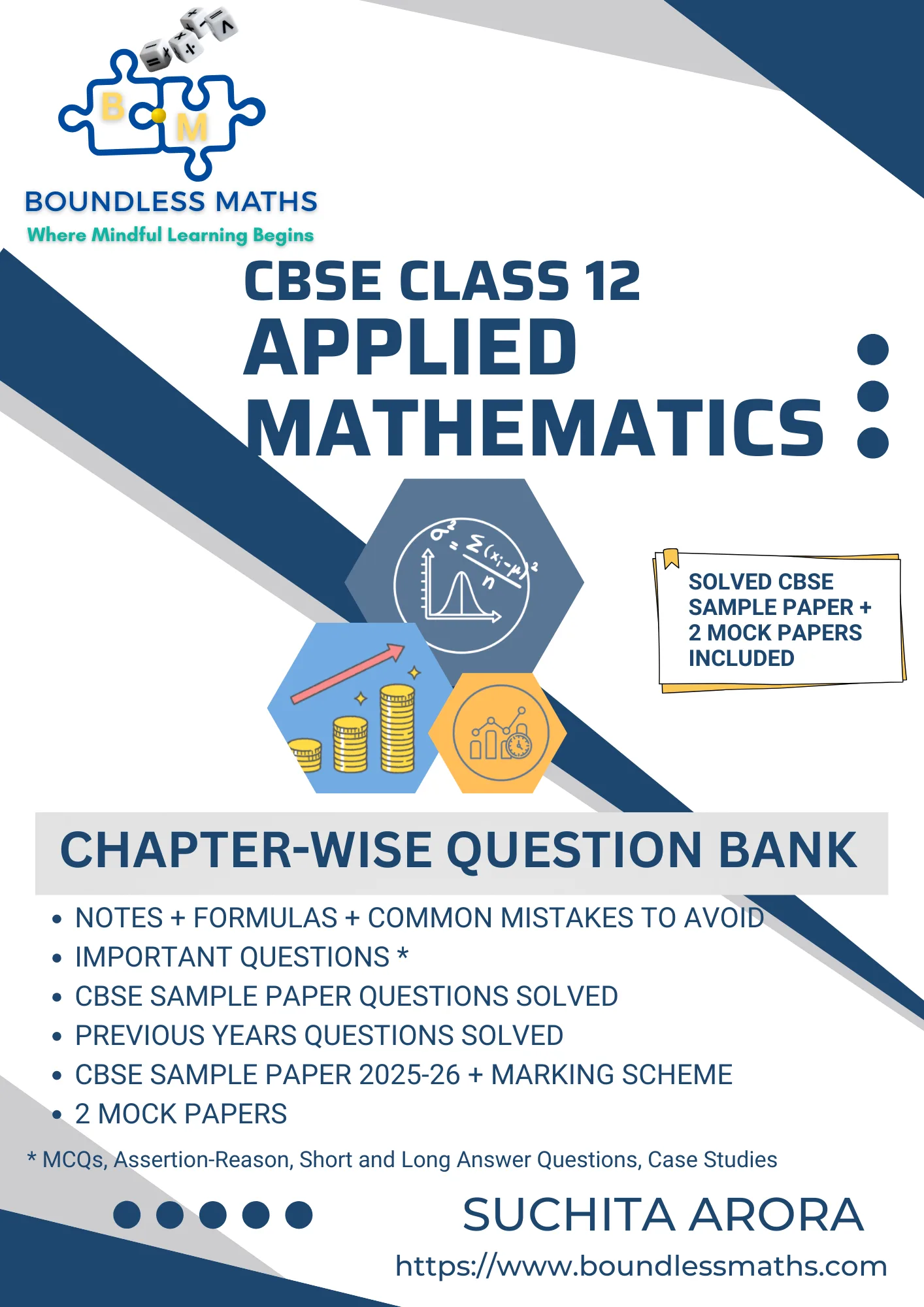
The AI Question Bank targets your weak areas automatically, gives instant feedback on every answer, and simulates the CBSE board exam. Smarter preparation in less time — designed for the final push before boards.
Official CBSE sample papers and actual board exam questions — your most critical study resources for CBSE Applied Maths Class 12. Download CBSE Applied Maths sample papers with complete marking schemes (2023-24, 2024-25, 2025-26), previous year board papers from 2023–2026, and Compartment exam papers. Solving these papers under timed conditions is the single most effective preparation strategy for scoring 90+ in CBSE Applied Mathematics.
Solve all CBSE sample papers and previous year board papers at least 2 times under timed conditions (3 hours). This is the single most effective preparation strategy for board exams.
Quick Guide to Using These Papers:
1. Start with latest CBSE Sample Paper 2025-26 (defines exact exam pattern)
2. Solve previous year board papers 2024, 2025 & 2026 (understand difficulty level)
3. Review marking schemes to understand step-marking and presentation
4. Solve as many full 3-hour mock papers as you can before your board exam
Released by CBSE — these define the exact exam pattern, question types, and marking scheme for your board exams. Start here.
Real questions from actual CBSE board examinations — practise with these to understand exam difficulty and question patterns.
📝 The real learning happens when you check your work.
See fully solved, step-by-step solutions for all CBSE Applied Maths board papers (2023–2026) in the AI Question Bank — written exactly the way CBSE expects answers to be presented. Know precisely how to write every answer to earn full marks.
Supplement your board exam preparation with actual school examination papers from top schools across India. Get extra practice with papers organised by exam type and coverage:
Unit Test Papers (UT-1/MT-1): Early assessment papers — perfect for building foundation.
Second Unit Tests (UT-2/MT-2): Mid-term papers — assess your progress halfway through the year.
Half-Yearly/Term-1 Papers: Comprehensive papers covering half of the syllabus.
Pre-Board Examination Papers: Full-syllabus papers in exact board exam format.
Schools: DPS 45, Amity, KV Sangathan, MRIS, RPS, Suncity, SPS Delhi.
First assessment papers covering Units 1–2 (Numbers, Algebra)
Second assessment papers covering Units 3–4 (Calculus, Probability)
Papers covering half the syllabus — units covered vary from school to school
Full syllabus (all 8 units) in board exam format — best for final preparation. Attempt under strict 3-hour exam conditions.
🤖 Want fully solved board papers, previous year questions, and adaptive AI practice? The AI Question Bank includes all of these with instant personalised feedback.
Unit-wise video tutorials for CBSE Applied Maths Class 12. Step-by-step video explanations for challenging topics — covering the CBSE Handbook, free practice questions, CBSE Sample Papers, Previous Years' Questions, Exam Strategies, Common Mistakes, and Quick Revision videos before exams. New videos added regularly — subscribe so you never miss an upload.
Numerical Inequalities — Complete One-Shot
▶ Watch on YouTube →Integration & Its Applications — Series (7 Videos)
▶ Watch Series →Probability Distributions — Series (3 Videos)
▶ Watch Series →Time-based Data — Complete One-Shot (31 min)
▶ Watch on YouTube →Linear Programming — Complete One-Shot
▶ Watch on YouTube →📺 New videos for Units 2, 5 & 7 uploaded regularly!
Subscribe and turn on notifications so you never miss an upload.
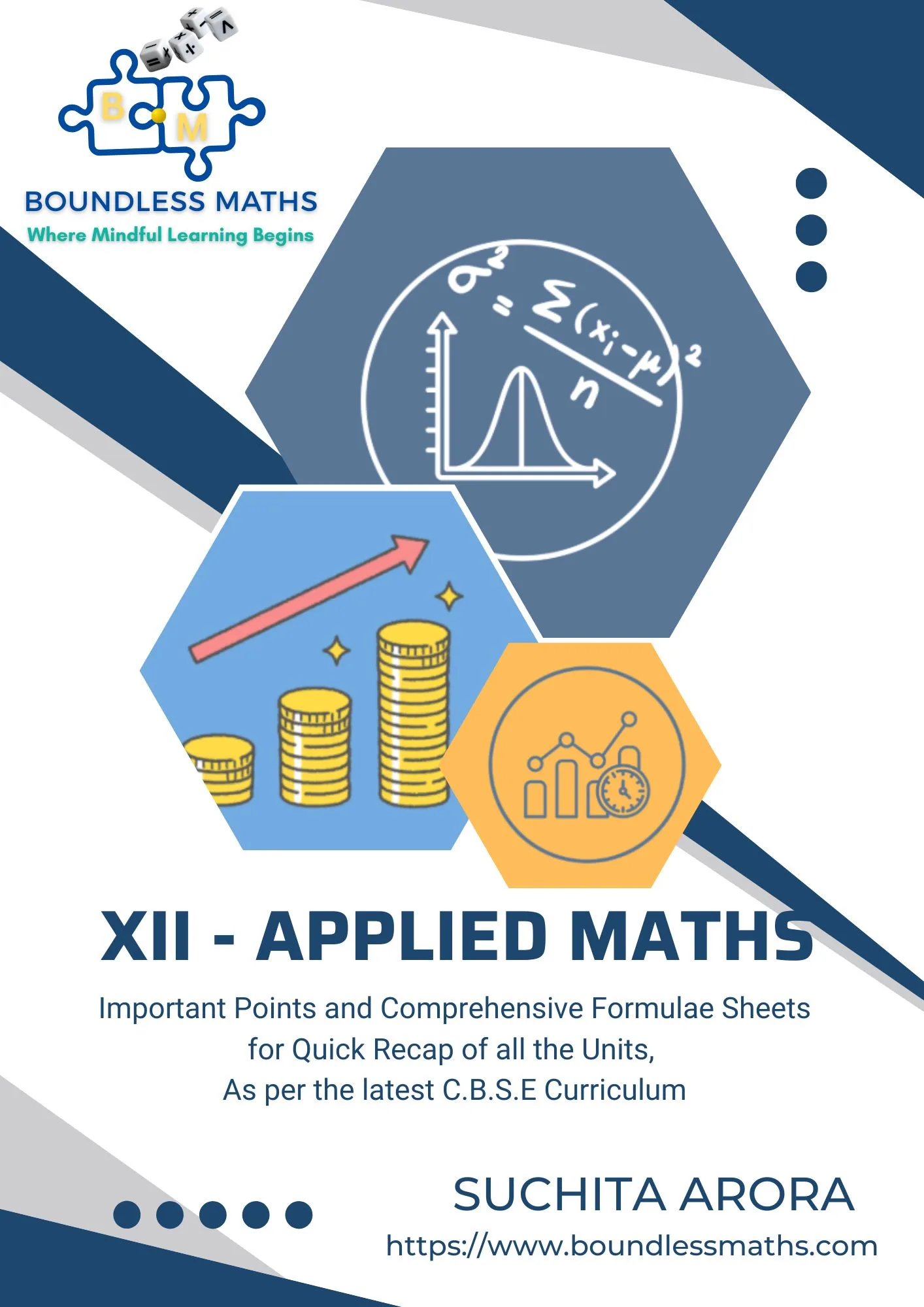
Subscribe to YouTube ChannelWhile we provide comprehensive free content, we also offer premium study aids for students who want extra support. Two options — Formula Deck for quick revision, and the AI Question Bank for adaptive smart preparation. If you've been searching for an Applied Maths Class 12 formula PDF or an AI-based question bank for CBSE board exam practice, both are built specifically for the 2026-27 syllabus and priced for one-time, instant access — no subscription required.
🔒 Secured by Razorpay · UPI / Cards / Net Banking
🔒 Secured by Razorpay · Instant access after payment
Prefer learning with a teacher? Get personalised, concept-first guidance for CBSE Applied Maths Class 12 — online, flexible, and built around how you learn best.
Many students find Applied Mathematics straightforward with the right guidance. Whether you are struggling with Financial Mathematics, Calculus, or Probability Distributions, or simply want structured after-school classes to stay on track — personalised online coaching can make a significant difference. At Boundless Maths, we believe in mindful, concept-first learning: understanding why before how, so that formulas stick and exam confidence grows naturally. Whether you are in Class 11 just starting out, or in Class 12 heading into Pre-Boards — we have a batch for you.
Complete CBSE Applied Maths Class 12 syllabus — from Numbers & Quantification through Financial Maths and Linear Programming.
Build real understanding before practising problems. You'll know when and why to apply each formula — not just how to use it.
Every session aligned to CBSE board exam pattern — MCQs, case studies, assertion-reason, and step-wise long answers.
Online classes that fit around your school timetable — no commute, no fixed batch constraints, no missed sessions.
Regular assessments after each unit to identify weak areas before they become problems in the board exam.
Questions are always encouraged. We pace learning to build lasting confidence — not exam-day anxiety.
💬 Who is this for?
Commerce students wanting personalised Applied Maths online tutoring · Students finding Financial Mathematics or Calculus difficult · Class 11 students starting early to build a strong foundation · Class 12 students looking for focused after-school coaching or pre-board revision sessions.
Enquire to experience the Boundless Maths approach — mindful, concept-first, and board-exam focused.
Common questions about Applied Mathematics — subjects, careers, coaching, and exam preparation — answered. Whether you are a student deciding between Applied Maths and Pure Maths, a parent researching options, or someone who wants to understand what this subject covers and how to score well — you will find the answers here. If your question isn't answered below, contact us and we'll reply promptly.
Choose the path that's right for you — free resources to start, AI-powered smart practice, or personal coaching. Whatever stage of Applied Maths Class 12 preparation you're at — just starting the syllabus, revising before Pre-Boards, or looking for a CBSE Applied Maths tutor near you — there's a next step below. Every option here is built around the 2026-27 CBSE Applied Mathematics syllabus, so you're always practising exactly what will be tested.
Unit-wise MCQs, solved examples and case studies across all 8 units — no sign-up required.
Every formula for all 8 units in one organised, printable PDF — chapter-wise layout with pro tips and common mistakes alongside each formula.
Adaptive AI practice that targets your weak areas automatically, gives instant feedback on every answer, and simulates the full board exam experience.
Expert CBSE Coaching · Class 9–12