
Where Mindful Learning Begins
Where Mindful Learning Begins
Class 8 Science Curiosity NCERT Solutions Chapter 6 — every Probe and Ponder prompt, all 6 Activities, all 13 "Keep the Curiosity Alive" exercise questions, and all 3 "Discover, Design, and Debate" project prompts, solved and explained on one page.
This chapter builds the idea of pressure as force per unit area, shows how liquids and air both exert pressure, and uses this to explain why wind blows, why high-speed winds can tear off roofs, and how thunderstorms and cyclones form — right up to how the India Meteorological Department tracks them.
Chapter 6 opens with fallen leaves swirling in the wind and a picnic bag with narrow straps digging into a shoulder, using both to build the idea of pressure — force spread over an area. It shows that liquids exert pressure at the bottom and sides of a container, that this pressure grows with the height of the liquid column, and that air itself exerts a very real atmospheric pressure on everything around us. From there, the chapter connects pressure differences to the formation of wind, shows why high-speed winds are linked to lower pressure (and can blow roofs away), and finally builds up to how storms turn into thunderstorms with lightning, and how thunderstorms over warm oceans can grow into destructive cyclones. Every Activity and exercise is solved here exactly as the textbook presents it.
Force per unit area, measured in N/m² or pascal (Pa) — the same force feels stronger over a smaller area.
Air always moves from high pressure to low pressure — that flow of air is what we call wind.
Rising warm, moist air builds clouds, charge, and rotation — escalating from a storm to a thunderstorm to a cyclone.
Pressure — force per unit area
Pressure = Force ÷ Area. The SI unit of force is the newton (N) and of area is the metre² (m²), so the SI unit of pressure is newton/metre² (N/m²), also called a pascal (Pa). At this stage, only forces acting perpendicular to the surface are considered.
| Practical unit | Value in pascal |
|---|---|
| Millibar (mb) | 100 Pa |
| Hectopascal (hPa) | 100 Pa |
For the same force, a smaller area gives a larger pressure. This is why a nail is driven in using its pointed end (not its head), an apple is cut with a knife's sharp edge (not its blunt edge), and why bags with broad straps or buckets with broad handles feel more comfortable to carry than ones with narrow straps or handles.
Pressure exerted by liquids
Pressure exerted by air (atmospheric pressure)
The envelope of air around the Earth is called the atmosphere (mainly nitrogen, oxygen, argon, and carbon dioxide), extending many kilometres above the surface. Air exerts pressure on all objects around us, known as atmospheric pressure. It is surprisingly large: the air column over just a 15 cm × 15 cm area presses down with a force close to 2250 N (the weight of a 225 kg object). We are not crushed because the pressure of fluids and gases inside our own bodies balances this outside atmospheric pressure.
How wind forms
| Idea | What it means |
|---|---|
| Direction of air flow | Air always moves from a region of higher pressure to a region of lower pressure — this moving air is wind. |
| Sea breeze (daytime) | Land heats faster than the sea; warm air over land rises and creates low pressure, so wind blows from the (cooler, higher-pressure) sea towards the land. |
| Land breeze (night-time) | At night, the sea stays warmer than the land; a low-pressure area forms over the sea, so wind blows from the land towards the sea. |
| High-speed winds | High-speed winds are accompanied by a lowered air pressure — this is why the pressure above a house's roof can drop below the pressure inside, sometimes blowing the roof away. |
Storms, thunderstorms & lightning
Stay away from tall objects; find a low-lying open area and crouch down (don't lie flat); minimise contact with the ground; avoid an umbrella with a metallic rod; get out of water if you're in it; you are comparatively safer inside a bus or car.
Cyclones
A cyclone is a large, spinning system of clouds, wind, and rain that forms over warm ocean waters, when rising warm, moist air keeps creating ever-lower pressure and Earth's rotation makes the surrounding inrushing air spin. The centre of lowest pressure is called the eye of the cyclone, where the wind is calm even though the surrounding region has strong winds and heavy rain. Cyclones can cause storm surges, flooding, landslides, and contaminated water supplies; the India Meteorological Department (IMD) monitors and tracks them to reduce their impact on life and property.
Sample answer: winds are stronger on some days because the pressure difference between two regions is larger on those days — a bigger pressure difference pushes air to flow faster, just as it takes more effort to push air out of a fully inflated balloon than a slightly inflated one. Water tanks are placed at a height because liquid pressure increases with the height of the liquid column, so a tank placed higher up produces a stronger, more powerful stream of water at the taps below it.
Air pressure is genuinely enormous — the weight of the entire atmosphere pressing down on us is roughly equal to a 225 kg mass sitting on every 15 cm × 15 cm patch of our body — but it doesn't crush us because the pressure inside our own bodies pushes back with equal force, keeping things balanced. Storms and cyclones are caused by warm, moist air rising and creating low-pressure regions that pull in surrounding air; cyclones specifically also need the Earth's rotation to make that inrushing air spin into the swirling pattern we recognise — without the Earth's rotation, storms could probably still form, but they likely wouldn't organise into the same large spinning cyclone structure.
This is an open reflection prompt meant to set up the chapter's central ideas — pressure, wind, storms, and cyclones — all explained in full through the Activities below.
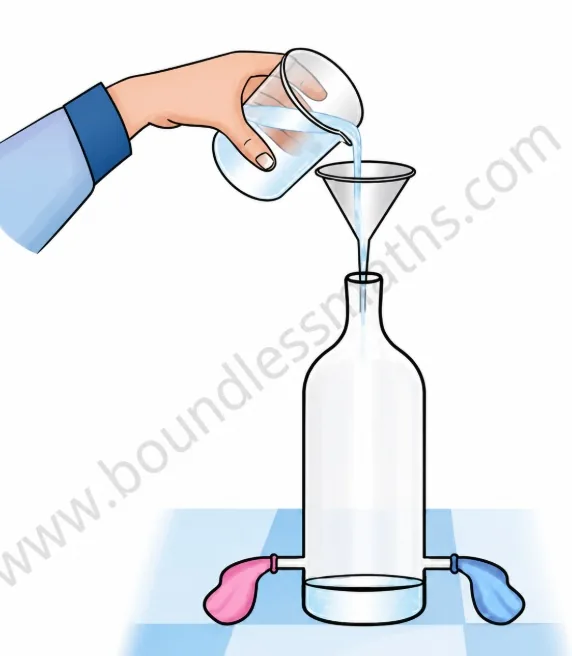
Observation: yes, both balloons bulge out to the same extent, even though the narrow pipe and the broad pipe hold very different amounts (and therefore weights) of water.
What we can infer: since the weight of water differs between the two pipes but the bulge is identical, the weight of water alone cannot be responsible for the bulge. It must be the pressure exerted by the water column that causes it — and since both columns are filled to the same height, they produce equal pressure and therefore equal bulges, regardless of the pipes' different diameters.
Going further — adding more water: pouring more water into one pipe increases the bulge of its balloon further. This shows that as the height of the water column increases, the pressure at the bottom increases too, causing a bigger bulge. This is exactly why overhead tanks are placed at a height — a taller water column above the taps produces greater pressure and a stronger stream of water.
Embedded question — which floor gets a more powerful stream: if an overhead tank sits on the top floor of a three-storeyed building, a resident on the first floor will receive a more powerful stream of tap water than a resident on the second floor. This is because the height of the water column between the tank and the first-floor tap is greater than the height between the tank and the second-floor tap, and greater height means greater pressure.
Observation: water spurts out through all four holes on the sides of the bottle as soon as the tape is removed.
What we can infer: since water flows out sideways through holes in the wall of the bottle (not just the bottom), water must be exerting pressure on the sides of the container too, not only at the bottom. In fact, liquids exert pressure in every direction.
Embedded question — water spurting from leaking pipes: water spurting out like a fountain from a leaking joint or hole in a pipe happens for exactly the same reason — the water inside the pipe is pushing outward on the walls of the pipe with pressure, and wherever there's a gap, that pressure forces the water out.
Observation: lifting the paper plate needs more effort when it is covered with the unfolded chart paper (larger covering area) than when covered with the same sheet folded (smaller covering area) — even though the weight of the covering sheet has not changed at all.
What we can infer: since only the area of the covering sheet changed (not its weight), the extra effort needed to lift it must come from air pushing down on the sheet — in other words, air exerts a force on the sheet, and this force increases as the area exposed to air increases. Since force per unit area is pressure, this shows that air exerts pressure on objects around us, known as atmospheric pressure. Air exerts pressure on all objects, in all directions.
Observation: the sucker sticks firmly to the surface, and it takes a noticeably strong pull to remove it.
Why this happens: pressing the sucker pushes out most of the air trapped between its cup and the surface, lowering the air pressure inside the sucker. The air pressure surrounding the sucker (atmospheric pressure) is now higher than the pressure inside it, and this pressure difference is what holds the sucker firmly against the surface. Pulling it off requires enough force to overcome this pressure difference.
Going further — how large is atmospheric pressure, and its units: atmospheric pressure is genuinely large — the force exerted by the air column over just a 15 cm × 15 cm area is close to 2250 N, roughly the weight of a 225 kg object. We aren't crushed by this because the pressure of fluids and gases inside our bodies balances the atmospheric pressure from outside. While the SI unit of pressure is N/m² (pascal, Pa), air pressure in practice is often expressed in millibar (mb) or hectopascal (hPa), both equal to 100 Pa.
Observation: air moves from the inflated balloon into the uninflated one through the straw — the inflated balloon gradually shrinks while the uninflated one grows, until after some time both balloons reach almost the same size, at which point the flow of air stops.
Why this happens: the air pressure inside the inflated balloon is higher than inside the uninflated one, so air moves from the higher-pressure balloon to the lower-pressure balloon. The flow continues only as long as this pressure difference exists, and stops once the pressure in both balloons becomes equal. This shows that air moves from a region of high pressure to a region of low pressure — which is exactly what causes wind.
Going further — sea breeze and land breeze: this same principle explains the sea breeze and land breeze. During the day, land heats up faster than the sea; the warm air above the land rises and creates a low-pressure area, so wind blows from the (higher-pressure) sea towards the land, giving a sea breeze. At night, the sea stays warmer than the land, so a low-pressure area forms above the sea instead, and wind blows from the land towards the sea, giving a land breeze.
Observation: when you blow air into the gap between the two balloons, they move towards each other rather than away. Blowing harder makes them come together faster.
Why this happens: blowing air between the balloons creates a region of lower pressure in that narrow gap. Since the air pressure surrounding the balloons (on their outer sides) is now higher than the pressure in the gap between them, this higher outside pressure pushes the balloons towards each other. This shows that high-speed winds are accompanied by a reduced air pressure.
Going further — why storms blow roofs away, and why to keep windows open: when high-speed winds blow over a house's roof, the air pressure just above the roof drops, while the pressure below the roof (inside the house) stays the same. If this pressure difference becomes large and the roof is weak, it can be blown off. This is why it is safer to keep doors and windows open during a storm with high-speed winds — letting air move through the house reduces the pressure difference between inside and over the roof, helping to keep the roof intact.
Water stored in a dam pushes horizontally on the dam's side walls and vertically on its floor, and this horizontal pressure is largest near the bottom, where the water column is tallest. A dam's base is built much broader than its top so that it can withstand this much greater pressure near the bottom without giving way.
A lightning conductor is a metallic rod fixed along a building's walls during construction, with its pointed end kept higher than the building's highest point and its other end buried deep in the ground. It gives electric charges from a lightning strike an easy, safe path to flow straight into the ground, protecting the building.
Isolated, localised thunderstorms occurring before the monsoon arrives are known by regional names across India — Kalbaisakhi in West Bengal, Bihar, and Jharkhand, and Bordoisila in Assam, both of which help kharif crops grow. In Kerala, Karnataka, and Tamil Nadu they're called mango showers since they help ripen mangoes, and in Karnataka they also support the growth of coffee plants.
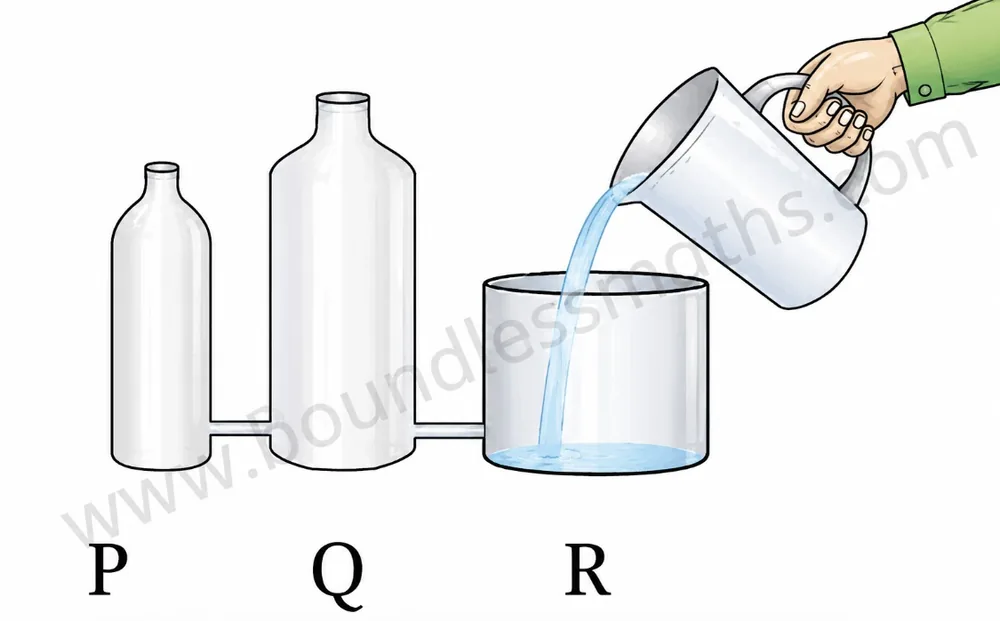
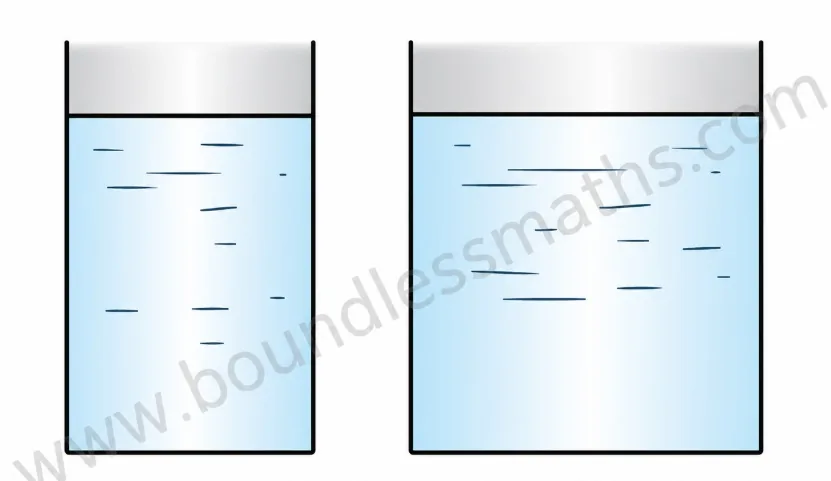
Parts (i) and (iv) are based on reading vessel shapes from Fig. 6.21 and Fig. 6.22. Do check your printed textbook's exact figure to confirm which vessel is widest before finalising your answer.
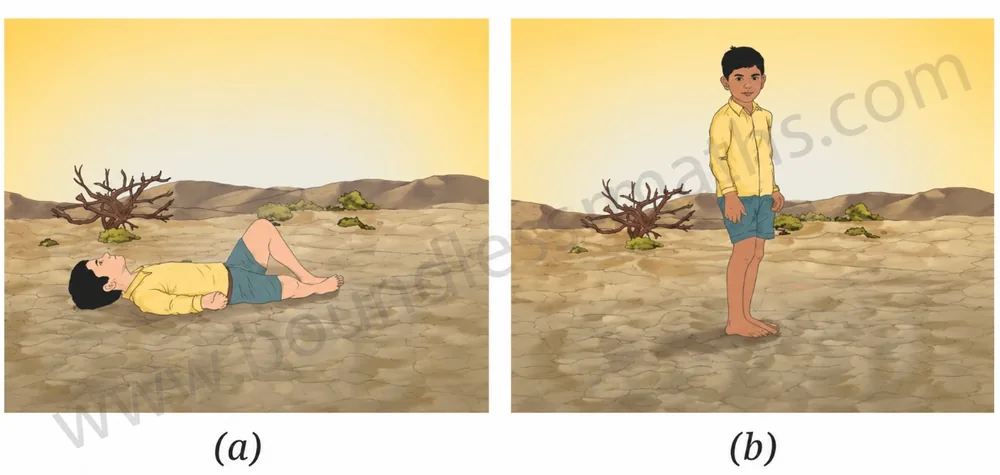
Answer: the boy sinks more when standing vertically (Fig. 6.23b).
Total area of contact: the elephant stands on 4 feet, each of area 0.25 m², so total area = 4 × 0.25 m² = 1 m².
Pressure = Force ÷ Area = 20000 N ÷ 1 m² = 20000 N/m² (20000 Pa, or 20 kPa).
Answer: no, lightning would not occur if air and clouds were good conductors of electricity.
Answer: a storm becomes a cyclone when it forms over warm ocean water, through the following steps:
It keeps intensifying over warm ocean water and weakens once it moves over land and loses its supply of warm, moist air.
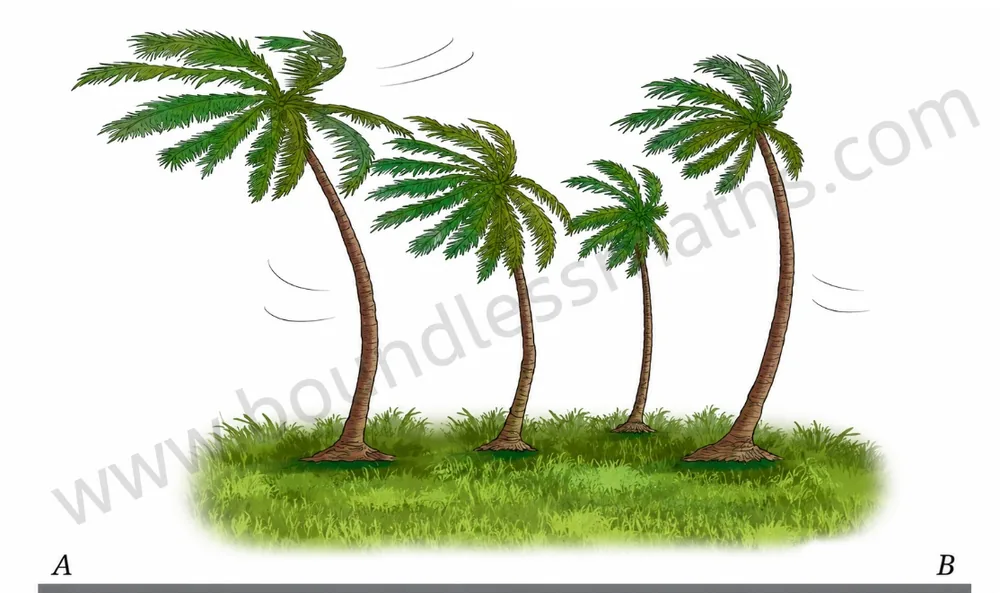
Answer: side B is the land, and side A is the sea.
Materials: two similar thin rubber balloons, a drinking straw, rubber bands.
Answer: a thunderstorm is a storm — strong winds accompanied by rain — that is also accompanied by lightning and thunder.
How it forms:
A storm accompanied by this lightning and thunder is called a thunderstorm.
Answer: holes are made in banners and hoardings to let wind pass through instead of pushing against a large solid surface.
These three prompts are hands-on investigations and research projects rather than fixed-answer questions. Here's guidance on how to approach each one.
Prediction and expected observation: when you blow air across the top surface of the hanging strip, the free end of the paper rises upward, moving into the stream of air you're blowing, rather than being pushed down and away from you.
Interpretation: blowing over the top surface makes the air above the paper move faster than the still air underneath it. Just as in Activity 6.6 (where blowing between two balloons lowered the pressure between them and pulled the balloons together), the faster-moving air above the strip creates a region of lower pressure there, while the pressure of the still air below the strip stays relatively higher. This higher pressure from below pushes the paper strip upward, into the lower-pressure region above — the same underlying idea (high-speed air means lower pressure) that explains how roofs can be lifted off buildings by strong winds.
Guidance on getting started: the chapter itself already mentions Cyclone Amphan (2020), which struck West Bengal and Odisha with peak wind speeds of about 270 km/h — a good starting point for your list. Look up two more well-known recent Indian cyclones (for example, ones affecting the east coast states like Odisha, Andhra Pradesh, and Tamil Nadu, or the west coast state of Gujarat) using recent India Meteorological Department (IMD) or National Disaster Management Authority (NDMA) reports, since exact wind speeds, casualty figures, and financial losses are best confirmed from these official, up-to-date sources rather than assumed.
Types of destruction to look for: for each cyclone, note down two of the following — flooding from storm surges, damage to homes and crops from wind and salt water, uprooted trees and blocked roads, and disruption to power and communication.
Government and community measures to research: early-warning alerts issued by the IMD, evacuation to cyclone shelters, deployment of the National Disaster Response Force (NDRF), and post-cyclone relief and rebuilding efforts.
Sample suggestions you could propose: stronger enforcement of cyclone-resistant building codes in coastal districts, and community-level cyclone preparedness drills held every year before the cyclone season begins.
Guidance on collecting data: look up India Meteorological Department (IMD) regional climate summaries or state disaster management reports for the frequency and intensity of thunderstorms across different states, and organise your findings into a simple table comparing regions.
A useful starting clue: this chapter already notes that pre-monsoon thunderstorms have their own regional names — Kalbaisakhi in West Bengal, Bihar, and Jharkhand, and Bordoisila in Assam — which is itself a hint that eastern and north-eastern India experience frequent, locally significant thunderstorm activity before the monsoon season.
Possible reasons to explore: regions closer to large water bodies or with generally higher humidity tend to have more moisture available to fuel thunderstorm formation, and areas that heat up strongly just before the monsoon arrives often see more intense convective activity, since both moisture and strong rising warm air are the two key ingredients this chapter identifies for thunderstorm formation.
Now that pressure, wind, and cyclones are covered, move on to how matter is made of tiny particles, revisit Chapter 5, or book a free demo class for personalised coaching.
Expert CBSE Coaching · Class 9–12