
Where Mindful Learning Begins
Where Mindful Learning Begins
You walked into that exam hall carrying a full year of work. Every formula revised, every concept practised, every mock paper attempted. You were ready.
And then — within the first five minutes of the reading time — you saw it. A question with trigonometry. In an Applied Maths paper. Your mind went: this shouldn't be here. You pushed through.
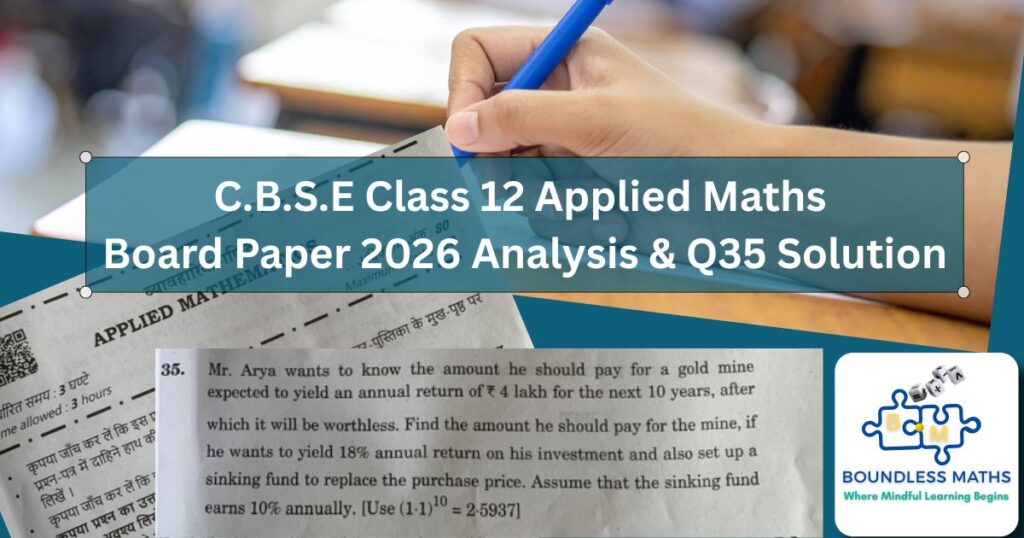
Ten minutes in — Q35. A 5-mark question. Gold mine, sinking fund, 18% ROI. You read it once. Twice. The context was unlike anything you had seen before. And in that moment, sitting in the exam hall with the clock running, your confidence just... dropped.
"Truly — working so hard for a year and then in the first 5 mins noticing sin, and then in the first 10 mins noticing that you don't know a 5 marker. The confidence was so shaken up."
— A student, after the exam
For students without an additional subject, every mark in this paper carries extra weight. A paper with out-of-syllabus questions and an ambiguous 5-marker is not just frustrating — it is genuinely consequential.
And I want you to know — your preparation was not wrong. This post is my honest analysis of exactly what happened in this paper, question by question, and what it means for your marks.
🌱 Read this fully. The Q35 solution is here, the grace marks picture is clear, and there is a message at the end for students who are still processing how the paper went.
Having gone through the paper — and having personally verified every solution — my honest assessment is straightforward: it was a decent and balanced paper. Questions spanned the entire syllabus — every unit had representation. There were no unexpected topics, no unfair trick questions, and nothing that should have caught a well-prepared student off guard.
The paper was not too long and not too tough. MCQs were moderate. If you prepared sincerely and covered your complete syllabus, you had every opportunity to perform well. There is no reason to panic about this paper.
There is one question I want to address in detail — Q35 — because it was genuinely different from the usual, and students deserve a clear explanation of the approach and where grace marks are likely. I've included the full worked solution below.
A small moment of humour: If you scanned the QR code printed on the question paper, you were not alone — and you were not taken to any CBSE resource. It linked to a certain very famous YouTube video. Students across the country reported the same thing. A surprising start to a board exam morning.
The paper covered all chapters of the Applied Maths syllabus. MCQs were moderate — concept and formula-based, not trick-based. The longer questions were distributed well across units.
💡 A note on the smaller chapters: The Numerical Inequalities 5-mark question was very easy and fully scoring. Differential Equations was similarly accessible. I say this every year — and this paper proved it again — do not skip the smaller chapters. They are often where the most reliable marks are.
Most of the paper was fair and on expected lines. But four questions — Q19, Q34(b), Q35 and Q37(a) — created real difficulty, and students deserve a clear explanation of each. Q35, being a 5-mark question, was the most impactful. I've included the full worked solution for Q35 below, personally verified.
Applied Maths was introduced by CBSE in 2020–21 and is still evolving. I have personally analysed every board paper since 2022, and the pattern is clear — the CBSE Handbook defines the syllabus explicitly. When questions go beyond it, students preparing sincerely should not have to second-guess whether a topic is in scope while sitting in the exam hall.
Q19 was an Assertion–Reason question involving trigonometric identities or functions. Trigonometry is not part of the Class 12 Applied Maths syllabus. A student who had prepared strictly within the CBSE Applied Maths framework had no reason to have covered this.
That said, for students who had been told during their preparation that certain formula evaluations lead to trigonometric functions — a reasonable, informed guess was possible here. The silver lining: Assertion–Reason questions allow elimination logic, which partially compensates when the underlying topic is unfamiliar.
Q34(b) involved a Poisson distribution problem where the solution required substituting the value of e−λ. This value was not given in the question — which is unusual, because such values are consistently provided in board papers when numerical substitution is expected.
Most students correctly worked through the formula and left their answer in terms of e−λ without substituting a numerical value — which is entirely reasonable given that the value was not supplied. Students who did this should receive full marks for their method and working.
This is the question that generated the most discussion — and the most anxiety — after the paper. Being a 5-mark question, it was the most impactful of the four. Here is the question exactly as it appeared, the correct worked solution (personally verified), and my assessment of where grace marks are likely.
Let P = purchase price of the mine. The ₹4 lakh annual income must simultaneously cover two things:
Using the sinking fund formula P = R × [(1.1)¹⁰ − 1] / 0.1 :
Mr. Arya should pay approximately ₹16.48 lakh for the gold mine.
Q37(a) required students to calculate the average change in sales. While the underlying logic — that average change of sales means calculating the mean of the differences in sales figures over time or just the slope of the line for the sales graph — is understandable to a student who reasons carefully. But while attempting a Board paper, attempting such a question towards the end, at times, makes a student go blank as such question types and framing is not covered in the CBSE Applied Maths Handbook.
A student preparing from the official syllabus and prescribed resources would not have encountered this format. During a board exam, when time is limited and confidence is everything, being asked something outside the defined handbook is genuinely unfair.
📢 A note to students aiming for 95+: Four problematic questions in a single paper is genuinely disappointing — especially in a subject you have worked hard to master. Your preparation was not wrong. The paper had questions it should not have had. That is a fair and honest assessment, and I hope the evaluation process reflects it.
Most students preparing for boards practice CBSE sample papers and previous years' main board papers. That is the right foundation. But this paper — and the pattern I observed last year as well — confirms something worth adding to your preparation strategy:
📌 Do not ignore previous years' compartment papers. The question patterns, contexts, and framing observed in compartment papers have repeatedly shown up in subsequent main board papers. If you are preparing for Applied Maths boards, add compartment papers to your practice set. It is one of the most underused preparation resources available.
Compartment papers test the same syllabus from slightly different angles — which is exactly the variation in framing that stops you from being caught off guard by a question like Q35.
Q35 caught students off guard not because the concept was hard — the sinking fund formula is standard. What made it difficult was the context: a gold mine instead of the usual machinery or vehicle. A student who had only seen one type of sinking fund problem had no frame of reference.
That is exactly the gap the AI Question Bank is built to close.
The Board Paper 2026 — including Q35 with a complete step-by-step solution — is inside the AI Question Bank, personally verified. Practice adaptive questions across all 8 units, get instant feedback on every answer, and use the timed mock exam to experience a full 3-hour board paper before the real one.
This was a decent paper overall — but four questions made it harder than it should have been. If your confidence took a hit, that reaction is completely understandable. You prepared well. The paper surprised you. Those are two separate things.
I know how much is riding on these marks for each of you — and I want you to know that your anxiety is valid, seen, and heard. Every correctly reasoned step you wrote has value. Trust the process — and trust the work you put in all year.
🌱 If you have more papers coming — that is where your focus belongs now. Applied Maths is done. Go make the next one count.
Teaching CBSE Applied Mathematics since its introduction in 2020–21. Personally analysed every board paper since 2022. Class 11 & 12 Applied Maths — online (pan-India) and offline in Gurugram. M.S. – BITS Pilani · UGC NET Qualified · Certified Vedic Maths Educator.
Whether it's Q35, score estimation, or planning your preparation — reach out directly.
contact@boundlessmaths.com · (+91) 8595236539
Expert CBSE Coaching · Class 9–12