
Where Mindful Learning Begins
Where Mindful Learning Begins
Class 8 Science Curiosity NCERT Solutions Chapter 3 — every Probe and Ponder prompt, all 7 Activities, all 11 "Keep the Curiosity Alive" exercise questions, and all 7 "Discover, Design, and Debate" project prompts, solved and explained on one page.
This chapter widens the definition of health beyond "not being sick" to physical, mental, and social well-being, then covers how communicable and non-communicable diseases are caused and spread, and how the body defends itself through immunity, vaccines, and antibiotics.
Chapter 3 opens by widening what "health" even means — using the WHO's definition of complete physical, mental, and social well-being — before moving into lifestyle habits, environmental cleanliness, and finally the two big categories of disease: communicable (caused by pathogens, spread person to person) and non-communicable (linked to lifestyle, diet, or environment). It closes with how the body defends itself, through natural immunity, vaccines, and antibiotics, and why misusing antibiotics is a growing global problem. Every Activity and exercise is solved here exactly as the textbook presents it.
The WHO definition covers physical, mental, and social well-being — habits, relationships, and surroundings all matter.
Pathogen-caused diseases that spread between people, versus lifestyle-linked conditions like diabetes and asthma that don't.
How the body fights disease naturally, how vaccines train it in advance, and why antibiotic misuse causes resistance.
WHO definition of health
A state of complete physical, mental, and social well-being — not merely the absence of disease.
Symptom vs sign
| Term | Meaning | Example |
|---|---|---|
| Symptom | What the patient feels (subjective) | Pain, tiredness, dizziness |
| Sign | What can be seen or measured (objective) | Fever, rash, high blood pressure, swelling |
Communicable vs non-communicable diseases
| Communicable | Non-communicable | |
|---|---|---|
| Cause | Pathogens — bacteria, viruses, fungi, worms, protozoa | Lifestyle, diet, environment, hormonal factors |
| Spreads person to person? | Yes | No |
| Examples | Typhoid, dengue, flu, chickenpox, TB, cholera | Cancer, diabetes, asthma, high blood pressure |
How diseases spread
| Route | Example diseases |
|---|---|
| Air (droplets from coughing/sneezing) | Common cold, chickenpox, measles, TB |
| Contaminated water/food | Hepatitis A, cholera, typhoid, ascariasis (roundworms) |
| Insect vectors (mosquitoes, houseflies) | Malaria (protozoa), dengue (virus) |
| Direct/indirect contact | Sharing personal items, shaking hands, rabid animal bites |
Body's defence: immunity, vaccines, antibiotics
| Term | What it means |
|---|---|
| Immunity | The body's natural ability to fight disease, via the immune system |
| Acquired immunity | Protection developed after exposure to a pathogen or a vaccine |
| Vaccine | Trains the immune system using a weakened, dead, or harmless part of a pathogen — preventive, not curative |
| Antibiotic | Medicine that kills bacteria by targeting bacterial-cell structures; doesn't work on viruses or protozoa |
| Antibiotic resistance | Bacteria surviving and multiplying despite treatment with an antibiotic that once killed them |
Sample answer: when my body detects an infection like a cold, my immune system responds with symptoms such as a mild fever, tiredness, and a runny nose — these are signs of the body actively fighting the pathogen, not just discomfort for no reason.
Diseases like smallpox and polio have become rare mainly because of successful vaccination programmes, while diabetes and heart problems have become more common because of changes in how people live today — more processed food, less physical activity, and longer lifespans. Climate change could plausibly increase certain diseases, since warmer temperatures and changed rainfall patterns can expand the regions where disease-carrying mosquitoes can survive, potentially increasing cases of diseases like malaria and dengue. Stress affects the body by triggering hormonal changes that can weaken immunity over time and disturb sleep, digestion, and mood, all of which affect overall health. Some groups may be more affected during outbreaks due to factors like crowded living conditions, limited access to healthcare, weaker immunity (in young children or the elderly), or pre-existing health conditions.
This is an open reflection prompt — there's no single fixed answer expected. A strong response connects each question to a specific reason (immune response, vaccination history, lifestyle change, mosquito-borne disease spread, hormonal stress response, or vulnerability factors) rather than a vague guess.
Answer: the root cause of the boy's health problems was social isolation — moving to a new city with no friends and busy parents left him lonely. To cope, he increased his screen time and social media use, but this became a negative cycle: more screen time made him feel worse, not better, and led to physical symptoms like headaches, weight loss, and poor sleep.
How habits and surroundings affected his well-being: his surroundings (a new, unfamiliar environment with no social support) created loneliness, and his habit of using screens to cope, rather than actively making friends, worsened rather than solved the problem. This shows that health depends on physical, mental, and social factors together — his physical symptoms were really a downstream effect of his social and emotional state, exactly matching the WHO definition of health as more than just the absence of physical disease.
Good habits to add to the list:
Habits that are not good for health, to add to the list:
Answer: comparing both lists to my own routine helps identify which healthy habits I already follow and which unhealthy habits I should try to reduce — this is exactly the point of the activity: our health depends on our own everyday lifestyle choices, which are within our control to improve.
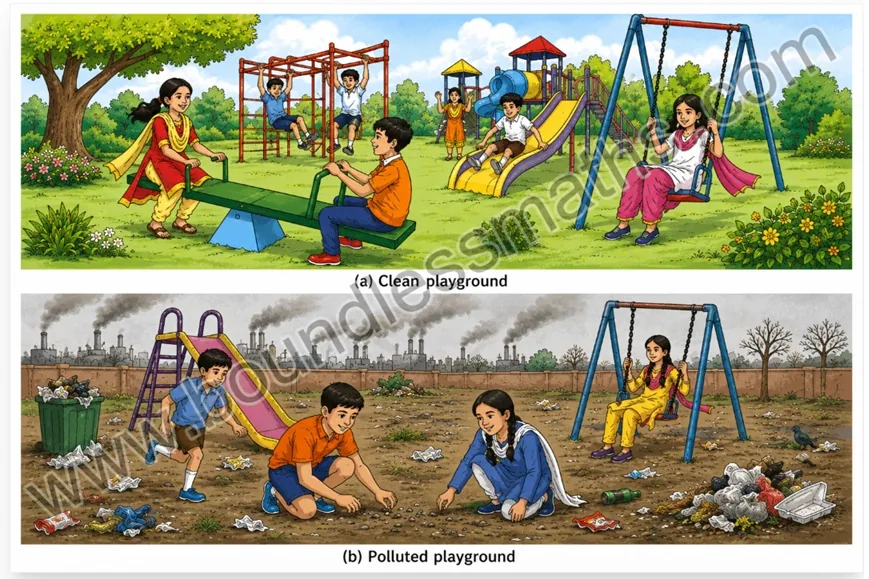
Answer: most people would prefer the playground in Fig. 3.3a, since it is clean, well-maintained, and pleasant to look at. The playground in Fig. 3.3b is polluted, dirty, and full of flies and mosquitoes, and people living in or visiting such an area are likely to fall sick more often.
Why this matters for health: a dirty, poorly maintained environment can breed disease vectors like flies and mosquitoes and expose people to pathogens more easily, increasing the risk of both digestive infections (from unhygienic surroundings) and vector-borne diseases (from mosquito breeding). This shows that keeping our surroundings clean, not just our own bodies, is an important part of staying healthy — clean air and water reduce cases of respiratory problems and water-/vector-borne diseases.
Table 3.1 — Common communicable diseases affecting humans:
Diseases spread through the air
| Disease | Causal agent | Site of infection | Symptoms | Preventive measures |
|---|---|---|---|---|
| Common cold & influenza | Virus | Respiratory tract | Nasal congestion, sore throat, fever, cough, body ache | Frequent handwashing, not sharing personal items, covering mouth/nose |
| Chickenpox | Virus | Respiratory tract, skin | Mild fever, itchy skin, rashes, blisters | Isolation of patient, covering mouth/nose, vaccination |
| Measles | Virus | Skin, respiratory tract | Fever, sore throat, reddish rashes | Isolation, covering mouth/nose, hygiene, vaccination |
| Tuberculosis (TB) | Bacteria | Lungs | Cough, fever, fatigue, loss of appetite, night sweats | Avoiding close contact with TB patients, covering mouth/nose, hygiene, vaccination |
Diseases spread through contaminated water and food
| Disease | Causal agent | Site of infection | Symptoms | Preventive measures |
|---|---|---|---|---|
| Hepatitis A | Virus | Liver | Fatigue, fever, nausea, vomiting, jaundice | Drinking boiled water, vaccination |
| Cholera | Bacteria | Intestine | Diarrhoea, dehydration | Hygiene, boiled water, properly cooked food, vaccination |
| Typhoid | Bacteria | Intestine | Headache, abdominal discomfort, fever, diarrhoea | Hygiene, boiled water, properly cooked food, vaccination |
| Ascariasis (roundworms) | Worms | Intestine | Worms in stool, poor appetite, poor growth, anaemia | Hygiene, boiled water, properly cooked food |
Diseases transmitted by insects
| Disease | Causal agent | Site of infection | Symptoms | Preventive measures |
|---|---|---|---|---|
| Malaria | Protozoa | Skin, blood | High fever, sweating, periodic chills | Mosquito nets/repellents, long sleeves, controlling mosquito breeding |
| Dengue fever | Virus | Skin, blood | Fever, headache, joint/muscle pain, nausea | Mosquito nets/repellents, avoiding stagnant water |
Key precautions overall: keeping ourselves and our surroundings clean, washing hands with soap, covering the mouth and nose while coughing/sneezing, wearing a mask in crowded places, avoiding sharing personal items, keeping food and water clean, and staying home to rest when unwell.
Model completed Table 3.2 — Non-communicable diseases:
| Disease | Signs and symptoms | Suggested lifestyle change(s) |
|---|---|---|
| Obesity | Excess body weight for one's height, fatigue, joint pain, breathlessness on exertion | Eating a balanced diet and exercising regularly |
| Diabetes | Frequent urination, excessive thirst, weight loss, tiredness, slow healing | Balanced low-sugar diet, regular physical activity, weight management, monitoring blood sugar |
| High blood pressure | Often no obvious symptoms; sometimes headache, dizziness, or blurred vision | Reduce salt intake, exercise regularly, manage stress, avoid smoking and alcohol |
| Heart disease | Chest discomfort, breathlessness, fatigue | Diet low in saturated fat, regular exercise, avoiding smoking, managing stress |
Answer: the exact three most common diseases will vary by neighbourhood and should ideally be confirmed by talking to a doctor, health worker, or family member as the activity suggests — but obesity, diabetes, and high blood pressure are commonly among the most reported lifestyle-related conditions across most Indian communities today.
Answer: this case study shows that simple public-health measures — in this case, improved sanitation through building and using toilets — can significantly reduce the spread of communicable diseases at a community level, especially diarrhoea and other infections in children.
This connects directly to how diseases spread through contaminated water and food: open defecation contaminates local water and soil, which then spreads pathogens to the wider community. Reducing open defecation cuts off this route of transmission. This shows that preventing disease isn't only about individual habits (like an individual washing their hands) — organised community-level action, like sanitation campaigns, can have an even larger impact on public health.
How antibiotic resistance develops: a few bacteria naturally carry random mutations that make them resistant to a particular antibiotic. When that antibiotic is used — especially unnecessarily, in the wrong dose, or for the wrong duration — it kills off the non-resistant bacteria, including helpful ones, but the resistant bacteria survive and multiply, eventually taking over the population. These resistant bacteria can also transfer their resistance to other bacteria, and can spread from animals (through food products) or hospitals (through surfaces and healthcare workers) into the wider community.
Precautions to reduce antibiotic resistance:
In 1928, Fleming, a bacteriologist, was studying harmful bacteria when he noticed that a mould growing on a discarded petri dish had stopped bacteria from growing near it. He worked out that the mould was releasing a substance that killed the bacteria — a chance discovery that led to penicillin, the first antibiotic used to treat bacterial infections, saving millions of lives since.
Ayurveda teaches that true health is a balance of body, mind, and surroundings. Following dinacharya (daily routine) and ritucharya (seasonal routine), eating food suited to one's prakriti (body constitution), and practising yoga and mindfulness are traditional ways to support this balance.
A pioneering Indian biomedical researcher who studied the links between hormones, certain viruses, and cancer — work that improved cancer treatment and prevention, and also showed how tobacco, diet, and pollution can raise cancer risk.
Long before modern vaccines, India used a traditional method called variolation to protect against smallpox — scratching the skin with material from a smallpox sore to trigger a mild, controlled infection and build immunity. Practitioners of this method were known as teekedaars.
India is one of the world's largest vaccine producers, manufacturing at massive scale and supplying vaccines to many countries. Indian vaccine companies played a key role during the COVID-19 pandemic and continue supporting global health efforts.
A well-known Indian doctor and scientist who, as Secretary of the Department of Biotechnology, helped develop the Rotavirus vaccine, which protects children from diarrhoea, and championed research-driven, affordable healthcare for India.
Communicable: Cold and flu, Typhoid, Chickenpox — all caused by pathogens (viruses or bacteria) and capable of spreading from person to person.
Non-communicable: Diabetes, Asthma — both are linked to lifestyle, hormonal, or environmental factors rather than a spreadable pathogen.
Answer: (b) ii and iii — Asthma and Diabetes. Both are non-communicable diseases linked to lifestyle and physiological factors, not pathogens. Typhoid (bacterial) and Measles (viral) are both communicable diseases, so options (a), (c), and (d) are incorrect.
(i) School actions: encourage visibly unwell students to go home and rest, ensure classrooms are well-ventilated, promote frequent handwashing and covering the mouth/nose while coughing or sneezing, consider masks in crowded areas, inform parents, and get common surfaces cleaned regularly.
(ii) Responding considerately to a sick classmate: gently suggest they visit the school nurse or rest at home, without shaming or excluding them; offer to share class notes so they don't feel left out, and be kind rather than making them feel guilty for being unwell.
(iii) Protecting yourself and others: wash hands frequently with soap, avoid touching your face, maintain some distance where possible, use a handkerchief or mask if needed, and avoid sharing water bottles, food, or personal items during the outbreak.
(i) Precautions: before the trip, pack mosquito repellents and nets, and consult a doctor about any recommended preventive medication. During the trip, use repellents/nets, wear long-sleeved clothing, and avoid being outdoors at dawn and dusk when mosquitoes are most active. After returning, watch for symptoms like fever or chills for a couple of weeks and consult a doctor promptly if any appear.
(ii) Explaining to a sibling: mosquito nets and repellents work by creating a physical or chemical barrier that stops mosquitoes from biting us. Since malaria only spreads through the bite of an infected mosquito (a vector), avoiding bites entirely is the single most effective way to avoid catching it.
(iii) Ignoring health advisories: travellers risk contracting malaria themselves, delayed diagnosis and treatment leading to a more severe illness, and the possibility of unknowingly spreading the infection further if they become infected.
(i) I would express genuine concern rather than criticism — mentioning how smoking harms the lungs and heart and raises cancer risk over time, and pointing out that real friendship shouldn't require adopting a harmful habit to feel accepted.
(ii) I would politely but firmly decline the cigarette, say no clearly, and if the pressure continued, remove myself from that situation rather than give in.
(iii) Schools can run awareness programmes on the health effects of smoking, offer counselling support, maintain strict tobacco-free campus policies, and encourage positive peer groups and role models that don't normalise smoking or other harmful substances.
Vinita could ask:
Conclusion: these questions should help Saniya realise that antibiotics only work on bacterial infections, don't cure viral or protozoal diseases, and overusing them creates a serious long-term problem — so they are not a substitute for disease prevention.
Table — number of dengue cases reported in a hospital over one year:
| S. No. | 1 | 2 | 3 | 4 | 5 | 6 |
|---|---|---|---|---|---|---|
| Month | January | February | March | April | May | June |
| No. of dengue cases | 10 | 12 | 15 | 18 | 22 | 40 |
| S. No. | 7 | 8 | 9 | 10 | 11 | 12 |
|---|---|---|---|---|---|---|
| Month | July | August | September | October | November | December |
| No. of dengue cases | 65 | 65 | 65 | 30 | 30 | 20 |
Bar graph — number of dengue cases by month:
Scale — X-axis: 1 division = 1 month; Y-axis: 1 division = 10 dengue cases
(i) Highest three months: July, August, and September, each with 65 cases.
(ii) Lowest month: January, with 10 cases.
(iii) Environmental factors during peak months: July–September falls during and just after the monsoon, when stagnant water collects in puddles, containers, and drains — ideal breeding conditions for the Aedes mosquitoes that spread dengue. Warm, humid weather during this period further speeds up mosquito breeding and the dengue virus's development inside them.
(iv) Preventive steps before peak season: clearing stagnant water sources ahead of the monsoon, community fogging and mosquito-control drives, public awareness campaigns about covering water-storage containers, ensuring proper drainage in residential areas, and distributing mosquito nets/repellents before the risk period begins.
Answer: antibiotics work by targeting specific structures or processes found in bacterial cells — for example, components of the bacterial cell wall — which are completely absent in viruses, since viruses aren't even made of cells. This means antibiotics have nothing to act on in a viral infection and cannot kill or stop the virus.
Taking antibiotics unnecessarily for a viral infection like a cold, cough, or flu provides no benefit, but it does contribute to antibiotic resistance over time, and can also kill off helpful bacteria naturally present in the body — which is why doctors recommend against using antibiotics for viral illnesses.
Answer: Hepatitis A, Poliomyelitis, and Cholera. These are all diseases that spread through the faecal-oral route, meaning the pathogen leaves an infected person's body in their excreta and can contaminate drinking water, later infecting someone who consumes that water.
Tuberculosis and Chickenpox, on the other hand, are not spread through water — TB spreads mainly through the air (via coughing), and Chickenpox spreads through the air and direct contact, not through contaminated water.
Answer: on first exposure, the immune system has never encountered that particular pathogen before, so it takes time to recognise it and build up a response (called the primary response). During this process, however, the body produces memory cells that "remember" the specific pathogen and remain in the body long after the infection has cleared.
On a second exposure to the same pathogen, these memory cells recognise it immediately and trigger a much faster and stronger response (the secondary response) — often clearing the pathogen before any symptoms even appear. This is the biological basis of how both natural immunity and vaccines provide lasting protection against a disease.
These seven prompts are open-ended research, design, and debate projects rather than fixed-answer questions. Here's guidance on how to approach each one.
Guidance: create a simple daily table with columns for each factor — meals eaten, hours of sleep, minutes of exercise, hygiene habits followed, screen time, and a brief note on mood. Reviewing the diary after a month often reveals patterns — for example, days with less sleep may correlate with lower mood or more screen time. This mirrors the chapter's point that health depends on lifestyle habits that are within our own control to track and improve.
Guidance: use trusted sources like your library, science textbooks, or educational websites for each scientist's contributions, and note down a couple of key facts about each — for example, their area of medical or scientific research, and one discovery or achievement they are known for. Presenting this as a short profile of each scientist, along with why their work mattered for public health in India, would make a strong response to this prompt.
Guidance on the research: smallpox was eradicated through a sustained global vaccination campaign that reduced cases dramatically between the 1960s and 1979 (as also shown in the chapter's graph), by building widespread immunity in the population and reducing the pathogen's ability to spread from person to person.
Guidance on the debate (both sides worth exploring): arguments in favour of mandatory vaccination often point to "herd immunity" — protecting people who cannot be vaccinated (like infants or those with certain medical conditions) by reducing overall disease spread, and citing smallpox eradication as proof mandatory-style campaigns can work. Arguments against mandatory requirements often raise concerns about personal choice and bodily autonomy, and the importance of building public trust through education rather than requirement. A balanced debate should consider both perspectives rather than assuming one is simply correct.
Guidance: CPR (cardiopulmonary resuscitation) generally follows a sequence of checking responsiveness and calling for emergency help, followed by chest compressions and, where trained, rescue breaths — but the exact technique, hand placement, compression depth, and timing require hands-on supervised practice to perform safely and correctly. This is exactly why the activity recommends inviting a doctor or certified professional for a mock drill rather than learning it only from a written description — proper CPR training (for example, through a Red Cross or St. John Ambulance certified course) ensures the technique is learned correctly under guidance.
Guidance: prepare a few thoughtful questions in advance, such as: What are common early signs of under-nutrition or over-nutrition in children? How does malnutrition affect growth and immunity? What role does a balanced diet play in preventing both under- and over-nutrition? How common are these conditions in our region, and what can families do to prevent them? Taking notes during the session and summarising the doctor's key advice afterward would make for a strong write-up of this activity.
Guidance — useful fields for a personal health card:
A health card like this is useful both for personal tracking and in emergencies, when quick access to key health information can matter.
Guidance on the debate (both sides worth exploring): one side could argue that fast food and other human food is typically high in salt, sugar, and fat, and can cause health problems in pets over time — such as obesity, digestive upset, pancreatitis, or kidney strain — since animals' bodies process food differently from humans. The other side could argue that occasional small treats, in moderation and under guidance, are unlikely to cause serious harm, and that the real risk depends on quantity, frequency, and the specific food involved (some human foods are genuinely toxic to pets, like chocolate or onions, while others are just less ideal nutritionally). A well-rounded debate would research veterinary guidance on this topic rather than relying only on assumptions.
Now that health and disease are covered, move on to the magnetic and heating effects of electric current, revisit Chapter 2, or book a free demo class for personalised coaching.
Expert CBSE Coaching · Class 9–12