
Where Mindful Learning Begins
Where Mindful Learning Begins
Class 9 Science NCERT question answers for Chapter 2, Cell: The Building Block of Life, covering every Think It Over, Activity, What If, Pause & Ponder, Revise Reflect Refine and Quest Continues question (CBSE 2026-27). Revise from your Class 9 Science chapter 2 notes, then use this page to check the reasoning behind each answer.
Cell: The Building Block of Life covers the cell membrane, osmosis and diffusion, every major organelle and how cells divide, and these Class 9 Science Chapter 2 NCERT solutions work through the potato and carrot osmosis experiments, the difference between prokaryotic and eukaryotic cells, mitosis and meiosis, and every Revise Reflect Refine question with full reasoning. Use them for cell organelles and their functions, plasmolysis and endosymbiotic theory answers, and long-answer practice.
Last updated 20 October 2026 · Reviewed by Suchita Arora, 13+ years teaching CBSE Maths & Science
Cell: The Building Block of Life is the first full content chapter of Class 9 Science, and it is a long one. It moves from how we study cells with microscopes, to the cell membrane and osmosis, to the cell wall, through every major organelle, and finally to how cells grow, divide and die. Every question is solved here, section by section, in textbook order: Think It Over, Activities 2.1–2.5, What If and inline questions, Pause and Ponder, the Revise Reflect Refine set, The Journey Beyond and The Quest Continues — a complete set of Class 9 Science Chapter 2 NCERT solutions with answers.
Limit of resolution, magnification, and estimating a real cell's size from what you see through the eyepiece.
Why the potato swells in water and shrinks in salt solution — and what that tells us about selectively permeable membranes.
The nucleus, ER, Golgi, mitochondria and plastids as a coordinated system — plus mitosis, meiosis, and why cells eventually die.
Step 1: a cell comes from a pre-existing cell by cell division.
Step 2: this is a part of the Cell Theory. In 1855 Rudolf Virchow stated that new cells are formed only from pre-existing cells.
Step 3: a parent cell divides to form new cells. Mitosis gives new body cells (for growth and repair), and meiosis gives gametes.
The very first cell: scientists believe life began in water, perhaps in hot-spring pools like Puga Valley (Ladakh). Calcium carbonate deposits there may have protected early organic molecules and helped form the first protective membrane of a cell.
Step 1: the human eye can see two points as separate only if they are at least 0.1 mm apart (limit of resolution). Most cells are much smaller.
Step 2: a convex lens, or a combination of an objective lens and an eyepiece, makes objects look larger. Robert Hooke used a microscope in 1665 and saw cork cells.
Step 3: light microscopes with 10X and 40X objective lenses are used in school laboratories.
Step 4: electron microscopes use a beam of electrons instead of light. They show cell structure at the nanometre scale, such as stomata on a leaf (Fig. 2.4).
Step 5: improvements in resolution, contrast and magnification made the microscope a powerful tool.
Example: the Golgi apparatus was first doubted because early microscopes could not show it clearly. Electron microscopes confirmed it decades later.
Structural unit:
1. All living organisms are made of cells.
2. Similar cells form tissues, tissues form organs, and organs form organ systems.
3. Even then, the cell remains the basic unit of structure.
Functional unit:
1. A cell carries out all the life activities: it makes energy, builds new materials and removes waste.
2. Its parts (organelles) do the work together, like a tiny living factory.
3. Single-celled organisms (bacteria, yeast) do all life functions with one cell.
Cell Theory: the cell is the basic unit of structure and function in living beings.
Step 1: a cell multiplies by cell division. New cells are formed from a pre-existing cell.
Step 2: there are two types of cell division:
1. Mitosis: one parent cell gives two genetically identical daughter cells with the same number of chromosomes. It is used for growth, repair and maintenance.
2. Meiosis: the parent cell divides twice and gives four daughter cells (gametes) with half the number of chromosomes. It occurs only in the reproductive organs.
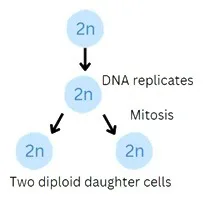
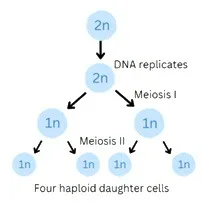
Unit conversion: 1 mm = 1000 µm.
Given: diameter of the field of view = 5 mm, number of cells along the diameter = 25
Step 1: diameter in µm:
Step 2: size of one onion cell:
Step 3: total magnification = magnification of eyepiece × magnification of objective lens:
Step 4: a cell of size 200 µm appears 100 times larger:
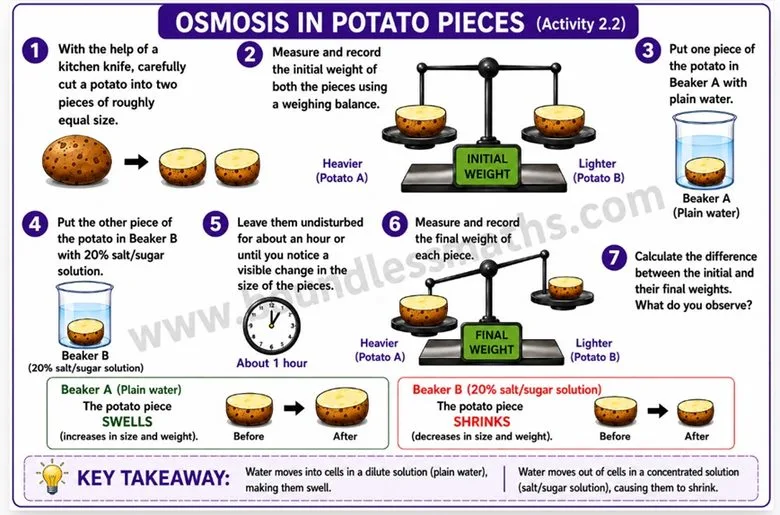
Observation:
1. Beaker A (plain water): the potato piece swells.
2. Beaker B (20% salt or sugar solution): the potato piece shrinks.
Change in weight (sample values):
| Beaker | Initial weight | Final weight | Difference |
|---|---|---|---|
| A (plain water) | 20 g | 23 g | +3 g (increase) |
| B (20% solution) | 20 g | 16 g | −4 g (decrease) |
Inference:
1. The cell membrane lets water pass in and out, but not the salt or sugar molecules.
2. Water moves from the area with more water (dilute solution) to the area with less water (concentrated solution) through a selectively permeable membrane. This is osmosis.
3. In Beaker A, water goes into the potato cells, so the weight increases.
4. In Beaker B, water comes out of the potato cells into the concentrated solution, so the weight decreases.
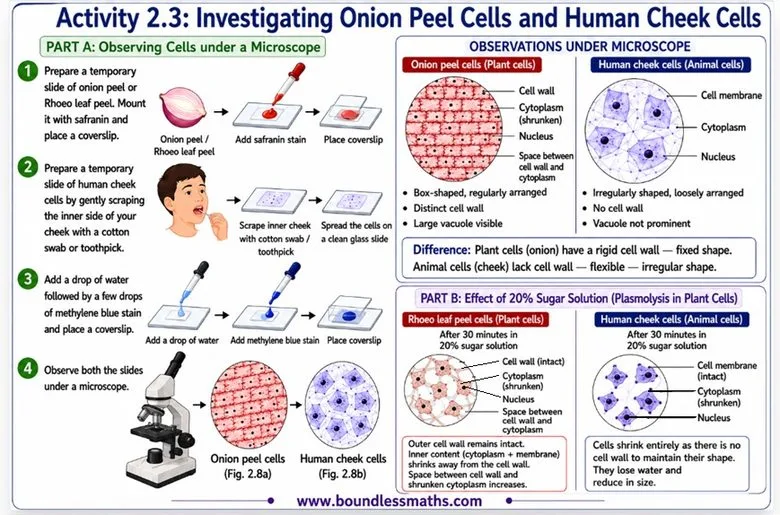
Observation (first slides):
1. Onion peel (or Rhoeo) cells are box-shaped and regularly arranged (Fig. 2.8a).
2. Cheek cells are irregularly arranged (Fig. 2.8b).
Reason for the difference:
1. Plant cells have a rigid cell wall outside the cell membrane. It gives them a fixed, box-like shape.
2. Cheek cells are animal cells. They have no cell wall, so they can change their shape easily.
Observation (in 20% sugar solution, after half an hour):
1. Plant cells: the cell boundary (cell wall) remains the same, but the inner content shrinks. The space between the inner and the outer boundaries increases (Fig. 2.9b).
2. Cheek cells: they shrink considerably.
Explanation: in the concentrated solution both cells lose water by osmosis. The plant cell wall is rigid, so the shape stays the same, and only the cell membrane pulls away from the wall. The animal cell has no wall, so it shrinks.
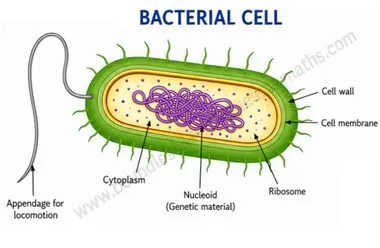
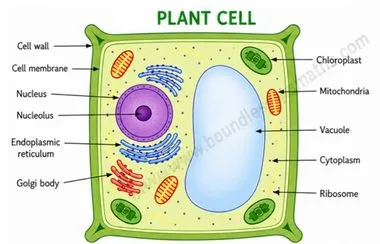
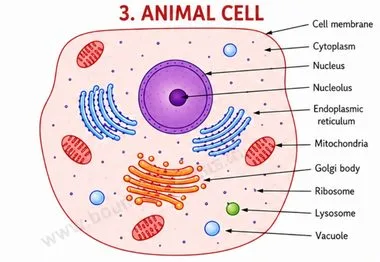
Table 2.1: comparison of different kinds of cells based on their structure
| S. No. | Cell structure | Bacterial cell | Plant cell | Animal cell |
|---|---|---|---|---|
| 1. | Cell membrane | ✔ | ✔ | ✔ |
| 2. | Cell wall | ✔ | ✔ | ✘ |
| 3. | Cytoplasm | ✔ | ✔ | ✔ |
| 4. | Well-defined nucleus (genetic material enclosed by a membrane) | ✘ | ✔ | ✔ |
| 5. | Primitive nucleus (nucleoid) (genetic material without membrane around it) | ✔ | ✘ | ✘ |
| 6. | Membrane-bound organelles | ✘ | ✔ | ✔ |
✔ = present, ✘ = absent
Conclusion: the bacterial cell has no well-defined nucleus and no membrane-bound organelles. Plant and animal cells have both.
Observation:
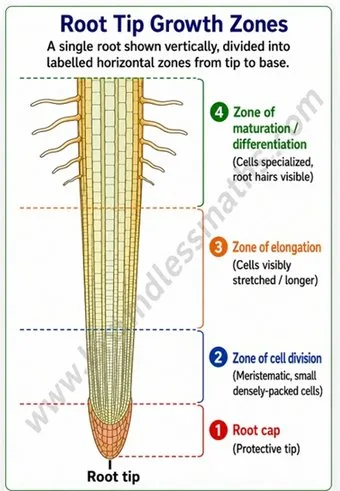
1. Yes, many small cells of the root tip are seen.
2. They are not all similar in structure. Some cells show thread-like or rod-like dark chromosomes, and some show two nuclei or a dividing cell, while others look like resting cells.
Reason for the difference:
1. The cells of the growing root tip divide continuously. This process is called cell division.
2. At any moment, different cells are at different stages of cell division, so they show different structures (Fig. 2.17).
The stage that comes first: the cell in which the chromatin material first becomes organised into visible chromosomes (the cell is ready to divide). The stage in which the cell has divided into two daughter cells comes last. The stages are learnt in detail in higher classes.
Step 1: the cell membrane is extremely thin (about 7 to 10 nm) and is made of a lipid bilayer with proteins in it (fluid-mosaic model).
Step 2: it is selectively permeable. It lets some substances pass and blocks others.
Step 3: small molecules like O₂ and CO₂ move across by diffusion, from a higher to a lower concentration. O₂ passes from the alveoli into the blood, and CO₂ passes from the blood into the alveoli.
Step 4: the proteins in the membrane act as gatekeepers and help other substances to pass.
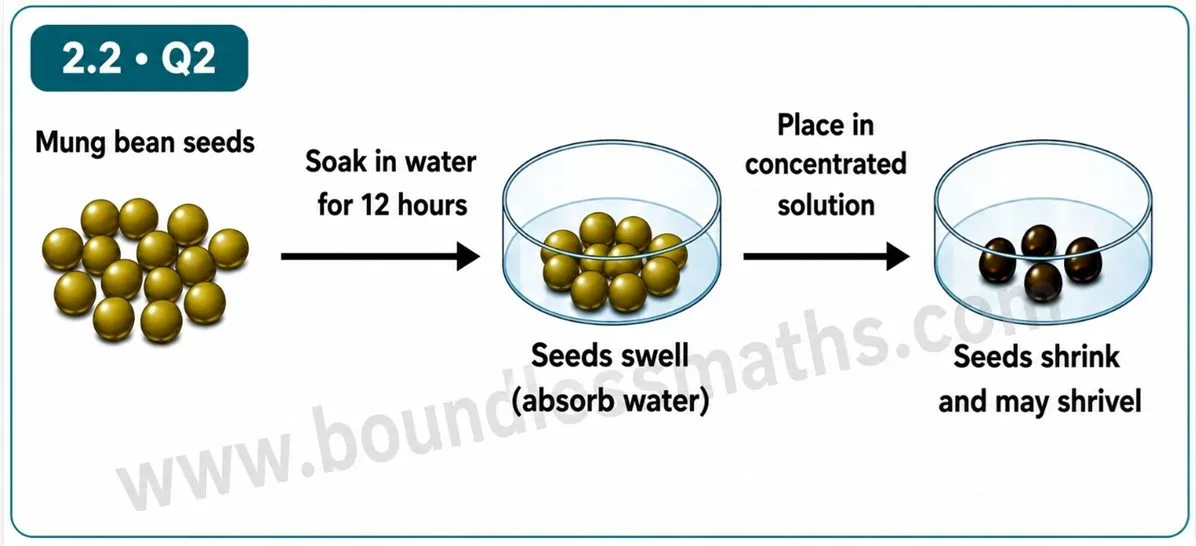
Step 1: in water for 12 hours, the seeds take in water by osmosis and swell.
Step 2: a concentrated solution is hypertonic compared to the cells of the seeds. It has less water than the seed cells.
Step 3: so water moves out of the seed cells into the concentrated solution by osmosis.
Result: the seeds lose water, shrink and become wrinkled.
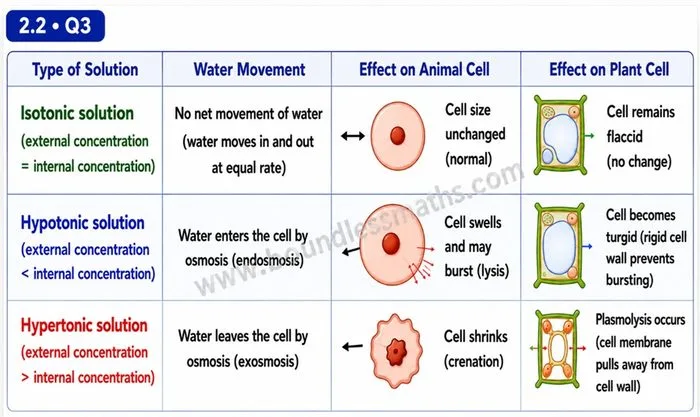
Types of solutions (compared with the inside of the cell):
| Solution | Solute concentration outside | Movement of water | Animal cell | Plant cell |
|---|---|---|---|---|
| Isotonic | Equal to that inside | No net movement | No change in size | No change |
| Hypotonic | Less than that inside | Water enters the cell | Swells, and may burst | Becomes firm (turgid), the wall stops bursting |
| Hypertonic | More than that inside | Water leaves the cell | Shrinks | Inner content shrinks away from the wall |
Necessity of the cell wall:
1. It gives shape and protection to the cell.
2. Plants cannot move from place to place, so they need a rigid structure to withstand wind and rain.
3. It helps leaves and flowers remain firm and helps plants stay upright.
4. In a hypotonic solution, it stops the cell from bursting, as the cell membrane cannot expand beyond it.
5. It is permeable, so water and minerals can pass through it, which helps roots absorb water.
6. In fungi and bacteria, it gives protection and structural support.
Cells without a nucleus:
1. Platelets in human blood (they are cell fragments without a nucleus).
2. Sieve tube cells of the phloem in plants (mature ones have no nucleus).
3. Bacteria do not have a well-defined nucleus. Their DNA lies in the nucleoid, which has no membrane.
Note: mature RBCs have no nucleus, so they have more space for haemoglobin. They cannot divide or repair themselves, so they live only about 120 days.
Step 1: a prokaryotic cell has no well-defined nucleus and no membrane-bound organelles. Its DNA lies in the nucleoid.
Step 2: a eukaryotic cell has a well-defined nucleus and membrane-bound organelles.
| Cell in Fig. 2.10 | Category | Reason |
|---|---|---|
| (a) Bacterial cell | Prokaryotic | Nucleoid, no nuclear membrane, no membrane-bound organelles |
| (b) Plant cell | Eukaryotic | Well-defined nucleus and membrane-bound organelles |
| (c) Animal cell | Eukaryotic | Well-defined nucleus and membrane-bound organelles |
Step 1: the cell has organelles called lysosomes. They are single membrane-bound sacs filled with enzymes.
Step 2: the enzymes break down unwanted proteins, carbohydrates and fats, and even the damaged parts of the cell.
Step 3: the products are released into the cytoplasm and are reused in other cell processes.
Result: the cell stays clean and healthy. This is why lysosomes are called the clean-up system.
Step 1: yes. Chloroplasts have the green pigment chlorophyll. Other plastids called chromoplasts have other pigments.
Step 2: the pigments of chromoplasts are yellow, orange or red. They give the bright colours to flowers, fruits and some vegetables.
Step 3: the bright colours attract pollinators for pollination and fruit-eating animals that help in seed dispersal.
Other plastids: leucoplasts have no pigment (colourless). They store starch, oils or proteins, for example in potato and taro.
Where stored: in the vacuole.
Step 1: a mature plant cell usually has one large central vacuole, surrounded by a single selectively permeable membrane.
Step 2: it is filled with cell sap. It stores water, minerals, sugars and waste material.
Why plants wilt:
Step 3: the vacuole holds a large amount of water and keeps the pressure inside the cell, so the cell stays firm.
Step 4: when a plant does not get enough water, the vacuole loses water, the cells become less firm, and the plant wilts.
Errors in mitosis:
1. They lead to uncontrolled cell divisions, which can form tumours.
2. They can give an abnormal number of chromosomes in body cells.
Errors in meiosis:
1. They may result in genetic disorders, with developmental problems or distinct physical features.
2. They may also cause early pregnancy loss or reduced fertility.
Step 1: no. Every cell has a definite life span.
Step 2: cells grow and divide in a controlled way, do their functions, and die when they are no longer needed.
Step 3: dead cells are replaced by new cells of the same function. For example, hundreds of billions of cells of our body, about 1 per cent, are replaced every day. Mature RBCs live about 120 days.
Step 4: if cells do not die when they should or die too early, problems arise in the body.
Step 1: normal cells grow, age and die in a controlled manner. In many animal cells, division stops when cells touch the neighbouring cells (contact inhibition).
Step 2: sometimes this system breaks down. Abnormal cells lose this control and start dividing uncontrollably.
Step 3: this forms tumours, which may be benign or malignant.
Step 4: cancerous (malignant) tumours invade nearby tissues and even spread to other parts of the body to form new tumours.
Ways by which cells keep a balance:
1. Programmed Cell Death (PCD): a genetically regulated process of selective cell destruction. It is needed in normal development, quality control and immune function. In the embryo, PCD removes the cells between the fingers. Without it we would have webbed hands.
2. Contact inhibition: in many animal cells, division stops when cells touch neighbours.
3. Controlled cell cycle: eukaryotic cells divide in a controlled and orderly manner.
4. Clean-up by lysosomes: they remove wastes and damaged parts.
5. Replacement: dead cells are replaced by new cells.
Plants:
1. They are fixed in one place and cannot escape wind, rain or other stress. So they need a rigid cell wall to give strength and support.
2. The wall keeps the leaves and flowers firm and the plant upright.
3. It stops the cell from bursting when it takes in water.
Animals:
1. They move from place to place, so they need flexible cells, to change shape and to allow movement.
2. Animal cells have no cell wall, so tissues can move and function easily.
Conclusion: a rigid wall suits fixed plants, and its absence suits moving animals.
Consequences:
1. The cell would not keep a fixed shape.
2. The plant would lose its strength. Stems and leaves would droop, and the plant could not stand upright.
3. In plain water, the cell would swell and could burst, as the wall would not stop it.
4. The protection against wind, rain and other stress would be lost.
Step 1: we want to compare the effect of only one factor: the liquid (plain water or concentrated solution).
Step 2: pieces of equal size and weight start in the same condition, so the other factors are kept the same. This makes the test fair.
Step 3: the initial weight is needed to find the change in weight (final − initial).
Result: we can say that the change is due to osmosis in the liquid, and not due to the difference in size.
Step 1: the colour of flowers comes from the pigments of chromoplasts (yellow, orange, red).
Step 2: a white flower has no coloured pigment in its petals. Its plastids are colourless (leucoplasts).
Step 3: it looks white because the petals reflect and scatter all the light that falls on them.
Note: some white flowers have colourless substances that absorb ultraviolet light, which insects can see.
Steps to draw a plant cell:
1. Draw a box-shaped outline. This is the cell wall. Draw the cell membrane just inside it.
2. Draw a dark, round nucleus in the cytoplasm, with a small nucleolus in it.
3. Draw the ER as a network of tubes joined to the nuclear envelope. Put dots (ribosomes) on the rough ER.
4. Draw rod-shaped mitochondria and rod-shaped chloroplasts in the cytoplasm.
5. Draw stacks of flat sacs for the Golgi apparatus, and a large central vacuole.
Labels: cell wall, cell membrane, cytoplasm, nucleus, nucleolus, ER, ribosomes, Golgi apparatus, mitochondrion, chloroplast, vacuole.
For an animal cell: leave out the cell wall, chloroplasts and the large vacuole, and draw an irregular outline.
Step 1: energy is made on the membranes of the mitochondrion (the inner membrane is folded into cristae). The more the surface area, the more the energy can be made and the more the materials can be exchanged.
Step 2: many small mitochondria together have a much larger total surface area than a single giant one of the same total volume.
Step 3: small ones can also be spread through the cell, near the places that need energy.
Step 4: a giant mitochondrion would have a small surface area compared to its volume. It would exchange materials slowly and make less energy.
Step 1: to heal a cut, skin cells must divide by mitosis. Mitosis gives two identical cells with the full number of chromosomes.
Step 2: meiosis gives four cells with half the number of chromosomes, which are different from each other. Meiosis normally occurs only in reproductive organs.
Step 3: such cells would not be normal skin cells and could not replace the lost cells properly.
Result: the cut would not heal properly, or would heal with abnormal cells.
| Cell membrane | Cell wall |
|---|---|
| Selectively permeable: it allows some substances to pass and blocks others | Permeable: water and dissolved minerals can pass through it |
| Thin, found in all cells | Rigid, found only in plant, fungi and bacterial cells |
| RER | SER |
|---|---|
| Has ribosomes attached to its surface, so it looks rough | Has no ribosomes on its surface, so it looks smooth |
| Makes and secretes proteins | Makes and stores fats and hormones |
| Chloroplasts | Chromoplasts |
|---|---|
| Have the green pigment chlorophyll | Have yellow, orange or red pigments |
| Make food by photosynthesis | Give bright colours to flowers and fruits |
Step 1: pure water has more water than the inside of Cell X. So water moves into Cell X by osmosis, and it swells.
Step 2: the concentrated salt solution has less water than the inside of Cell Y. So water moves out of Cell Y, and it shrinks.
Check the options:
(i) wrong. The cell membrane does not allow salt to enter freely, and the shrinking is due to the loss of water.
(ii) wrong. It says salt entered the cell, which is not correct.
(iii) correct. Only water moves, through the cell membrane.
(iv) wrong. Osmosis is the movement of water, not of the solute.
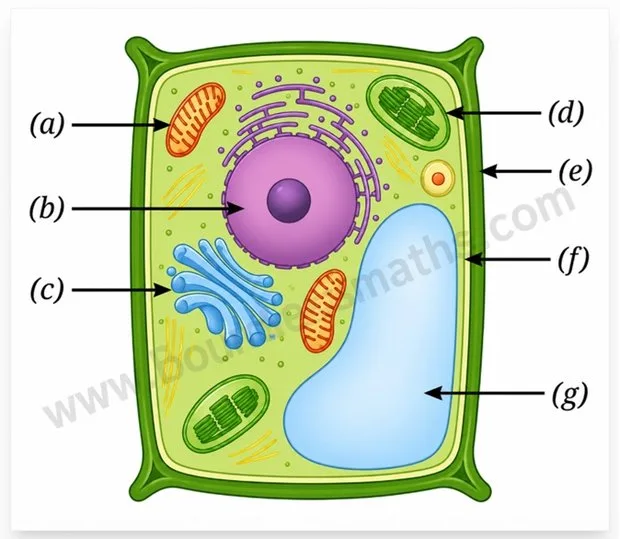
| Label | Part | Function |
|---|---|---|
| (a) | Mitochondrion | (ii) Site of cellular respiration |
| (b) | Nucleus | (i) Controlling all the activities of a cell |
| (c) | Golgi apparatus | (vi) Packs and stores materials received from ER |
| (d) | Chloroplast | (vii) Helps in manufacturing food |
| (e) | Cell wall | (v) Provides structural rigidity to the cell |
| (f) | Cell membrane | (iv) Separates the cell contents from surroundings |
| (g) | Vacuole | (iii) Storage organelle that also provides rigidity to the cell |
| Option | Present in the plant cells | Absent in the animal cells |
|---|---|---|
| (i) | Leucoplast | Cell wall |
| (ii) | Mitochondria | Ribosome |
| (iii) | Cell wall | Golgi apparatus |
| (iv) | Lysosome | Endoplasmic reticulum |
Check each option:
(i) leucoplasts are plastids, present only in plant cells. The cell wall is absent in animal cells. Correct.
(ii) mitochondria are also present in animal cells, and ribosomes are present in animal cells. Wrong.
(iii) the Golgi apparatus is present in animal cells. Wrong.
(iv) lysosomes and the ER are present in animal cells also. Wrong.
Renu is correct.
Step 1: plastids are not only chloroplasts. There are three types: chloroplasts, chromoplasts and leucoplasts.
Step 2: chloroplasts are for photosynthesis, so they are in the green parts. Roots do not do photosynthesis, so they do not have chloroplasts.
Step 3: but root cells have other plastids. Leucoplasts (colourless) store starch, oils or proteins, for example in potato and taro. Chromoplasts give colour to some roots (like carrot).
Why Rohit is wrong: he thinks plastids are only for photosynthesis, but plastids also store food and pigments.
Similarities:
1. Both are surrounded by two membranes (double-membrane-bound).
2. Both have their own DNA and ribosomes, so they can make some of their own proteins.
3. Both are linked with energy: mitochondria release energy and chloroplasts capture light energy.
4. Both resemble certain bacteria, so they probably share an evolutionary history with them.
Differences:
| Feature | Mitochondria | Chloroplasts |
|---|---|---|
| Found in | Plant and animal cells | Plant cells only |
| Function | Cellular respiration: release energy (ATP) from glucose | Photosynthesis: make food (sugars) from light energy |
| Inner membrane | Folded into cristae | Has disc-shaped structures with chlorophyll |
| Fluid inside | Matrix | Stroma |
| Pigment | No pigment | Chlorophyll (green) |
Organelles that contain DNA: nucleus, mitochondria and chloroplasts.
Check the options:
(i) chloroplasts have DNA, but ribosomes do not. Wrong.
(ii) mitochondria and nucleus both have DNA. Correct.
(iii) Golgi bodies and ribosomes have no DNA. Wrong.
(iv) the nucleus has DNA, but lysosomes do not. Wrong.
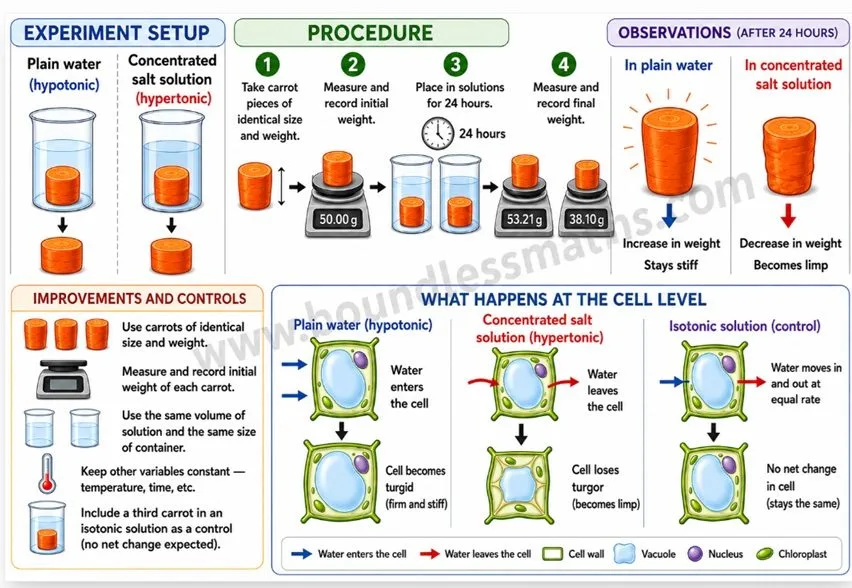
The movement of water in and out of the carrot cells depends on the concentration of the solution around them.
Plant cells gain water in a dilute solution and lose water in a concentrated solution (osmosis).
1. Use carrots of the same size and weight, and record the initial weight.
2. Use the same volume of solution and the same type of container.
3. Keep the temperature and the time the same.
4. Add a third carrot in an isotonic solution, as a control, to show no change.
5. Measure the final weight, and repeat the experiment.
Plain water: it has more water than the carrot cells (hypotonic). Water enters the cells by osmosis. The cells become full of water and firm (turgid), and the cell wall stops them from bursting. So the carrot stays stiff and crunchy.
Concentrated salt solution: it has less water than the cells (hypertonic). Water leaves the cells by osmosis. The cells lose their firmness. So the carrot becomes rubbery and limp.
| Structure in a cell | Bacterial cell | Animal cell |
|---|---|---|
| Chromosome | ✔ (single, circular DNA in the nucleoid) | ✔ |
| Nucleus | ✘ (nucleoid, no membrane) | ✔ |
| Mitochondria | ✘ | ✔ |
| Golgi complex | ✘ | ✔ |
| Chromoplasts | ✘ | ✘ (found in plant cells) |
✔ = present, ✘ = absent
Reason: bacterial cells are prokaryotic. They have no nucleus and no membrane-bound organelles. Animal cells are eukaryotic. Chromoplasts are plastids, found only in plant cells.
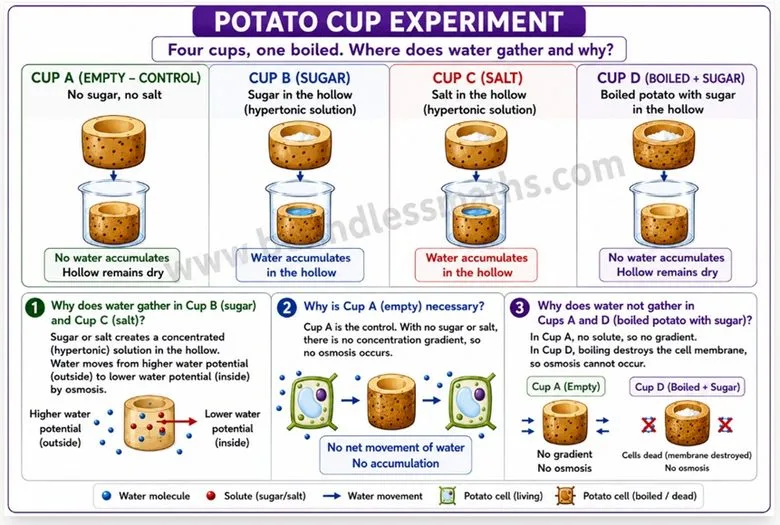
Step 1: sugar (Cup B) and salt (Cup C) make a concentrated solution in the hollow, which has less water than the cells of the potato and the water outside.
Step 2: the potato cells are living, so their cell membranes are selectively permeable. Water moves from the beaker, through the living cells, into the hollow by osmosis.
Result: water gathers in the hollow.
Cup A is the control. It has no sugar or salt.
If water does not gather in A but gathers in B and C, we know that the water gathers only because of the sugar or salt (osmosis), and not for any other reason (like leakage).
Cup A: there is no dissolved sugar or salt, so there is no difference in concentration and no osmosis.
Cup D: the potato was boiled, so its cells are dead. The cell membranes of dead cells are not selectively permeable, so osmosis cannot take place, even though sugar is present.
Check each pair:
(i) ribosomes are the sites of protein synthesis. Correct pair.
(ii) SER makes and stores fats (lipids) and hormones. It does not make cellulose. Incorrect pair.
(iii) lysosomes have enzymes that break down unwanted and foreign materials. Correct pair.
Step 1: mitochondria are the powerhouses of the cell. They break down glucose and release energy in cellular respiration, and store it as ATP.
Step 2: without mitochondria, the cell cannot make enough ATP.
Step 3: most cell activities (making materials, moving substances, division) need ATP, so they would stop or slow down.
Result: the cell would become weak and would soon die.
Phenomenon: contact inhibition.
Step 1: in many animal cells, cell division usually stops when cells come in contact with the neighbouring cells.
Step 2: this stops the cells from piling up. Cancer cells lose this control and keep dividing, which forms tumours.
Plants:
Step 3: plant cells do not show contact inhibition, because their rigid cell walls make them grow in a different pattern.
Step 4: so plants can also develop tumour-like growths (for example, galls). But their rigid cell walls hold the cells in place, so the cells do not spread to other parts as in animals.
Organelles that help:
1. Ribosomes on the RER make the proteins.
2. The SER makes the lipids.
3. The Golgi apparatus modifies, sorts and packages them.
Path:
Step 1: proteins are made by ribosomes on the RER, and lipids are made by the SER.
Step 2: they move to the Golgi apparatus in small vesicles.
Step 3: the Golgi apparatus modifies, sorts and packs them into vesicles.
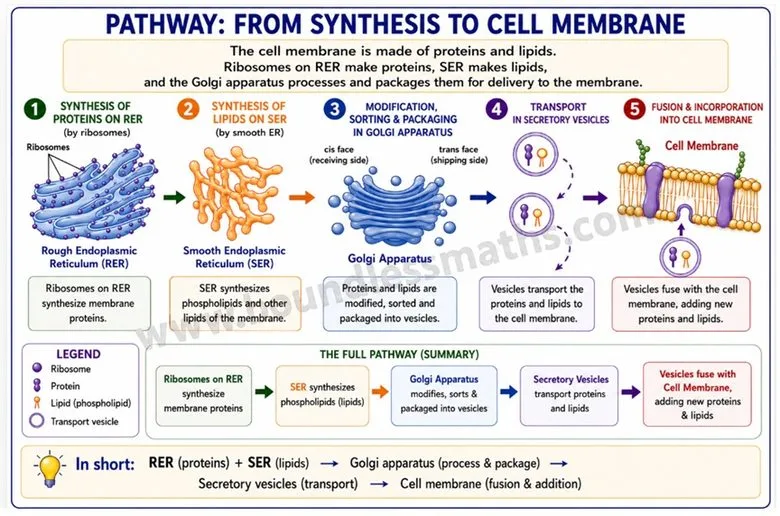
Step 4: the vesicles carry the packed material to the cell membrane and fuse with it, so the proteins and lipids become part of the membrane.
Step 1: in mitosis, the daughter cells have the same number of chromosomes as the parent cell. So each gamete would have the full number of chromosomes.
Step 2: at fertilisation, two gametes join. The chromosome number would double in the zygote.
Step 3: it would keep doubling in each generation, so the number would not stay fixed for the species.
Step 4: also, mitosis gives identical cells, so there would be no variation among the offspring.
The farmer has applied osmosis.
Step 1: a high concentration of salt or sugar makes the surroundings hypertonic to the cells of bacteria and fungi.
Step 2: water moves out of the microbial cells by osmosis, and the cell contents shrink.
Step 3: without water, the microbes cannot grow or multiply, and they die. So the food does not spoil.
Amla murabba with jaggery:
1. Wash the amla, prick it, and boil it for a short time to soften it.
2. Make a thick syrup of jaggery and water with a little cardamom.
3. Soak the amla in the syrup for about two days.
4. Store it in clean, dry glass jars.
1. Use of scientific knowledge (osmosis) to solve a real problem.
2. Reducing waste, which is sustainability.
3. Food security, as seasonal fruits are available for a longer time.
4. Respect for traditional knowledge, and earning a livelihood (local economy).
Steps:
1. Choose a tool, such as PowerPoint, Scratch or a free animation app.
2. Draw a parent cell with chromosomes in the nucleus.
3. For mitosis, show the chromosomes lining up, separating, and the cell dividing into two identical cells.
4. For meiosis, show two divisions and four cells with half the chromosomes.
5. Add labels and a short caption for every step.
6. Show it in the class and explain the stages.
Materials: clay or dough, a used plastic bottle cap or an old container, coloured paper, seeds, beads, jelly or a plastic bag.
Steps:
1. Take a transparent bag or a bowl of jelly as the cell membrane.
2. Fill it with a gel (cytoplasm).
3. Put a ball of clay (a synthetic nucleus with DNA made of coloured thread).
4. Add beads as ribosomes and clay shapes as mitochondria.
5. Label each part with a small flag.
Idea: a synthetic cell has only the parts that we put in, so it is simple.
Model: use coloured wool or pipe cleaners for chromosomes, and a cardboard disc for the cell. Show the stages in order.
Teamwork helped because:
1. We divided the work: research, making the chromosomes, drawing and labelling.
2. We corrected each other’s mistakes about the stages.
3. We shared ideas, and finished on time.
Change in understanding (sample answer):
1. I learnt that mitosis gives two identical cells, while meiosis gives four cells with half the chromosomes.
2. I understood why growth and repair need mitosis and why gametes need meiosis.
Characters: Nucleus (the Boss), Mitochondria (the Energy Man), Ribosome (the Cook), Golgi (the Postman), Lysosome (the Cleaner), Cell membrane (the Gatekeeper).
Sample dialogues:
1. Nucleus: “I keep the instructions (DNA) and tell everyone what to do.”
2. Ribosome: “I make proteins, the food and building material of the cell.”
3. Mitochondria: “I give everyone energy (ATP). Without me, no work will be done!”
4. Golgi: “I pack and send the goods, like a post office.”
5. Lysosome: “I clean the cell and break down the waste.”
6. Gatekeeper: “Only the needed things can come in or go out.”
Message: all parts work together like a team, so our cell (and our community) stays healthy.
The cell is the basic structural and functional unit of every living thing — a coordinated system of organelles, bounded by a selectively permeable membrane, that grows, divides by mitosis or meiosis, and eventually dies, all governed by the same three principles of Cell Theory across bacteria, plants, animals and humans alike.
Present position: in 2010, J. Craig Venter’s team made a synthetic DNA of a bacterium and put it into another cell. The cell grew and divided by the new DNA. But only the DNA was synthetic and the rest of the cell was natural.
Future:
1. A cell may be built from non-living chemicals completely, to find the minimum parts needed for life.
2. Synthetic cells could make medicines, vaccines and useful chemicals.
3. They could be designed to clean pollutants or make clean fuels.
4. They can help us understand how the first cell on the Earth arose.
Challenge: it is very hard to make all the parts work together.
Ethical issues:
1. Is it right to create life in a laboratory?
2. Safety: a synthetic organism could escape and harm the environment or health.
3. Misuse: it could be used to make harmful germs (biological weapons).
4. Ownership: who would own such cells and benefit from them (patents and cost)?
5. The effect on natural biodiversity.
So there must be strict rules, open discussion and responsible use.
The cell is the basic structural and functional unit of every living thing — a coordinated system of organelles, bounded by a selectively permeable membrane, that grows, divides by mitosis or meiosis, and eventually dies, all governed by the same three principles of Cell Theory across bacteria, plants, animals and humans alike.
Here are extra practice questions for Class 9 Chapter 2, Cell: The Building Block of Life. It is a mix of MCQs, Assertion-Reason, Very Short, Short, and Long Answer Questions, and a Case Study — apart from the NCERT questions — to make you confident in your understanding of the chapter. Attempt the questions yourself first, and then cross-check your answers below.
Mitochondria break down glucose and other molecules and release energy, which is stored as ATP.
So they supply the energy for most cell activities.
Osmosis is the movement of water through a selectively permeable membrane, from a region of more water to a region of less water.
Diffusion does not need a membrane, and it is not specific to water. Plasmolysis is the shrinking of the cell content in a concentrated solution. Active transport needs energy.
Prokaryotic cells have cytoplasm, ribosomes and a cell membrane.
They have no well-defined nucleus, so they have no nuclear membrane.
Each question below has an Assertion (A) and a Reason (R). Choose the correct option:
(A) Both A and R are correct, and R is the correct explanation of A.
(B) Both A and R are correct, but R is not the correct explanation of A.
(C) A is true but R is false.
(D) Both A and R are false.
Assertion: true. The cell membrane shows fluid behaviour (fluid-mosaic model).
Reason: true. Its lipid and protein molecules can move sideways, flip and rotate.
The movement of the molecules gives the fluid nature, so the Reason explains the Assertion.
Assertion: false. The cell wall is a non-living part of the plant cell. The living part is the protoplasm inside it.
Reason: true. The cell wall gives protection, rigidity and support.
Assertion: true. O₂ and CO₂ are small molecules, and they diffuse across the membrane from a higher to a lower concentration.
Reason: true. The plasma membrane is selectively permeable and lets some materials pass in and out.
This property allows the gases to pass, so the Reason explains the Assertion.
Assertion: true. A bacterial cell has no definite nucleus.
Reason: true. The genetic material lies in the nucleoid, with no nuclear membrane around it.
The absence of the nuclear membrane is the cause of the absence of a definite nucleus, so the Reason explains the Assertion.
Ribosomes may be present freely in the cytoplasm, or attached to the endoplasmic reticulum (rough ER).
(They are also present inside mitochondria and chloroplasts.)
Leucoplasts are colourless plastids that store food, such as starch, oils or proteins.
In storage tissues like potato they store starch, so the potato can keep food.
The vacuole stores water, minerals, sugars and waste materials.
The Golgi apparatus modifies, sorts and packs proteins and lipids into vesicles for transport, like a post office.
Robert Hooke first observed cells in 1665, in a thin slice of cork, using a microscope designed by him.
DNA is deoxyribonucleic acid.
The plant cell wall is made mainly of cellulose, a carbohydrate made of many glucose units joined together.
(The cell walls of fungi and bacteria are made of other materials.)
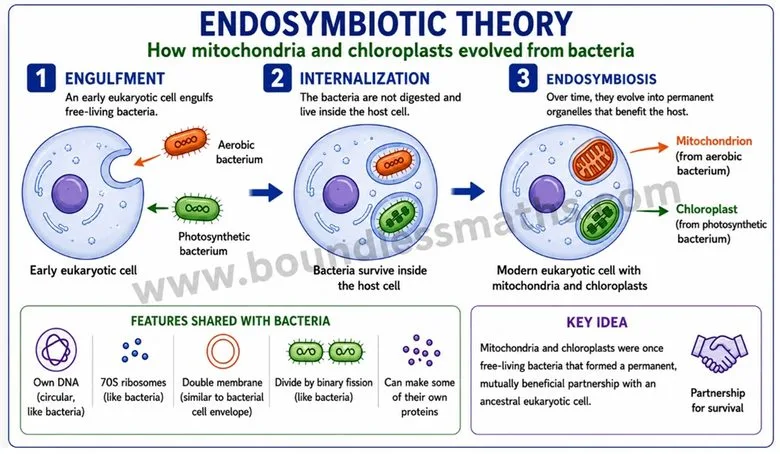
Similar features of mitochondria and chloroplasts with bacteria:
1. Both have their own DNA.
2. Both have their own ribosomes, so they can make some of their proteins.
3. Both are about the size of bacteria.
Conclusion: these features suggest that both share an evolutionary history with single-celled organisms like bacteria. They were probably free-living bacteria that were taken inside a larger cell, and they stayed there.
Contact inhibition: in many animal cells, division stops when the cell touches the neighbouring cells.
Importance:
1. It stops the cells from dividing without control and piling up.
2. It prevents the formation of tumours.
3. Cancer cells lose it, and keep dividing.
1. Meiosis produces gametes (sperm and egg) with half the number of chromosomes.
2. When two gametes join in fertilisation, the original chromosome number is restored.
3. Without it, the chromosome number would double in each generation.
4. It also creates variation, so children resemble their parents but are not exactly the same.
1. Errors in mitosis lead to uncontrolled cell divisions.
2. This can form tumours.
3. It can also give an abnormal number of chromosomes in body cells.
Step 1: in a hypotonic solution, water enters both the cells by osmosis, and they swell.
Step 2: a plant cell has a rigid cell wall outside the cell membrane. The wall does not let the cell expand beyond a limit, so the cell becomes firm (turgid), and does not burst.
Step 3: an animal cell has no cell wall, only a thin membrane. It keeps swelling and may burst.
Features of eukaryotes not found in prokaryotes:
1. A well-defined, membrane-bound nucleus.
2. Membrane-bound organelles (like mitochondria, ER, Golgi apparatus).
The nucleus is called the brain of the cell.
1. It controls all the activities of the cell.
2. It contains chromosomes, which have DNA and genes with the coded instructions.
3. It passes the information for the inherited characters to the next generation.
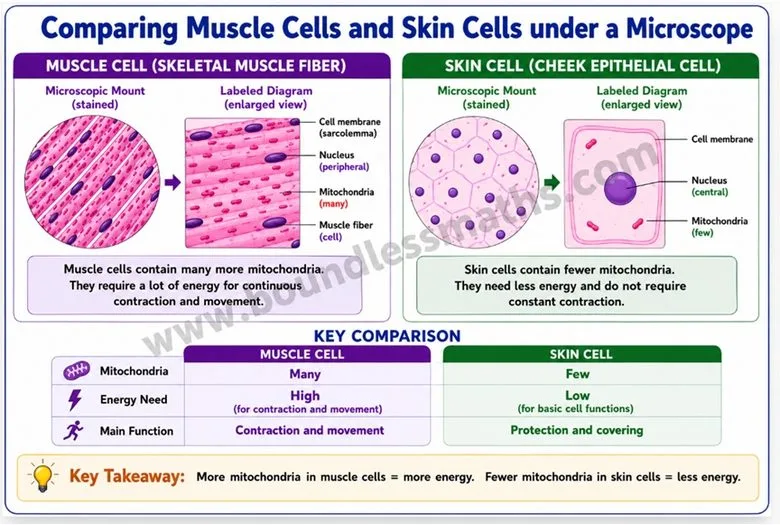
Step 1: muscle cells contract again and again, so they need a lot of energy.
Step 2: mitochondria are the powerhouses of the cell, and they make the energy.
Step 3: skin cells need less energy, so they need fewer mitochondria.
Cellular respiration: glucose and other molecules are broken down to release energy.
ATP (Adenosine Triphosphate) is the energy currency of the cell.
Step 1: read the point where the line cuts the 0% change line (x-axis).
Step 2: this is at 0.4 mol/L.
Step 1: at 0.4 mol/L there is no change in mass, so there is no net movement of water.
Step 2: so the solution has the same concentration as the potato cell sap. It is isotonic.
Below 0.4 mol/L: the solution is hypotonic. Water enters the cells by osmosis, so the mass increases (+16% in pure water).
Above 0.4 mol/L: the solution is hypertonic. Water leaves the cells by osmosis, so the mass decreases (−14% at 1.0 mol/L).
Step 1: boiling kills the cells, and the cell membrane is no longer selectively permeable.
Step 2: osmosis does not take place, so the mass would show almost no change at any concentration.
Graph: a nearly flat line along 0%.
Given: eyepiece = 10X, objective lens = 40X
Total magnification = magnification of eyepiece × magnification of objective
Step 1: convert the diameter to µm.
Step 2: size of a cell = diameter of the field ÷ number of cells.
Step 1: apparent size = real size × magnification.
Step 2: convert to mm.
Next up is Chapter 3 — Tissues in Action. Or explore the full chapter list, browse the Class 9 Science hub, or revise with the Class 9 Science Notes, or test yourself with the free Class 9 Science Sample Paper and Marking Scheme.
Expert CBSE Coaching · Class 9–12