
Where Mindful Learning Begins
Where Mindful Learning Begins
NCERT Class 9 Science Chapter 3 question answers for Tissues in Action (CBSE 2026-27), covering every Think It Over, Inline, Activity, Pause & Ponder, Think as a Scientist, Revise Reflect Refine and Quest Continues question. Keep your Class 9 Science chapter 3 notes beside it and check the reasoning behind each answer.
Tissues in Action builds on Chapter 2 by moving from single cells to groups of cells: meristematic and permanent plant tissues, and epithelial, connective, muscular and nervous animal tissues. These Class 9 Science Chapter 3 NCERT solutions explain xylem and phloem, the types of joints, the onion-root growth experiment and totipotency step by step, so you can answer difference-between questions, diagram questions and case-based questions with confidence.
Last updated 20 October 2026 · Reviewed by Suchita Arora, 13+ years teaching CBSE Maths & Science
Tissues in Action moves up one level from Chapter 2 — instead of single cells, it looks at groups of cells organised into tissues in both plants and animals. On the plant side it covers meristematic tissue (the dividing zones that make growth possible) and the permanent tissues, simple (parenchyma, collenchyma, sclerenchyma) and complex (xylem, phloem). On the animal side it covers epithelial, connective, muscular and nervous tissue, plus joints and body movement, and it closes with F.C. Steward's totipotency experiments behind plant tissue culture. Every question is solved here, section by section, as Class 9 Science Chapter 3 NCERT solutions with answers.
Understanding life processes:
1. All life processes (growth, nutrition, respiration, movement, control) happen in cells and tissues.
2. Tissues form organs, and organs form organ systems. So we must know tissues to know how the body works.
3. It tells us how plants grow (meristems) and how animals move and respond (muscles, nerves).
Human welfare:
1. Medicine: doctors diagnose and treat diseases such as cancer (uncontrolled cell division) and fractures or ligament tears.
2. Bone marrow transplants use stem cells to treat blood cancers (leukemia) and thalassemia.
3. Agriculture: plant tissue culture gives disease-resistant and improved crops.
4. Genetic engineering: Agrobacterium is used to put useful genes into plants.
Reason for the difference: plants are fixed in one place and make their own food. Animals move and get food from outside.
| Feature | Plant tissues | Animal tissues |
|---|---|---|
| Support | Cell wall gives rigidity and strength, so they stay firm and upright | No cell wall, so cells change shape easily and suit movement |
| Movement | Fixed in one place | Can move (locomotion), by muscle tissue |
| Nutrition | Tissues use solar energy to make food by photosynthesis | Tissues digest food obtained from outside |
| Transport | Xylem carries water, and phloem carries food | Blood (a connective tissue) carries nutrients, gases and hormones |
| Growth | Only in meristematic tissues (tips, sides and nodes) | Growth is not limited to special growth zones |
| Main types | Meristematic and permanent tissues | Epithelial, connective, muscular and nervous |
Step 1: division of labour means different groups of cells do different work. This makes the body efficient.
Step 2: levels of organisation:
1. Cell: each cell is specialised, for example a muscle cell contracts and a neuron carries messages.
2. Tissue: cells of similar structure work together for one function, for example muscle tissue gives movement.
3. Organ: different tissues form an organ, for example the heart has muscle, nerve, connective and epithelial tissue.
4. Organ system and organism: organs together do the big jobs, for example digestion and breathing.
Step 3: at every level the structure suits the function. Cells with the same structure form a tissue, and tissues with different structures form organs that do complex work.
Step 4: in unicellular organisms like amoeba, one cell does all the work. In multicellular organisms, division of labour makes complex life processes possible.
Step 1: the tip of the stem has the apical meristem. It makes the stem grow in length.
Step 2: when the tip is cut, the apical meristem is removed. The stem stops growing in length.
Step 3: new branches arise from the nodes of the stem (Fig. 3.5). The intercalary meristem is at the base of the internode or just above the node.
Example: when a hedge is cut, more branches appear and it becomes bushy. Grass grows again after mowing.
Features of meristematic cells: small, thin walls, large prominent nucleus, dense cytoplasm with many organelles, tightly packed.
Reasons for no vacuoles:
1. These cells divide continuously and rapidly, so they need dense cytoplasm and a large nucleus.
2. A large vacuole would take up space and dilute the cytoplasm.
3. Vacuoles store water, minerals and wastes. Young dividing cells do not need to store anything.
4. Cells are tightly packed, with little or no intercellular space, and they do not need a vacuole for firmness.
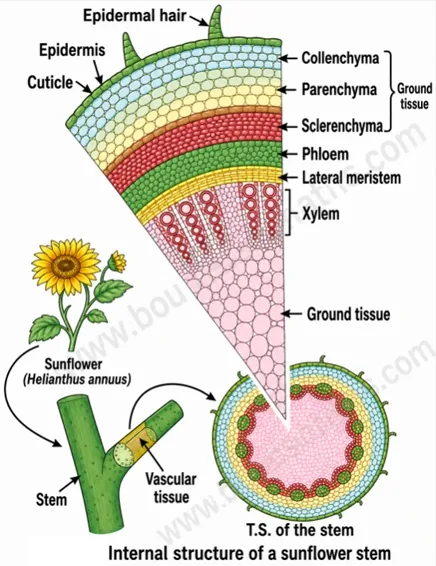
Observation: different groups of cells are present. All the cells are not similar in shape and size.
Tissues identified: 7 types:
| Tissue | Where it is | Difference seen |
|---|---|---|
| Epidermis | Outermost layer, with cuticle and hairs | Single layer of flat, tightly packed cells |
| Collenchyma | Ground tissue | Cells with unevenly thickened corners |
| Parenchyma | Ground tissue | Thin walls, loosely packed with spaces |
| Sclerenchyma | Ground tissue | Thick lignified walls, hard |
| Xylem | Vascular tissue | Thick-walled tubes |
| Phloem | Vascular tissue | Sieve tubes with companion cells |
| Lateral meristem | Ring in the stem | Small cells that divide |
Reason for the different tissues:
1. Each tissue is specialised to perform a specific function (protection, support, storage, transport, growth).
2. This is division of labour, so the plant body works efficiently.
Step 1: these functions are done by the supporting tissues, which are the simple permanent tissues: parenchyma, collenchyma and sclerenchyma.
Plant stays upright: sclerenchyma (thick lignified walls, hard and strong) and collenchyma give support.
Fresh twig bends, dry twig breaks:
1. A fresh twig has living collenchyma with pectin in the thickened corners. Pectin gives flexibility like rubber, so it bends.
2. A dry twig has lost its water, and its hard lignified cells (sclerenchyma) make it stiff, so it breaks.
Seed coats are hard: they have sclerenchyma with lignin, as in walnut shell and coconut husk.
Aquatic plants float: parenchyma forms air spaces in them, which help them float.
Water reaches the leaves:
1. Roots absorb water and minerals. Xylem carries them upwards to the leaves.
2. Xylem is made of tracheids and vessels, which are tubular and thick-walled.
3. Transpiration from the stomata creates a transpiration pull in the xylem, which pulls the water up.
Food reaches other parts:
1. Food made in the leaves is carried by the phloem to all parts of the plant.
2. Sieve tubes are long tubes joined end to end by perforated walls. They carry the food.
3. Companion cells monitor the loading and unloading of sugars in the sieve tubes.
Muscular tissue. Its cells contract and relax and bring about movement (blinking, clenching the fist).
Nervous tissue. Neurons receive the message from the skin and send it to the brain.
Epithelial tissue. A single layer of thin, flat cells lines the lungs and blood vessels, and allows rapid diffusion of gases.
Connective tissue (for example bone, cartilage, tendons and ligaments). It connects and supports the other tissues.
Step 1: muscles pull on bones to produce movement.
Step 2: muscles are attached to bones by strong, flexible bands called tendons.
Step 3: when a muscle contracts, the tendon transmits the force to the bone, and the bone moves at the joint.
Step 4: the muscles work under the control of the nervous system, which sends them the instructions.
How can the rib cage move?
1. The ribs are attached to the spine at the back and to the breast bone (sternum) in the front.
2. They are joined by flexible cartilage, so the cage can expand and contract.
Why does it need to move?
1. The movement increases and decreases the space in the chest during breathing.
2. This allows air to move in and out of the lungs.
Note: injury to the ribs makes breathing painful and difficult.
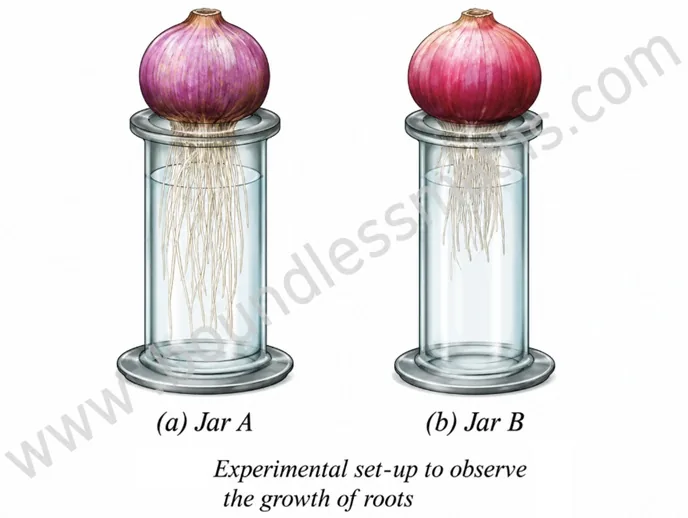
Table 3.1: Experimental data (sample readings, read from Fig. 3.2; your own readings will vary slightly)
| Jar | Day 1 | Day 2 | Day 3 | Day 4 | Day 5 | Day 6 | Day 7 |
|---|---|---|---|---|---|---|---|
| A | 0.2 | 0.8 | 1.8 | 2.9 | 3.8 | 4.9 | 5.8 |
| B | 0.2 | 0.7 | 1.6 | 2.6, then 1.6 after the cut | 1.6 | 1.6 | 1.6 |
Trend:
1. Roots in Jar A continue to grow in length every day.
2. Roots in Jar B grow like Jar A till the tips are cut. After that they stop growing.
Comparison with Fig. 3.2: yes, our observations are similar. Jar A rises steadily, and Jar B becomes flat after the cut.
Inference:
1. Roots grow only from their tips.
2. The tips have cells that divide continuously (apical meristem). We saw this as mitosis in onion root tips in Chapter 2.
3. Shoot tips also have such cells, so plants have growth zones at the tips of roots and shoots.
Table 3.3 completed:
| Experience | Observation | Question | Explanation |
|---|---|---|---|
| Small cut on the skin | Red blood oozes out. A clot forms after some time | What causes blood to clot? | Platelets help in blood clotting at the site of injury |
| Skin infection | The area turns red and slightly swollen. There may be fever | Why does the infected area turn red and swell? | White Blood Cells (WBCs) collect at the infected area, causing redness, swelling and pus |
| Exercise or running | You breathe faster. Your face may turn red | Why do we breathe faster and why does the face turn red? | Muscles need more oxygen, so breathing becomes faster and blood flow increases |
Related facts:
1. The red colour of blood is due to haemoglobin, an iron-rich protein in the Red Blood Cells (RBCs).
2. RBCs live for about 4 months and are replaced regularly.
3. Blood is a connective tissue. Its matrix (plasma) is watery, so it is fluid.

Table 3.4: Connective tissues
| Action | Experience | Function | Connective tissue |
|---|---|---|---|
| Touch your elbow gently | A hard and rigid structure | Gives strength, support and protection | Bone (Fig. 3.12b) |
| Press and fold your ear or gently press your nose and stop | A soft and flexible structure that retains shape again | Provides flexibility and cushions the ends of bones for shock absorption | Cartilage (Fig. 3.12c) |
| Touch your forearm muscles and wiggle your fingers | Feel movement in the forearm even though fingers are far away | Connects muscle to bone, and brings about movement | Tendon (Fig. 3.12c) |
| Sit on a chair and move your leg upwards till your knee allows | The joint does not go beyond a limit | Connects bone to bone and provides stability, limits movement and helps prevent dislocation | Ligament (Fig. 3.12c) |
Reasons:
1. Bone has a rigid matrix with calcium and phosphorus compounds, so it is hard.
2. Cartilage has a soft, jelly-like matrix, so it is flexible.
3. Tendons connect muscles to bones, and ligaments connect bones to bones.
Given: sample body weight = 50 kg (use your own weight)
Bone weight (12 to 15 per cent):
Muscle weight (for a girl, 30 to 40 per cent):
Comparison: bones are about 6 to 7.5 kg and muscles about 15 to 20 kg. Together they are about 21 to 27.5 kg, which is nearly half of the body weight.
Class average: add the values of all the students and divide by the number of students.
Why bone and muscle mass differ between individuals:
1. Age and gender (adult males have more muscle).
2. Body composition and body type.
3. Physical activity, food and nutrition.
Contribution to body weight: bones are about 12 to 15 per cent, and muscles are 30 to 50 per cent. So they make up a large part of the body weight.
Table 3.5 (completed from the joint types in Section 3.5; check each movement on your own body):
| Body part | Complete rotation | Partial rotation | Bending | Turning, side-raising, up-down or any other movement |
|---|---|---|---|---|
| Elbow | No | No | Yes | No |
| Shoulder | Yes | Yes | Yes | Yes |
| Knee | No | No | Yes | No |
| Neck | No | Yes | Yes | Yes |
| Fingers | No | No | Yes | Yes |
| Toes | No | No | Yes | Yes |
| Wrist | No | Yes | Yes | Yes |
Why some parts move in many directions and others in one: the difference is due to the type of joint.
1. Shoulder: ball and socket joint, so it moves forward, backward, sideways and in a circle.
2. Elbow and knee: hinge joints, so they move in one direction only, like a door hinge.
3. Neck: pivot joint, so the head turns from side to side.
4. Joints allow movement, but muscles move the bones through tendons.
Coconut husk fibres (hard and brittle):
1. They are made of sclerenchyma.
2. Sclerenchyma cells have thick walls with deposition of lignin.
3. Lignin makes them hard and strong. Most of these cells are dead, so the fibre does not bend easily.
Coriander leaf stalks (soft and flexible):
1. They have collenchyma.
2. Collenchyma cells are living, with unevenly thickened corners due to pectin.
3. Pectin gives flexibility like rubber, so the stalk bends without breaking.
Desert plant:
1. Water is very scarce, and water is lost by transpiration through the stomata.
2. A thick waxy cuticle reduces the loss of water, so the plant survives.
3. It also protects against mechanical injury and parasites.
Plant living underwater:
1. Water is all around, so there is no problem of water loss.
2. The plant takes in water, dissolved minerals and gases directly through its surface. A thick cuticle would block this.
3. So a thick cuticle is a disadvantage underwater.
Step 1: xylem has tracheids and vessels. These are tubular, thick-walled, hollow (dead) cells. They form a continuous pipe from the roots to the leaves.
Step 2: the living cells in the leaves lose water as vapour through the stomata (transpiration).
Step 3: this creates a transpiration pull in the xylem, which pulls the water column upwards.
Step 4: the dead cells only need to be open channels, and the living leaf cells do the work of pulling.
Result: the dead xylem cells and the living leaf cells work as a team, and water keeps moving up against gravity.
Stomata are pores in the epidermis of leaves. If they were absent:
1. No gaseous exchange: carbon dioxide could not enter for photosynthesis, and oxygen could not leave.
2. No transpiration: there would be no transpiration pull, so water and minerals would not be pulled up through the xylem.
3. Wastes would not be removed through transpiration.
4. Photosynthesis would stop, so the plant would not make food.
Result: the plant would weaken and die.
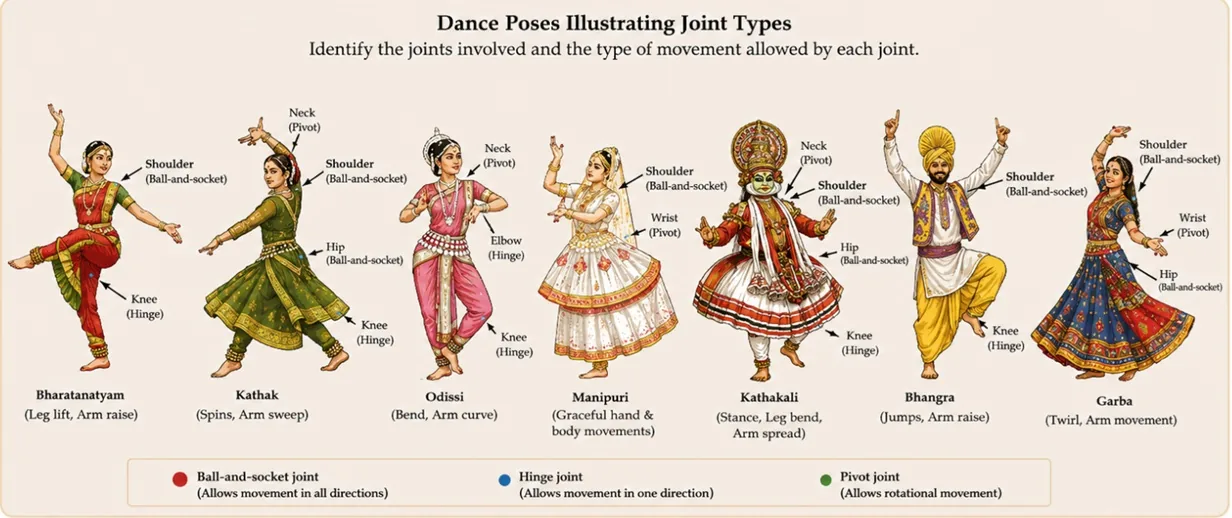
Joints involved in the poses:
| Joint | Type of joint | Movement it allows |
|---|---|---|
| Shoulder (arms stretched or raised) | Ball and socket | Forward, backward, sideways and circular |
| Elbow (bent arms) | Hinge | Bends and straightens in one direction |
| Knee (bent legs) | Hinge | Bends and straightens in one direction |
| Neck (turning of the head) | Pivot | Side to side movement |
Note: the hip joint is also a ball and socket joint, and it allows the legs to move in many directions, as in the wide leg poses.
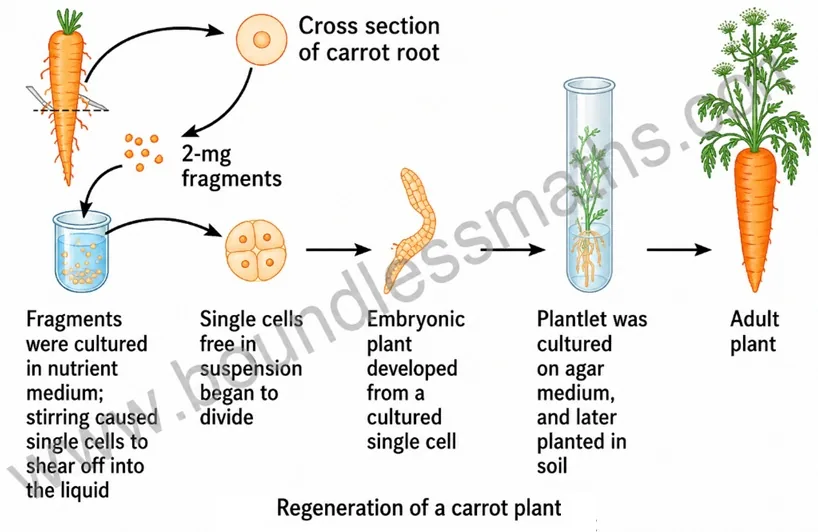
Table 3.6: effect of light, air and nutrient medium on growth of the cultured plant cells
| Light | Air | Nutrient medium | Increase in fresh weight of the cells |
|---|---|---|---|
| ✔ | ✘ | Solid medium + nutrients | reduced |
| ✔ | ✔ | Liquid medium + nutrients | 20% increased |
| ✘ | ✔ | Liquid medium + nutrients | reduced |
Conclusion:
1. Even single, mature phloem cells can divide and grow into a complete plant. They are totipotent.
2. First they dedifferentiate (regain the ability to divide) to form an undifferentiated mass of cells.
3. These then divide and redifferentiate to form roots, shoots and the complete plant.
4. This is similar to a zygote dividing and differentiating into an entire organism.
5. Their growth depends on the conditions: light, air and the nutrient medium (Table 3.6).
Highest biomass: the second combination (light and air present, liquid medium + nutrients). The fresh weight increased by 20%.
Lowest biomass: the first combination (light, but no air, solid medium) is likely the lowest. The third combination (no light) also shows a reduction. The table does not show which of the two is lower.
Possible reasons:
1. Air is needed. The cells need oxygen for respiration to get energy for division. Without air (combination 1) the growth is reduced.
2. Light is needed. Without light (combination 3) the growth is reduced.
3. A liquid medium is better. The cells float freely in the liquid with nutrients, so each cell gets nutrients, and stirring separates the single cells. In a solid medium, the contact is poor.
So the best growth needs light, air and a liquid nutrient medium together.
No, we will not get the same results.
1. Plant cells like carrot phloem are totipotent and can form a complete plant. Differentiated animal cells generally cannot form a complete animal in this way.
2. Animal cells have no cell wall and need different nutrients and growth conditions. They do not grow like plant cells in a liquid with sugars and plant hormones.
3. Animal cells do not make food by photosynthesis, so light will not help them in the same way.
Note: only some animal cells (such as stem cells) can form other cell types.
Application 1: plant tissue culture for mass production.
1. Thousands of identical plants can be grown quickly from a small piece or single cells.
2. It is used for crop plants and ornamental plants, and it helps in saving rare plants.
Application 2: improved and disease-resistant crops.
1. Plants grown from selected cells are used for crop improvement.
2. It is used in genetic engineering to put useful genes into plants, for valuable phytochemicals, improved crops and disease-resistant varieties.
Step 1: meristematic cells divide continuously and rapidly.
Step 2: thin walls, dense cytoplasm and a large nucleus allow this.
Check the other options:
(i) wrong. Thick walls are in permanent tissues like sclerenchyma.
(ii) wrong. Vacuoles are generally absent in meristematic cells.
(iv) wrong. They are not differentiated. Differentiation makes them permanent tissues.
Step 1: food is made in the leaves.
Step 2: food is carried to all parts of the plant by the phloem (sieve tubes).
Check the other options: xylem carries water and minerals, epidermis protects, and sclerenchyma supports.
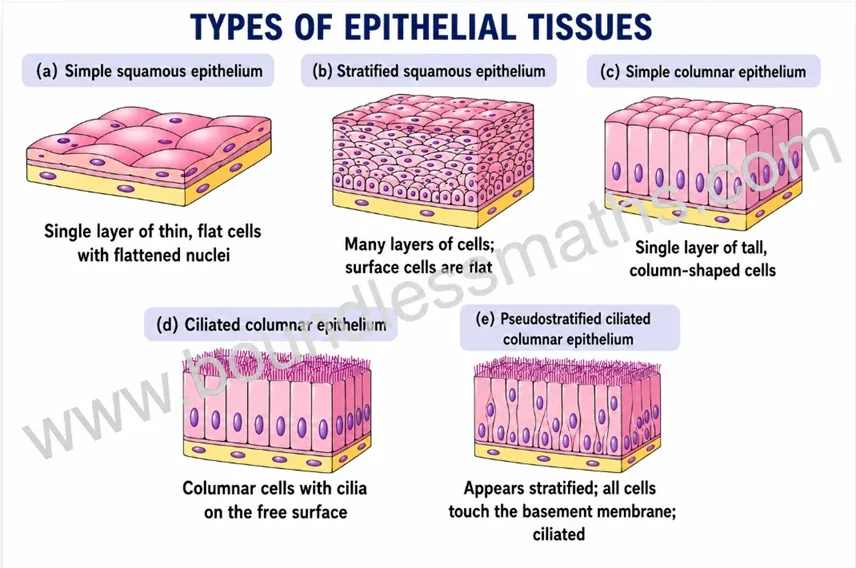
Step 1: the lining of the blood vessels and lungs is a single layer of thin, flat cells (Fig. 3.11a).
Step 2: thin layers are crossed quickly by gases and liquids (rapid diffusion).
Step 3: many layers, as in skin, give protection but slow down the exchange.
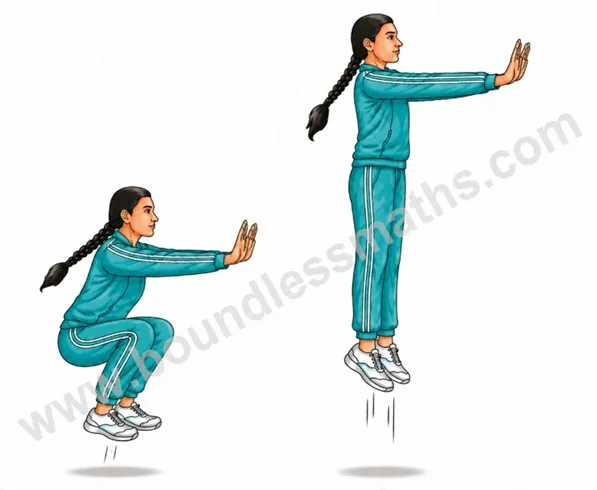
| Joint | Straight-leg jump | Normal jump |
|---|---|---|
| Ankle | Kept stiff, so it hardly bends | Bends on take-off and landing |
| Knee | Kept straight and stiff | Bends (hinge joint) to take the load |
| Hip | Stays nearly straight | Bends slightly as the body goes down and up |
Observation:
1. In the straight-leg jump, the landing is hard and jerky, because the force goes straight to the bones.
2. In the normal jump, the landing is smooth and soft, because the bent joints (with cartilage, ligaments and muscles) absorb the shock.
Step 1: the knee bends and straightens in one direction only, like a door hinge.
Step 2: the ankle also bends up and down in one direction.
Step 3: ball and socket joints (shoulder) move in all directions, and pivot joints (neck) turn side to side.
Assertion: true. Lung epithelium is a single layer of thin, flat cells, so it suits rapid diffusion.
Reason: false. It is not multiple layers of tall cells. Many layers would slow down diffusion.
Assertion: true. Cardiac muscles work tirelessly and rhythmically without fatigue.
Reason: true. Many mitochondria give a lot of energy, and the abundant blood supply gives oxygen and nutrients.
The reason explains the assertion.
Assertion: false. Tendons connect muscle to bone. It is ligaments that connect bone to bone.
Reason: true. Tendons are tough connective tissue that transmit force from muscle to bone.
Assertion: true. The elbow and knee move in one direction only, like a door hinge.
Reason: false. The bone ends are shaped to limit movement to one plane. Sliding in all directions happens in a ball and socket joint.
Table 3.7: data related to the age of a teak tree
| S. No. | Age (years) | DBH (cm) | Annual rings |
|---|---|---|---|
| 1. | 5 | 4 | 5 |
| 2. | 10 | 8 | 10 |
| 3. | 20 | 24 | 20 |
| 4. | 25 | 28 | 25 |
| 5. | 30 | 32 | 30 |
| 6. | 40 | 40 | 40 |
Graph: age on the x-axis, and both the diameter and the number of annual rings on the y-axis.
Step 1: the diameter keeps increasing as the tree grows older, from 4 cm to 40 cm.
Step 2: rate of increase in each period:
1. 5 to 10 years: (8 − 4) ÷ 5 = 0.8 cm per year.
2. 10 to 20 years: (24 − 8) ÷ 10 = 1.6 cm per year.
3. 20 to 30 years: (32 − 24) ÷ 10 = 0.8 cm per year.
4. 30 to 40 years: (40 − 32) ÷ 10 = 0.8 cm per year.
Step 3: the growth is fastest between 10 and 20 years, and slower and steady after that.
1. One annual ring is formed every year, so the number of rings equals the age of the tree in years.
2. As more rings are formed, the diameter increases.
3. Rings can be wide or narrow, depending on the favourable or unfavourable conditions of that year.
1. The lateral meristem is responsible for the girth.
2. It is a ring of actively dividing cells in the stem (along its circumference).
3. It produces new cells inside and outside, so the stem becomes thicker.
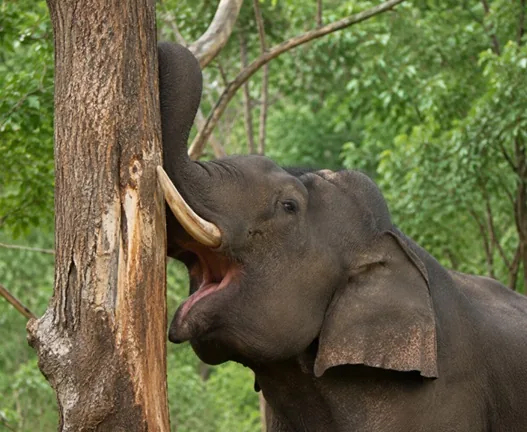
1. Protection: the bark protects the tree from injury, water loss, microbes and extreme conditions.
2. Transport of food: if the phloem is removed with the bark, food cannot reach the roots and other parts.
1. The xylem lies below the bark.
2. The lateral meristem (which gives girth) is also there.
1. Xylem carries water and minerals from the roots to the leaves. This transport would stop.
2. The leaves would wilt and photosynthesis would be reduced.
3. The tree would not be able to grow in girth.
Assumptions:
1. Debarking removed the outer protective cork and the phloem, but not the xylem.
2. The bark was removed all around the trunk.
If the assumptions change:
1. If only the cork was removed, the phloem stays, and food transport continues.
2. If the bark was removed only on one side, the tree can survive, as some phloem remains.
Tissue responsible: collenchyma.
1. It has living cells with unevenly thickened corners due to pectin.
2. Pectin gives flexibility like rubber, so the stem bends without breaking.
If it were replaced by sclerenchyma:
1. Sclerenchyma has thick lignified walls, and most cells are dead. It is hard and strong but not flexible.
2. The stem would be stiff and brittle.
3. In strong monsoon winds the stem would snap instead of bending.
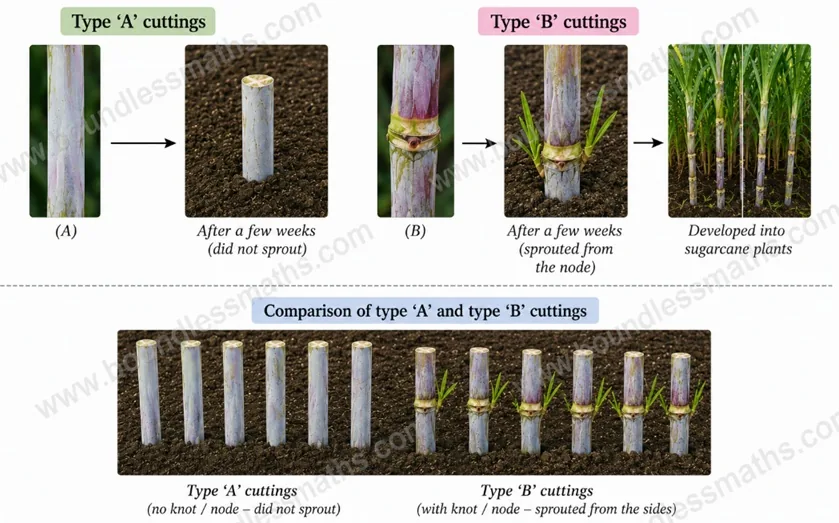
1. The type B cutting has a node. The type A cutting is only an internode piece.
2. The intercalary meristem is located at the base of the internode or just above the node.
3. It has dividing cells that form new shoots and roots, so the cutting with the node sprouts.
Type B has a node (and so the meristem), and type A has no node.
1. Observe whether the cuttings sprouted (shoots and roots) after a few weeks.
2. Measure the length of the new shoot, and count the number of shoots, for both types.
1. Same length and thickness of the cuttings, from the same sugarcane variety.
2. Same soil, same amount of water and sunlight.
3. Same temperature, and same time of observation.
Simple tissues:
1. They are made of only one type of cell.
2. Examples are parenchyma, collenchyma and sclerenchyma.
3. So Rohan’s statement is true for them.
Complex tissues:
1. They are made of more than one type of cells working together.
2. Xylem has tracheids, vessels, xylem parenchyma and xylem fibres.
3. Phloem has sieve tubes, companion cells, phloem parenchyma and phloem fibres.
4. The cells are not all similar, but they work together for one common function (transport).
So Rajiv is right: a tissue is a group of cells that work together to perform a specific function. The cells are similar in simple tissues, and of different types in complex tissues.
Tissue: sclerenchyma.
1. Its cells have thick walls with deposition of lignin, so they are hard and strong.
2. Most cells are dead, and they are long fibres, which makes the husk tough.
Why parenchyma cannot do this:
1. Parenchyma cells are living and have thin walls.
2. They are loosely packed with intercellular spaces.
3. So they are soft and weak. They store food and do not give strength.
The statement is incorrect.
1. Apical meristems are at the root and shoot tips.
2. Lateral meristem is along the circumference of the stem and gives growth in girth.
3. Intercalary meristem is at the base of the internode or just above the node.
Questions Neha can ask:
1. How does the stem of a tree become thicker every year?
2. Why does grass grow again after it is mowed or grazed?
3. Why do new branches arise from the nodes when the tip is cut?
The plant cell has the larger vacuole.
1. A mature plant cell has a large central vacuole that stores water, minerals and wastes.
2. The vacuole holds water and keeps the cell firm.
3. Animal cells have small vacuoles, or none.
1. Both are mature, living and typical cells.
2. The plant cell is not a meristematic cell (these have no vacuoles).
3. The plant cell is in normal conditions with enough water.
Questions to ask:
1. Does each tissue do only one job, or more?
2. What does the epidermis do other than protection?
3. What does the parenchyma do other than storage?
4. Does the xylem only conduct water?
Examples of tissues to take, and what we find:
1. Epidermis: protects, has stomata for gas exchange and transpiration, and root hairs for absorption.
2. Parenchyma: stores food, does photosynthesis in green parts, and makes air spaces for floating.
3. Xylem: transports water and minerals and also gives strength.
Conclusion: the statement is not correct. A plant tissue can perform more than one function.
What happens (sample findings, confirm with your doctor):
1. Ligament rupture: the ligament that joins two bones is torn, so the joint becomes unstable and painful.
2. Cartilage rupture: the cartilage that cushions the bone ends is torn, which causes pain and stiffness in the joint.
3. Fracture: a bone breaks or cracks, so there is pain and the limb cannot be used.
Lifestyle changes to reduce the risk:
1. Regular exercise and yoga for strong muscles and flexible joints.
2. Warm up before sports, and use protective gear.
3. Correct posture, and maintaining a healthy body weight.
Nutrition: a balanced diet with calcium and protein (milk, curd, pulses, green vegetables), and some sunlight.

Observation: a thick, strong band (the tendon) moves under the fingers when the toes are pointed down and up.
Why: the tendon connects the calf muscle to the heel bone. When the muscle contracts, the tendon pulls the bone.
Other tendons to explore (sample):
1. Back of the wrist and fingers: tendons move when you wiggle your fingers.
2. Back of the knee: tendons are felt when you bend the knee.
3. Inside of the elbow: tendon is felt when you bend the arm against a force.
Yoga:
1. The postures stretch the muscles and make the joints flexible.
2. It improves posture and breathing, and reduces stress.
Kabaddi:
1. Running, jumping and tackling make the muscles strong.
2. Regular activity puts a load on the bones, which keeps them strong.
So regular physical practice, with good food, keeps the bones strong, the muscles fit and the joints flexible, and protects the body from stiffness.
1. Pruning: cutting the tips removes the apical meristem, and new branches grow from the nodes, so the plant becomes bushy.
2. Grafting: the conducting tissues (xylem and phloem) of the two plants join, so water and food pass between them.
3. Irrigation: water is absorbed by the roots and moves through the xylem to the leaves. Water also keeps the cells firm.
4. Crop rotation: it keeps the soil rich in minerals, which helps the growth of the meristems and healthy tissues.
| Habitat | Leaf adaptation |
|---|---|
| Desert | Thick waxy cuticle, few stomata or small leaves, to reduce water loss |
| Very moist | Large leaves with pointed tips to drain water |
| Aquatic | Thin cuticle, and air spaces in the parenchyma so that the plant floats |
1. Banana and teak leaves are used as plates, as they are large and water repellent.
2. Neem leaves deter insects, so they are kept with stored grains.
3. Leaves such as banana leaves are used to wrap food, which keeps it fresh.
Note: these are sample examples. Write the uses told by the elders of your own community.
Steps (sample plan):
1. Choose tribal dance forms (for example, Bihu of Assam, Garba, or Karma).
2. Each student learns at least five steps.
3. Note the joints used in each step.
| Step | Joint used | Type of joint |
|---|---|---|
| Raising and swinging arms | Shoulder | Ball and socket |
| Bending arms | Elbow | Hinge |
| Bending knees | Knee | Hinge |
| Turning the head | Neck | Pivot |
4. Develop a dance or drama in which each group shows one type of joint and names it.
5. Perform at the annual function, with a short explanation of the joints.
Tissues are cells organised for a shared purpose — meristematic tissue makes plant growth possible, permanent tissues give plants their structure and transport systems, and in animals the four fundamental tissue types (epithelial, connective, muscular, nervous) work together at every level from cell to organ system, all while plant cells retain a special ability — totipotency — that most animal cells have lost.
Is it possible?
1. In plants, single cells can give a whole plant (totipotency).
2. In animals, it is much harder. Scientists have made clones, for example Dolly the sheep (1996), by putting the nucleus of an adult cell into an egg cell.
Advantages:
1. Saving endangered animals.
2. Making genetically identical animals for research and medicine.
3. Growing tissues and organs to replace damaged ones.
Challenges:
1. The success rate is very low.
2. Clones may have health problems.
3. It is expensive and needs egg cells and surrogate mothers.
4. There are ethical issues, as well as concerns for animal welfare.
Tissues are cells organised for a shared purpose — meristematic tissue makes plant growth possible, permanent tissues give plants their structure and transport systems, and in animals the four fundamental tissue types (epithelial, connective, muscular, nervous) work together at every level from cell to organ system, all while plant cells retain a special ability — totipotency — that most animal cells have lost.
Here are extra practice questions for Class 9 Chapter 3, Tissues in Action. It is a mix of MCQs, Assertion-Reason, Very Short, and Short Answer Questions, and Long Answer Questions — apart from the NCERT questions — to make you confident in your understanding of the chapter. Attempt the questions yourself first, and then cross-check your answers below.
The cells of meristematic tissue divide continuously, so they add new cells and cause growth.
Phloem carries food (made in the leaves) to the other parts. Xylem carries water.
Tendons connect muscles to bones. Ligaments connect bones to bones.
Cardiac muscles are found only in the heart.
The skull is connected to the backbone through a pivot joint, so the head moves side to side.
For each question, the Assertion (A) and Reason (R) are given. State whether each is true or false, and whether the Reason correctly explains the Assertion.
Assertion: true. Meristematic tissues make the plant grow.
Reason: true. Their cells divide continuously.
Continuous division adds new cells, so the reason explains the assertion.
Assertion: true. Cardiac muscles work tirelessly without fatigue.
Reason: true. They work continuously throughout life.
But working continuously is not the cause of not getting tired. The cause is the many mitochondria and the abundant blood supply.
Assertion: true. Xylem transports water and minerals.
Reason: true. Xylem has tracheids and vessels, which are tubular and thick-walled and form the channels for water.
So the reason explains the assertion.
Assertion: true. Ligaments are strong and flexible, and they stretch a little.
Reason: true. Ligaments connect bones to bones.
Connecting bones is the job of ligaments. It is not the reason for being elastic, which comes from the fibres in them.
Assertion: true. Water vapour is lost through the stomata in transpiration.
Reason: true. Stomata are pores in the epidermis that allow gaseous exchange.
Water vapour escapes through these same open pores, so the reason explains the assertion.
A tissue is a group of cells (similar in structure) that work together to perform a specific function.
Meristematic tissue is a tissue made of actively dividing cells.
1. It is at the tips of roots and shoots (apical), along the stem (lateral) and at the nodes (intercalary).
2. Its cells are small, with thin walls, a large nucleus and dense cytoplasm.
Stomata are pores in the epidermis of leaves.
1. They allow gaseous exchange (CO₂ in, O₂ out).
2. They help in transpiration, which creates the transpiration pull in the xylem.
Tendons are strong, flexible bands of connective tissue. They connect muscles to bones, and transmit the force of the muscle to the bone.
Cartilage is a connective tissue with a soft, jelly-like matrix. It is flexible and cushions the ends of bones. It is found in the ear, the nose and between the vertebrae.
| Plant tissues | Animal tissues |
|---|---|
| Have cell walls, so they give rigidity | No cell walls, so cells are flexible |
| Support plants that are fixed in place | Help animals to move |
| Growth only in meristematic tissues | Growth is not limited to special zones |
| Xylem and phloem transport water and food | Blood transports nutrients, gases and hormones |
| Meristematic and permanent tissues | Epithelial, connective, muscular and nervous tissues |
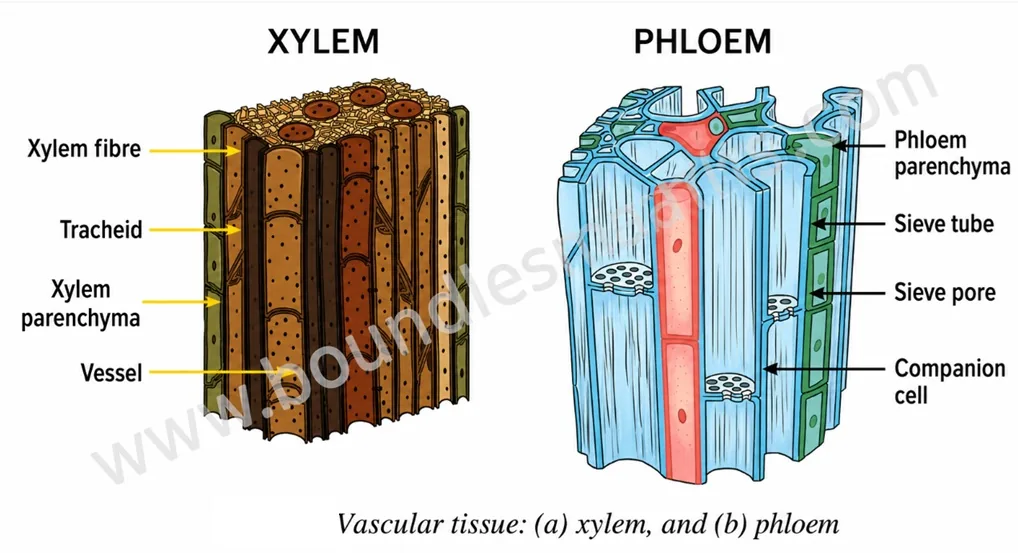
Xylem:
1. It carries water and minerals from the roots to the other parts.
2. It also gives strength to the plant.
3. It has tracheids, vessels, xylem parenchyma and xylem fibres.
Phloem:
1. It carries food from the leaves to the other parts.
2. It has sieve tubes, companion cells, phloem parenchyma and phloem fibres.
3. Companion cells monitor the loading and unloading of sugars in the sieve tubes.
| Tendons | Ligaments |
|---|---|
| Connect muscle to bone | Connect bone to bone |
| Transmit the force of the muscle to the bone and bring about movement | Give stability, limit movement and prevent dislocation |
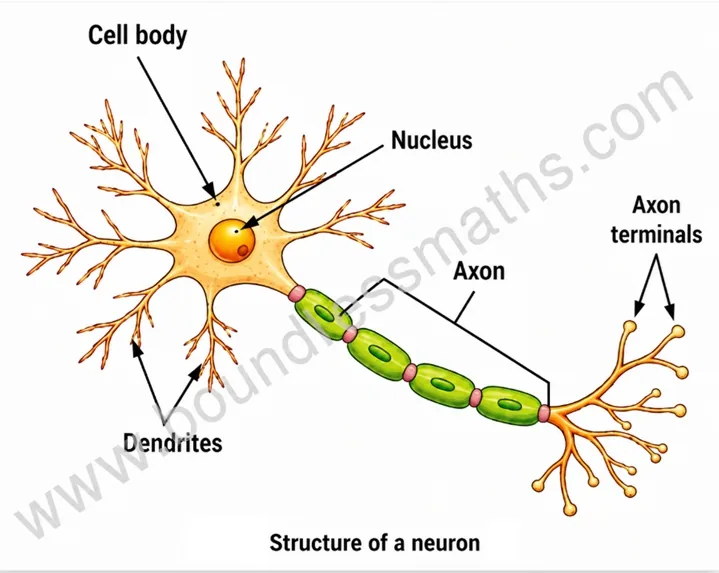
Neuron (nerve cell) is the cell of nervous tissue.
Structure:
1. Cell body: it has the nucleus and controls the cell activities.
2. Dendrites: they receive signals from other neurons.
3. Axon: a long fibre that carries messages from the cell and ends at the axon terminals.
Function: it receives, processes and transmits messages. The axon terminals pass the message to other cells.
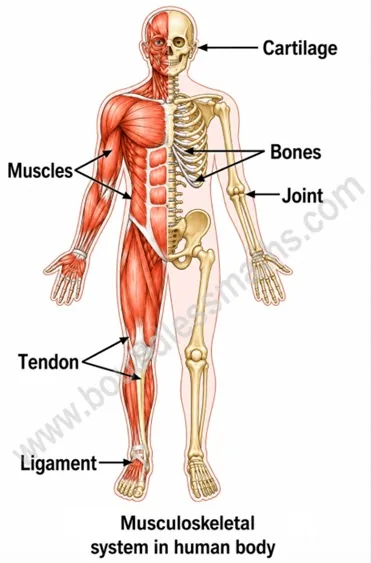
Functions of the skeletal system:
1. It is the framework of bones that gives strength and support to the body.
2. It helps us stand upright, and keeps the posture.
3. It protects delicate organs: the skull protects the brain, and the rib cage protects the heart and lungs.
4. The backbone protects the spinal cord, and its cartilage discs give flexibility.
5. Bones and joints, with the muscles, help in movement.
6. The rib cage moves during breathing.
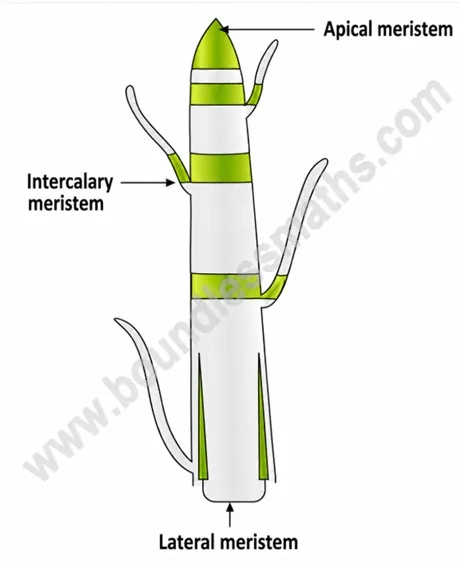
Meristematic tissues have actively dividing cells. Their cells are small, thin-walled, with a large nucleus, dense cytoplasm and no vacuoles.
Types:
| Type | Location | Function |
|---|---|---|
| Apical meristem | Tips of roots and shoots | Growth in length |
| Lateral meristem | Along the circumference of the stem | Growth in girth |
| Intercalary meristem | Base of the internode or just above the node | Regrowth after cutting or grazing (as in grasses) |
Differentiation: some new cells lose the ability to divide and become permanent tissues.
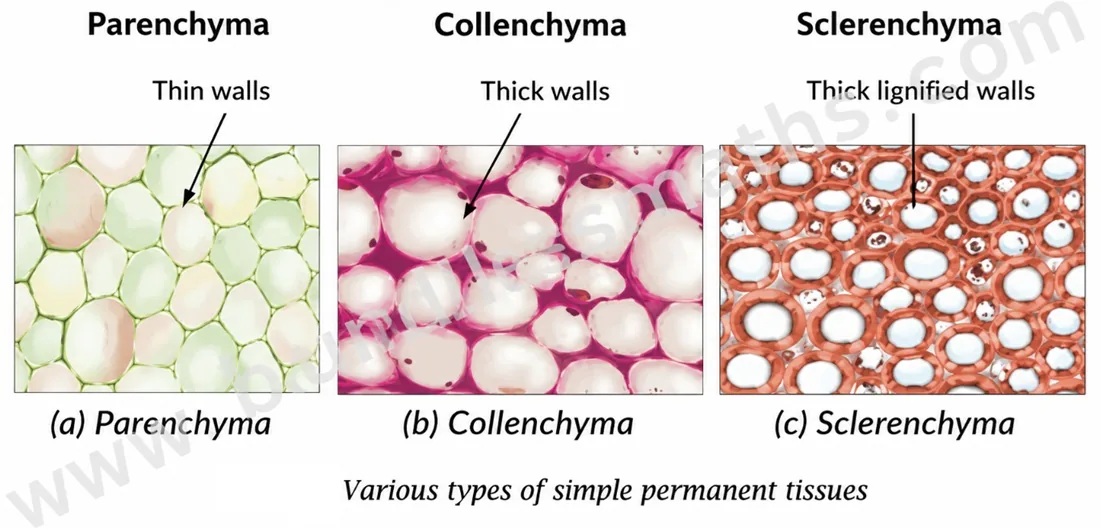
Simple permanent tissues are made of only one type of cell. They are the supporting tissues.
| Tissue | Structure | Function | Example |
|---|---|---|---|
| Parenchyma | Living, thin walls, loosely packed with spaces | Stores food, photosynthesis in green parts, floating in aquatic plants | Cortex of stem, leaf |
| Collenchyma | Living, unevenly thickened corners (pectin) | Support with flexibility | Stems and tendrils, coriander stalk |
| Sclerenchyma | Thick lignified walls, mostly dead | Hardness and strength | Coconut husk, walnut shell |
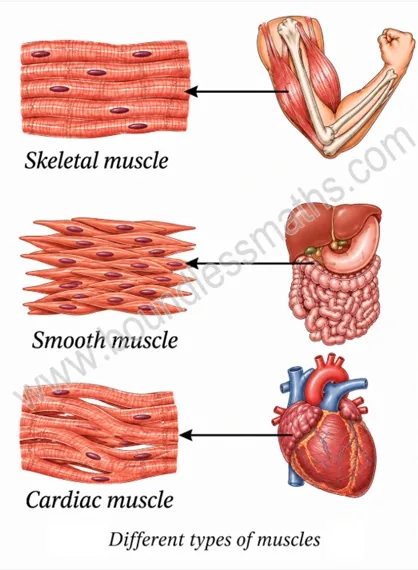
| Muscle | Structure | Control | Where found |
|---|---|---|---|
| Skeletal | Long, cylindrical, unbranched, many nuclei, striated | Voluntary | Attached to the skeleton |
| Smooth | Spindle-shaped, single nucleus, no striations | Involuntary | Stomach and intestines (slow movement, digestion) |
| Cardiac | Cylindrical and branched, single nucleus, faint striations | Involuntary | Heart only (beats throughout life without fatigue) |
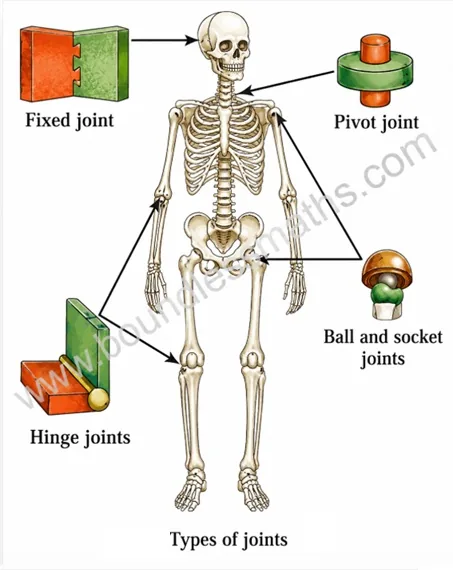
| Joint | Movement | Example |
|---|---|---|
| Ball and socket | Forward, backward, sideways and circular | Shoulder |
| Hinge | In one direction only, like a door hinge | Elbow and knee |
| Pivot | Side to side, like a doorknob turning | Between the skull and the backbone (neck) |
| Fixed | No movement | Bones of the skull |
Connective tissue connects and supports other tissues. The matrix decides its nature.
| Tissue | Matrix | Importance |
|---|---|---|
| Blood | Watery and fluid (plasma), with RBCs, WBCs and platelets | Carries nutrients, gases and hormones, fights infection and clots |
| Bone | Hard, with calcium and phosphorus compounds | Strength, support and protection |
| Cartilage | Soft, jelly-like | Flexibility and cushioning of the bone ends |
| Tendon | Strong flexible bands | Connects muscle to bone |
| Ligament | Strong bands | Connects bone to bone, limits the movement |
From the graph: before mowing the height is 10 cm, and after mowing it is 3 cm.
From day 4 to day 8 the height rises from 3 cm to 7 cm.
1. The intercalary meristem is responsible.
2. It is at the base of the leaves and nodes of grasses, so it is not removed by mowing.
1. In the tree stem, the apical meristem is at the tip. When the tip is cut, the apical meristem is removed.
2. So the stem stops growing in length. New branches arise from the nodes.
3. In grass, the growing region is at the base, so only the top of the leaf is cut.
1. Cartilage discs act as a cushion and give flexibility, so we can bend and twist.
2. Bone is rigid, so the backbone would become stiff, and bending and twisting would be difficult.
1. Bone cannot absorb shocks, so every jump or jerk would be passed to the vertebrae.
2. The spinal cord inside the backbone could get injured.
No, I do not agree.
1. The backbone needs both strength and flexibility. Bones give strength, and cartilage gives flexibility and cushioning.
2. Strength alone is not enough, so the structure must suit the function.
Given: diameter at 10 years = 8 cm, diameter at 30 years = 32 cm
Given: diameter d = 40 cm
Circumference = π × d
Given: diameter at 20 years = 24 cm, at 40 years = 40 cm
Next up is Chapter 4 — Describing Motion Around Us. Or explore the full chapter list, browse the Class 9 Science hub, or revise with the Class 9 Science Notes, or test yourself with the free Class 9 Science Sample Paper and Marking Scheme.
Expert CBSE Coaching · Class 9–12