
Where Mindful Learning Begins
Where Mindful Learning Begins
Class 8 Science Curiosity NCERT Solutions Chapter 2 — every Probe and Ponder prompt, all 9 Activities, all 9 "Keep the Curiosity Alive" exercise questions, and all 4 "Discover, Design, and Debate" project prompts, solved and explained on one page.
This chapter moves from the invention of the microscope to the discovery of cells, then out into the invisible world of microorganisms — protozoa, algae, fungi, and bacteria — and how they quietly power composting, fermentation, and nitrogen fixation all around us.
Chapter 2 opens with the invention of the lens and microscope, then uses that tool to answer a simple question: what are living things actually made of? Through the onion peel and cheek cell activities, it establishes that all organisms are built from cells, and that cells differ in shape depending on their function. It then zooms further in, to microorganisms too small to see with the naked eye — protozoa, algae, fungi, and bacteria — and shows how they quietly decompose waste, fix nitrogen for legumes, and ferment dough, curd, and batter. Every Activity and exercise is solved here exactly as the textbook presents it.
How the invention of the microscope, by Robert Hooke and Antonie van Leeuwenhoek, revealed the basic unit of life.
Protozoa, algae, fungi, and bacteria — found in pond water, soil, and even inside our own bodies.
Fermentation in bread and curd, decomposition into manure, and nitrogen fixation in legume roots.
Basic parts of a cell
| Part | Found in | Function |
|---|---|---|
| Cell membrane | All cells — plant, animal, bacterial | Outer boundary; controls entry and exit of materials |
| Cytoplasm | All cells | Jelly-like material where most life processes occur |
| Nucleus | Plant and animal cells | Regulates all cell activities and growth |
| Nucleoid | Bacterial cells only (no true nucleus) | Region holding the bacterium's genetic material |
| Cell wall | Plant, fungal and bacterial cells (not animal) | Gives rigidity and structural strength |
| Chloroplast & vacuole | Plant cells | Photosynthesis; storage, waste removal and shape support |
Levels of organisation in a living body
Cell → Tissue → Organ → Organ system → Organism
The four main groups of microorganisms
| Group | Cell type | Example / role |
|---|---|---|
| Protozoa | Unicellular | Amoeba, Paramecium — found in pond water |
| Algae | Unicellular or multicellular | Green, photosynthetic; e.g. Spirulina, Chlorella |
| Fungi | Unicellular (yeast) or multicellular (mould) | Yeast ferments dough; moulds decompose waste |
| Bacteria | Unicellular | Lactobacillus ferments curd; Rhizobium fixes nitrogen |
Viruses are microscopic but acellular (not made of cells) and can only multiply inside a living host cell.
Sample answer: if the invisible world around me suddenly became visible, I would see a drop of pond water crowded with moving, irregularly shaped creatures like Amoeba, spiral and rod-shaped bacteria, and tiny green algae — none of which look like the plants and animals I usually think of as "living."
This would change how I think about size and complexity, because it would show that something doesn't need to be big, or even visible, to be alive — a single microscopic cell can still feed, respire, grow, and reproduce on its own. It would also show that living things interact with each other in ways I can't normally see: bacteria living inside the root nodules of bean plants, yeast fermenting bread dough, and bacteria in my own gut helping digestion are all examples of tiny organisms working together with, or inside, much larger ones.
This is an open reflection prompt — there is no single correct answer. Examiners generally look for a genuine, specific observation (not a vague "I would see a lot of germs") connected to at least one idea about size, complexity, or interaction between organisms.
Observation: the letters on the page appear noticeably larger when viewed through the water-filled flask, because the curved glass-and-water surface bends light rays the same way a convex lens does — it acts like a simple magnifying glass.
With a real magnifying glass on an ant: details of the ant's body that are invisible to the naked eye — its segmented body, jointed legs, and antennae — become clearly visible, since the lens magnifies the image formed on the eye.
A lens is simply a piece of transparent material — glass or water — that is thicker in the middle and thinner at the edges, like a lentil seed (which is where the word "lens" comes from). This curved shape bends light rays to form a magnified image. Stronger, more refined lenses eventually led to the compound microscope, letting Robert Hooke and Antonie van Leeuwenhoek discover cells and microorganisms in the 1660s.
Observation: the onion peel shows nearly rectangular, closely packed structures with no gaps between them — these are the cells of the onion peel. Each cell shows a cell wall, a cell membrane just inside it, a central nucleus, and cytoplasm filling the rest of the cell.
Similarity with a brick wall: just as a brick wall is built from individual bricks stacked tightly together with no space between them, the onion peel is built from individual cells packed just as tightly. This is a useful way to picture why the cell is called the "basic unit" of a living structure — a wall is only as strong as how its bricks are arranged, and a tissue is only as functional as how its cells are arranged.
What is an animal's body made of? The same building principle applies — animal bodies are also made up of cells, though (as the next activity shows) animal cells lack a cell wall and look quite different from plant cells.
Observation: the cheek cells appear as polygon-shaped structures — irregular, loosely arranged, and without the neat rectangular packing seen in onion peel cells.
Similarities with onion peel cells: both show a cell membrane, cytoplasm, and a nucleus.
Differences from onion peel cells: cheek cells have no cell wall (so they aren't rigidly rectangular), are irregular in shape, and are loosely packed rather than tightly arranged — reflecting the difference between animal cells (no cell wall) and plant cells (rigid cell wall).
Function of the three main parts: the cell membrane encloses the cytoplasm and nucleus, separates one cell from another, and is porous — allowing essential materials in and waste materials out. The cytoplasm contains carbohydrates, proteins, fats and mineral salts, and is where most life processes take place. The nucleus regulates all activities within the cell, including its growth.
Cells with a cell wall (like onion peel) look firm and compactly arranged; cells without one (like cheek cells) look loosely packed and irregularly shaped — the cell wall is what gives plant tissue its rigidity.
Observation: tiny, moving organisms are visible in the drop of water — irregularly shaped, single-celled creatures like Amoeba, elongated single-celled organisms like Paramecium that move using specialised structures, and green, single-celled algae that move similarly and appear green due to their pigment.
This shows that even a seemingly clear or still body of water is full of microscopic life invisible to the naked eye.
Observation: small, moving organisms similar to those seen in Activity 2.4 (pond water) are visible in the soil suspension as well.
What this shows: even ordinary garden or field soil — not just standing water — contains a variety of microorganisms invisible to the unaided eye, confirming that microbes are present essentially everywhere in the environment, not just in water bodies.
Table 2.1 — Organisms in pond water:
| Organism | Group | Remarks |
|---|---|---|
| Amoeba | Protozoa | Single cell, moving, irregular shape |
| Paramecium | Protozoa | Single cell, moves using specialised structures |
| Algae | Algae | Single cell, green due to pigment, moves using specialised structures |
Table 2.2 — Organisms in soil suspension:
| Organism | Group | Remarks |
|---|---|---|
| Bread mould | Fungi | Branched filament without chlorophyll, sac-like structure |
| Mould | Fungi | Branched filament without chlorophyll, brush-like structure |
| Algae | Algae | Spherical, green due to chlorophyll |
| Bacteria | Bacteria | Spherical, comma, spiral or rod-shaped; hair-like projections |
Conclusion: together, both tables show that microorganisms fall into four broad categories — protozoa, algae, fungi, and bacteria — and can be found in both water and soil environments.
Observation: the peels of fruits and vegetables turn into a dark-coloured material — this is manure, rich in nutrients that improve soil fertility.
Why this happens: soil naturally contains microorganisms such as fungi and bacteria (as identified in Activity 2.6). These microbes act on the plant waste, gradually breaking it down into simpler, nutrient-rich manure. This is exactly why gardeners collect dry leaves and plant waste in pits — to let microorganisms convert it into natural manure over time. Manure formation needs optimal temperature and appropriate moisture to proceed efficiently.
Microorganisms don't just make manure from garden waste — they also decompose fallen leaves, decaying plants, and the bodies of dead animals, returning nutrients to the soil. This nutrient recycling is one of the most important roles microbes play in nature.
Observation: the dough in bowl A (with yeast) rises slightly, becomes fluffy, and develops a distinct smell compared to the dough in bowl B (without yeast), which shows no such change.
Why this happens: yeast is a unicellular fungus. Like other living organisms, it respires — breaking down the sugar in the dough to release energy for its own growth and life processes. During this respiration, carbon dioxide gas is released, which forms bubbles that make the dough soft and fluffy. Yeast also produces a small amount of alcohol in the process, giving the dough its characteristic smell.
Why sugar and warm water were added: sugar provides the food yeast needs to respire and multiply, while warm water creates the ideal temperature for yeast activity — yeast grows poorly in cold conditions.
This same fermenting principle, using different microorganisms, is used elsewhere in the kitchen — bacteria such as Lactobacillus ferment batter for idli and dosa, and dough for bhatura.
| Bowl A (warm milk) | Bowl B (cold milk) | |
|---|---|---|
| Change in appearance | Milk thickens and sets into curd | Milk does not curdle; remains liquid |
| Change in taste/colour | Turns slightly sour | May turn a little sour, but does not set |
Possible reason: curd already contains bacteria, including Lactobacillus. This bacterium feeds on the sugar naturally present in milk (lactose), multiplies rapidly, and ferments the milk into curd. Instead of producing alcohol like yeast, it produces lactic acid, which is what makes curd taste sour.
Why the difference between bowl A and bowl B: Lactobacillus grows well in warm conditions but is far slower to multiply in the cold. That's why milk sets into curd in the warm bowl (A) within a few hours, but does not properly curdle in the refrigerated bowl (B) over the same period.
Chapter 2 is dotted with "Ever heard of...", "A step further", "Our scientific heritage", and "Be a scientist" boxes. They're not graded, but they add useful context — here's what each one covers.
In 1665, Robert Hooke published Micrographia, showing detailed drawings made using a microscope that magnified objects 200–300 times. Looking at a thin slice of cork, he saw tiny empty compartments resembling a honeycomb and called each one a "cell" — the first scientific use of the word.
Around the same time in the 1660s, this Dutch scientist built more powerful microscopes using better lenses, becoming the first person to clearly see and describe bacteria and blood cells. He is remembered as the Father of Microbiology.
The yolk of an ostrich egg is a single cell — the largest known cell in the living world, measuring roughly 130–170 mm across. The rest of the egg (shell and white) is extra, non-cellular material that protects and nourishes that one cell.
Viruses are microscopic but acellular — they aren't made of cells at all. They can only multiply after entering a living cell, and may infect plants, animals, or even bacteria, sometimes causing disease.
Certain bacteria decompose plant and animal waste in oxygen-free conditions, releasing a gas mixture rich in methane alongside carbon dioxide. This biogas is used as fuel for cooking, heating, generating electricity, and even running vehicles.
In 1971, this scientist developed a special bacterium capable of breaking down oil spills to help clean up the environment — a discovery that received a patent in 1980, showing how microorganisms can be engineered to solve pollution problems.
Ancient Indian texts, particularly the Vedas (including the Atharvaveda), refer to the word "Krimi" for tiny entities — both "Drishya" (visible) and "Adrishya" (invisible) — describing their beneficial and harmful effects long before the microscope existed.
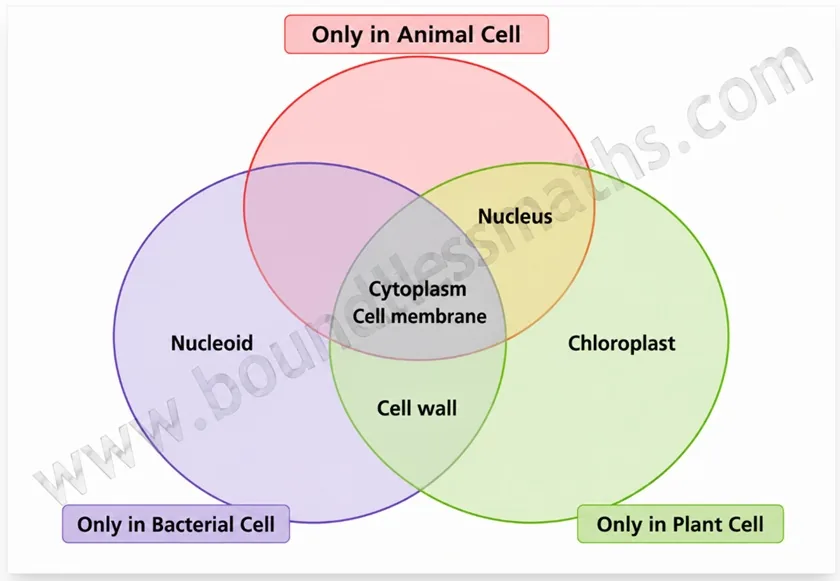
| Region of the Venn diagram | Cell part(s) | Reason |
|---|---|---|
| Common to all three cells | Cell membrane, Cytoplasm | Every cell — animal, bacterial, or plant — has an outer membrane and cytoplasm |
| Only in Plant Cell | Chloroplast | Only plant cells carry out photosynthesis |
| Only in Bacterial Cell | Nucleoid | Bacteria lack a well-defined nucleus and have a nucleoid region instead |
| Shared by Animal and Plant cells only | Nucleus | Bacteria don't have a true, membrane-bound nucleus |
| Shared by Bacterial and Plant cells only | Cell wall | Bacteria and plants both have a rigid cell wall; animal cells don't |
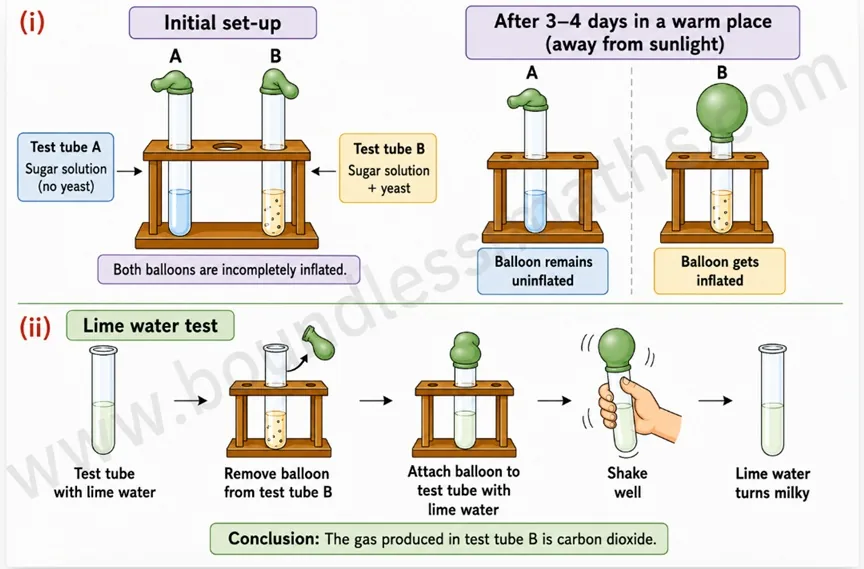
(i) The balloon on test tube B inflates because yeast respires by breaking down the sugar in the solution, releasing carbon dioxide gas as a by-product. Since the balloon is sealed onto the test tube, this gas has nowhere to escape except into the balloon, inflating it. Test tube A has no yeast, so no fermentation occurs and its balloon stays uninflated.
(ii) Aanandi tests the gas with lime water to confirm its identity — specifically, to check whether it is carbon dioxide. Carbon dioxide is known to turn clear lime water milky/cloudy on contact, so the lime water turning milky confirms that the gas produced by yeast fermentation is indeed CO₂.
Answer: beans are legumes, and legume roots form nodules that house Rhizobium bacteria. These bacteria trap nitrogen directly from the air and convert it into a form the plant can use, naturally enriching the soil around the bean crop's roots.
Because the bean plant effectively fertilises its own soil through this bacterial partnership, the farmer doesn't need to add extra nitrogen fertiliser. Wheat, on the other hand, is not a legume and has no such nitrogen-fixing root nodules, so it depends on nitrogen being supplied externally through fertiliser to grow well.
Answer: Snehal is testing whether mixing dried leaves with fruit and vegetable peels affects how efficiently (or how quickly) the waste decomposes into manure.
Dried leaves add carbon-rich, fibrous material to the mix, alongside the moisture- and nitrogen-rich peels. Comparing pit A (peels + dried leaves) against pit B (peels alone) after the same 3-week period lets her observe whether the combination decomposes more completely or faster than the peels decomposing on their own — essentially testing what conditions help microorganisms break down waste most effectively.
(i) Bacteria — found virtually everywhere, including water, soil, air, and inside the human gut, where certain bacteria assist with digestion.
(ii) Yeast — a unicellular fungus that releases carbon dioxide during respiration, making dough soft and fluffy.
(iii) Rhizobium (a bacterium) — lives in the root nodules of legumes (pulse crops) such as peas, beans, and lentils, and fixes nitrogen from the air to nourish the plant.
Suggested experiment (using bread slices, changing one variable at a time):
Key principle: in each trial, only one condition should be changed at a time while keeping everything else the same, so that any difference in microbial growth can be linked clearly to that one factor.
Observation: the slice left near the sink is likely to show visible mould growth (a powdery or cottony patch), while the refrigerated slice stays comparatively fresh, with little or no visible growth.
Reason: the area near a sink tends to be warm and humid — favourable conditions for fungal spores (which are present in the air) to germinate and grow on the moist bread. Refrigeration slows down the metabolism and growth rate of microorganisms significantly, since most microbes multiply far more slowly, or not at all, at low temperatures. This is exactly why refrigeration is used to preserve food.
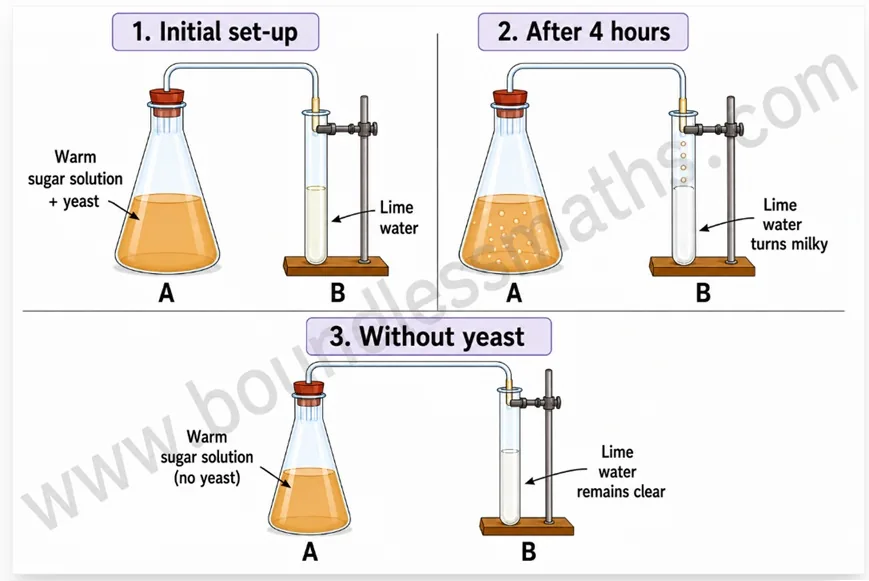
(i) In flask A: the yeast respires, feeding on the sugar in the warm solution and releasing carbon dioxide gas as a by-product of fermentation — this typically appears as bubbling in the flask.
(ii) In test tube B, after four hours: the lime water turns milky/cloudy. This happens because the carbon dioxide gas produced by the yeast's fermentation in flask A travels through the connecting tube into test tube B, where it reacts with the lime water (calcium hydroxide solution) to form a chalky, insoluble precipitate of calcium carbonate — the classic test used to confirm the presence of CO₂.
(iii) Without yeast in flask A: there would be no fermentation, so no carbon dioxide would be produced. As a result, the lime water in test tube B would remain clear and unchanged, since no gas would travel through the connecting tube to react with it.
These four prompts are open-ended research and interview projects rather than fixed-answer questions. Here's guidance on how to approach each one.
Guidance: look up the government's biogas initiatives — commonly run under schemes for national biogas and organic manure management — which promote small biogas plants in rural households, typically using cattle dung and other organic waste as feedstock. Note how these plants use bacteria to decompose waste in oxygen-free conditions, producing methane-rich gas used for cooking and lighting, while also yielding nutrient-rich manure as a by-product. Good sources include the Ministry's official website, library references, and discussions with family members familiar with rural or agricultural life.
Guidance: with help from parents and teachers, identify a few fermented foods common in your region — for example, idli or dosa batter, dhokla, dahi (curd), pickles, or regional specialities like fermented rice preparations. For each one, research: (a) the ingredients used, (b) the step-by-step method of preparation, (c) which microorganism (usually a bacterium or yeast) drives the fermentation, and (d) why the food matters culturally or nutritionally in your community — many fermented foods are valued both for their taste and for being easier to digest or more nutrient-rich than their unfermented ingredients.
Guidance: a mushroom is the visible, above-ground reproductive structure of a macro fungus. Using a magnifying glass first, examine the cap (the umbrella-shaped top), the gills or pores underneath the cap (where spores are produced), and the stalk (or stipe) that supports it. With a microscope or foldscope, thin sections of these parts can reveal filament-like structures called hyphae, similar in principle to the branched filaments seen in bread mould in this chapter. Take help from senior students or a teacher to prepare thin slides safely for viewing under magnification.
Guidance: if possible, arrange a conversation (in person or online) with someone involved in commercial or small-scale mushroom farming. Useful questions to ask include: what growing medium (substrate) is used, how temperature and humidity are controlled, how long it takes from spawning to harvest, what precautions prevent contamination by unwanted fungi or bacteria, and how the mushrooms are sold or distributed once harvested. This connects the biology learned in this chapter to a real livelihood application of fungal cultivation.
Now that cells and microorganisms are covered, move on to how the body fights infection and stays healthy, revisit Chapter 1, or book a free demo class for personalised coaching.
Expert CBSE Coaching · Class 9–12