
Applied Maths for
CBSE Commerce — Class 11 & 12
Free Resources · Expert Coaching · Gurugram & Online India
Your complete guide to CBSE Applied Mathematics for Class 11 and Class 12 — the right subject-selection decision, free syllabus resources, unit-wise practice questions, school exam papers, and specialist coaching across Gurugram and India.
Helped
Score
Reviews
Experience
What is CBSE Applied Mathematics — and Who is it Really For?
CBSE Applied Mathematics is a two-year subject for Class 11 and 12, introduced in 2020-21 specifically for Commerce and Humanities students. Unlike Core Mathematics — which is built for PCM/Science students preparing for JEE — Applied Maths covers Financial Mathematics, Business Statistics, Quantitative Aptitude, Logical Reasoning, and real-world Calculus applications. Topics that matter for a commerce student's education and career, right now and in the future.
A typical CBSE Commerce student's subject basket — and where Applied Maths fits in:
Why CBSE introduced Applied Mathematics: Before 2020-21, commerce students who wanted Maths were forced into Core Maths — a syllabus built for Science/JEE aspirants with no overlap with commerce subjects. Applied Mathematics was introduced to fix this: a subject purpose-built for commerce, with topics that reinforce Accountancy, Economics, and BST rather than ignore them.
The Subject Decision Every Commerce Student Faces After Class 10
Both are called "Maths." Both appear in the CBSE subject list. But they are designed for completely different types of students — and choosing the wrong one for Class 11 means a year of content with no connection to your other subjects, your stream, or your career path.
The clearest analogy: Would you pair Accountancy with Physics? Of course not — Physics is built for Science students, not Commerce. Core Maths sits in exactly the same category: full of trigonometry, 3D vectors, and abstract proofs designed for JEE aspirants — with zero overlap with commerce. CBSE introduced Applied Maths in 2020-21 precisely to fix this mismatch.
✅ Choose Applied Maths if you are a…
- Commerce student with Accountancy, Economics or BST
- Student planning BCom, BBA, Economics Honours or Business Analytics
- CA or CS aspirant — Applied Maths directly mirrors CA Foundation Paper 3
- Student who wants Maths that reinforces your other commerce subjects
- Student who prefers real-world financial & data problems over abstract proofs
- Student preparing for CUET, IPMAT, or management entrance exams
- Anyone who wants a head start in quantitative subjects at graduation
› Core Maths is right if you are a…
- PCM/Science student targeting engineering (JEE, BITSAT, etc.)
- Student actively considering a switch to Science or Technology
- Student aiming for B.Sc. Maths, Physics, or pure science programmes
- Student with a genuine interest in abstract mathematics as a discipline
For commerce students, this list almost never applies. Applied Maths is the correct choice for the commerce stream.
Topic-by-Topic Syllabus Comparison
| Topic / Area | Applied Maths | Core Maths | For Commerce? |
|---|---|---|---|
| Annuity & Sinking Funds | ✓ Included | ✗ Not covered | Highly Relevant |
| Income Tax Calculations | ✓ Included | ✗ Not covered | Highly Relevant |
| EMI & Loan Mathematics | ✓ Included | ✗ Not covered | Highly Relevant |
| Depreciation, Bonds & CAGR | ✓ Included | ✗ Not covered | Highly Relevant |
| Advanced Statistics & Probability | ✓ Deep coverage | Basic only | Supports Economics |
| Index Numbers & Time Series | ✓ Included | ✗ Not covered | Supports Economics |
| Logical Reasoning & Quantitative Aptitude | ✓ Included | ✗ Not covered | Entrance Exam Prep |
| Number Systems | ✓ Included | ✗ Not covered | Entrance Exam Prep |
| Excel & Practical Tools | ✓ Mandatory | ✗ Not included | Real-World Skill |
| Linear Programming | ✓ Application-focused | ✓ Included | Both include |
| Trigonometry | ✗ Not in syllabus | ✓ Extensive | Not Relevant |
| 3D Vector Algebra | ✗ Not in syllabus | ✓ Included | Not Relevant |
| Binomial Theorem & Abstract Proofs | ✗ Not in syllabus | ✓ Included | Not Relevant |
The pattern is unmistakable. Applied Maths is built around topics commerce students use in their other subjects right now — and in their careers later. Core Maths contains topic after topic with zero connection to the commerce stream.
Applied Maths Doesn't Just Sit Alongside Commerce — It Strengthens It
Most students don't realise this until they're already in the classroom. Applied Maths isn't a parallel subject you manage separately. It actively reinforces every other subject you're already studying — and every topic in Applied Maths connects directly to at least one commerce subject, career path, or entrance exam.
Economics
Karl Pearson correlation, regression analysis, index numbers, time series, and advanced probability — all taught in Applied Maths and used directly in your Economics class. Learn it once; it carries across both subjects all year.
Accountancy
Compound interest, depreciation, EMI calculation, net present value, and income tax computations are in Applied Maths with full mathematical rigour — making the same numerical topics in your Accounts class significantly easier to understand and solve.
Business Studies
Quantitative reasoning, data interpretation, and logical analysis translate directly into business decision-making and case study work — core BST skills for both CBSE boards and professional roles in business and management.
CA & CS Foundation
CA Foundation Paper 3 (Business Maths, Logical Reasoning, Statistics) maps almost directly to the Applied Maths syllabus. Students who studied Applied Maths Class 11 and 12 walk into CA Foundation with a significant head start on the paper most students struggle with.
Excel & Professional Skills
Applied Maths includes mandatory Excel internal assessment — teaching financial and statistical functions genuinely used in banking, finance, analytics, and every other professional role that a commerce graduate enters.
Graduation Advantage
BCom, BBA, and Economics students face compulsory quantitative papers in their first year — Business Statistics, Financial Maths, Operations Research. Applied Maths students already know the material. Everyone else builds these foundations from scratch.
University Acceptance & Career Paths After Applied Maths
The most persistent concern — especially among parents — is whether Applied Maths will be accepted at university. The answer is unambiguous: Applied Maths is accepted on equal footing with Core Maths at all universities for commerce stream admissions.
BCom, BBA, Economics Honours, Business Analytics, Actuarial Science, CA Foundation, CS — fully accepted, no bias, no disadvantage. For quantitative programmes like Economics Honours and Business Analytics, Applied Maths is actually a differentiator in your favour — it demonstrates the right preparation.
CA & CS Foundation
Applied Maths QA, financial maths, and statistics directly mirror CA Foundation Paper 3. The most concrete built-in exam advantage of choosing Applied Mathematics.
Business Analytics
Statistics, probability, and data interpretation — the three pillars of analytics — are deep Applied Maths units. Industry-relevant skills built at the school level.
Banking & Finance
Financial mathematics, time value of money, risk probability, and interest calculations are daily tools in banking, insurance, and fintech roles.
Economics Research
Statistical inference, hypothesis testing, correlation, and index numbers — all Applied Maths topics — are foundational for economics research and policy.
Management & Consulting
Quantitative reasoning, logical analysis, and data-based decision-making are expected in virtually every strategy and management role. Applied Maths builds exactly these skills.
CUET & Competitive Exams
Logical reasoning and quantitative aptitude from Applied Maths are core sections of CUET, IPMAT, CLAT Maths, and most management entrance exams. Built-in preparation.
How Applied Maths Pays Off at Graduation
The full value of this choice often becomes visible when students reach graduation — and those who made the right call at school are already ahead of their peers. BCom, BBA, and Economics students encounter compulsory papers like Business Statistics, Quantitative Methods, Financial Mathematics, and Operations Research in their first year. Applied Maths students walk into these courses having seen most of this content before. Everyone else starts from scratch.
Student who took Applied Maths ✓
- Business Statistics is familiar — distributions, hypothesis testing, and correlation already covered in Class 11 and 12
- Financial Maths topics (EMI, sinking funds, bonds) are reinforcement, not new learning
- Linear Programming and Operations Research covered in Class 11–12
- Builds on a strong foundation — more time for depth and confidence in first year
- Carries the quantitative advantage across every paper in the commerce degree
Student who took Core Maths
- Encounters quantitative methods in graduation without commerce-specific preparation
- Financial concepts like annuities, depreciation, and net present value are entirely new
- Abstract maths background (trigonometry, vectors) doesn't map to applied business problems
- Builds applied foundations from scratch in first year of college
- More catch-up effort, less confidence in early semesters of the degree
4 Common Myths About Applied Maths — Addressed Directly
Misinformation about Applied Mathematics travels fast through school WhatsApp groups, coaching corridors, and well-meaning relatives. Here are the four myths that send commerce students towards the wrong subject every year.
"Universities don't accept Applied Maths"
False. Applied Maths is fully recognised on equal footing with Core Maths for all commerce stream admissions — BCom, BBA, Economics Honours, CA Foundation, CS — at all major Indian universities. No disadvantage for any commerce-track programme. Always verify specific programme requirements, but for commerce students there is no restriction.
"The Applied Maths syllabus is bigger and harder"
False. Both subjects have comparable demands. The difference is relevance — and for commerce students, Applied Maths topics feel purposeful and directly connected to your other subjects. Purposeful content is always easier to learn, remember, and apply than abstract content with no visible payoff.
"There aren't enough teachers or resources for Applied Maths"
False. Applied Maths has been in CBSE since 2020-21. The ecosystem of books, coaching centres, and online resources has grown substantially — including the comprehensive free and premium resources here at Boundless Maths, designed specifically for Applied Maths Class 11 and 12 students.
"Core Maths keeps more career doors open"
False. Applied Maths keeps every commerce door open — BCom, BBA, CA, CS, Economics, Management, Banking, Analytics. The only doors it doesn't open are engineering ones — and those were never the destination for commerce students in the first place.
The Mid-Session Switch Problem
This scenario plays out every year in CBSE schools across India. It is entirely avoidable with one informed decision at the start of Class 11.
For parents: Applied Mathematics is relatively new (introduced 2020-21), which means some school counsellors and well-meaning relatives may not yet be familiar with it. A lack of familiarity is not a reason to avoid it — it is a reason to research it. This page exists for exactly that reason.
Still Deciding? Watch This Before You Choose.
A clear, plain-language breakdown of Applied Maths vs Core Maths — syllabus differences, career connections, and exactly how to make the right decision before Class 11 begins. Share it with your family.
Applied Maths vs Core Maths — Which Is Right for Commerce Students?
Every key difference — topic by topic — with practical guidance for students finishing Class 10 and parents helping them navigate the choice. Watch before the session begins.
Applied Maths Class 11 & 12 — Free CBSE Resources. Start Here.
Boundless Maths is the dedicated resource hub for CBSE Applied Mathematics Class 11 and 12 — free unit-wise practice questions, complete syllabus PDFs, school exam papers, video tutorials, and premium formula decks. Everything a student needs to score 90+, in one place.
Applied Maths Class 11 — Free Resources & Syllabus 2026-27
Build strong foundations for board exam success. Unit-wise free practice questions across all 8 units, complete 2026-27 CBSE syllabus, school exam papers from DPS, Amity & KV, and the premium Formula Deck — everything a Class 11 Applied Maths student needs.
Applied Maths Class 12 — Board Exam Resources
Master the CBSE Applied Mathematics Class 12 board exam. 200+ free practice questions across all 8 units, CBSE sample papers, school pre-board papers, and premium question banks with 1000+ solved questions. Everything you need to target 90+ in boards.
CBSE Applied Mathematics Syllabus — Class 11 & 12 (2026-27)
The official CBSE Applied Mathematics syllabus for 2026-27 spans two years — Class 11 (7 units) and Class 12 (8 units) — each with 80 marks theory and 20 marks internal assessment. The structure below is taken directly from the official CBSE curriculum document (Subject Code 241). Note that the 2026-27 syllabus has important structural changes from earlier years, particularly for Class 11.
Class 11 — Applied Mathematics Syllabus 2026-27
7 units · 240 periods · Theory: 80 marks · Internal Assessment: 20 marks
| Unit | Unit Name | Key Topics (2026-27) | Periods | Marks |
|---|---|---|---|---|
| I | Numbers, Quantification & Numerical Applications | Numbers in Indian Knowledge System & binary numbers; indices, logarithms & antilogarithms; clocks & calendars; time & work; speed, distance & time; seating arrangements (linear & circular) | 30 | 10 |
| II | Algebra | Sets, subsets & power sets; Venn diagrams & set operations; ordered pairs, Cartesian product & relations; mathematical logic (odd man out, syllogism, blood relations, coding-decoding); AP & GM; sequences & series | 50 | 18 ★ |
| III | Calculus | Functions & their graphs (domain, co-domain, range, types); limits & continuity; differentiation (instantaneous rate of change); algebra of derivatives — sum, product, quotient & chain rule | 40 | 12 |
| IV | Combinatorics & Probability | Factorial; fundamental principle of counting; permutations; combinations; difference between permutation & combination; random experiments & sample space; types of events; probability; conditional probability | 30 | 10 |
| V | Descriptive Statistics | Measures of dispersion — range, mean deviation, standard deviation & variance (ungrouped & grouped); percentile rank; Karl Pearson's coefficient of correlation; Spearman's rank correlation; regression coefficients, equations & properties | 30 | 10 |
| VI | Basics of Financial Mathematics | Nominal, effective & real interest rates; simple & compound interest; immediate annuity, annuity due & deferred annuity (future & present value up to 3 periods); income tax & GST (new tax guidelines); utility bills — electricity, water & PNG | 45 | 15 ★ |
| VII | Coordinate Geometry | Slope & various forms of equation of a line; real-world applications (demand & supply curves); circles — standard, central, diameter & general forms; parabola — standard form, focus & directrix | 15 | 5 |
| Theory Total (7 units) + Internal Assessment | 80+20 | |||
★ Highest-weight units in Class 11: Algebra (Unit II, 18 marks) and Financial Mathematics (Unit VI, 15 marks) together account for 41% of theory marks — build these first. Full Class 11 resources and scoring strategy →
Key 2026-27 changes from earlier versions: Class 11 now has 7 units (not 8) — Mathematical Reasoning has been merged into Algebra (Unit II); Combinatorics (Permutations & Combinations) is now combined with Probability in Unit IV; Coordinate Geometry (Unit VII) now includes Circles & Parabola; Unit I marks increased from 9 to 10; Algebra marks increased from 15 to 18; Calculus marks increased from 10 to 12; Probability/Combinatorics is now 10 marks; Descriptive Statistics reduced from 12 to 10 marks.
💻 Class 11 Practicals (Internal Assessment): The 2026-27 syllabus specifies 7 spreadsheet/GeoGebra practicals — visualising functions in GeoGebra; understanding derivatives via tangent lines; personal budgeting tracker; comparative cost-benefit analysis; descriptive statistics using spreadsheet functions (AVERAGE, STDEV.P etc.); interest growth analysis (Simple vs Compound); environmental & economic data modelling (weather, inflation, AQI).
Class 12 — Applied Mathematics Syllabus 2026-27
8 units · Theory: 80 marks · Internal Assessment: 20 marks
| Unit | Unit Name | Key Topics (2026-27) | Marks |
|---|---|---|---|
| I | Numbers, Quantification & Numerical Applications | Modulo arithmetic & congruence modulo (modular addition, subtraction, equivalence class); alligation & mixture (mean price of mixture); boats & streams (upstream/downstream); pipes & cisterns; races & games; numerical inequalities | 11 ★ |
| II | Algebra | Matrices & types (entries, rows, columns, order); equality, transpose, symmetric & skew-symmetric matrices; matrix operations — addition, subtraction, multiplication & scalar multiplication; determinants — singular & non-singular, |AB|=|A||B|; inverse of a matrix (using cofactors, properties); solving simultaneous linear equations — Cramer's rule & inverse method (up to 3 variables) | 10 |
| III | Calculus | Second-order derivatives; parametric & implicit differentiation; rate of change (area, volume); marginal cost & marginal revenue; increasing/decreasing functions; maxima & minima (first & second derivative test) — cost, revenue & profit problems; indefinite integrals (substitution, partial fractions, by parts); definite integrals & area under curve; consumer & producer surplus; differential equations (variable separable method) | 15 ★ |
| IV | Probability Distributions | Discrete & continuous random variables; mathematical expectation; variance & SD of a random variable; binomial distribution — Bernoulli trials, P(r)=nCr pʳqⁿ⁻ʳ, mean=np, variance=npq; Poisson distribution — P(X)=λ𝗽e⁻λ/x!, mean=variance=λ; normal distribution — characteristics, total area=1, standard normal variate Z=(x−μ)/σ | 10 |
| V | Inferential Statistics | Population vs sample; representative & non-representative samples; simple random & systematic random sampling (sample size <100); parameter vs statistic (mean & SD); central limit theorem (conceptual); statistical significance & inferences (conceptual); null & alternate hypothesis (non-directional); one-sample t-test for small groups | 5 |
| VI | Time-Based Data | Time series — meaning & definition; components — secular trend, seasonal variation, cyclical variation, irregular variation; fitting a straight-line trend & estimating values; moving average method; method of least squares | 6 |
| VII | Financial Mathematics | Perpetuity & sinking funds (meaning, real-life examples, sinking fund vs savings account); bond valuation — coupon rate, maturity rate, current price, present value approach; EMI — flat-rate method & reducing-balance method (real-life loan & asset purchase examples); CAGR — meaning, formula, comparison with AGR; linear method of depreciation — cost, residual value, useful life | 15 ★ |
| VIII | Linear Programming | Decision variables, constraints, objective function, non-negative constraints; formulation of LPP (up to 3 non-trivial constraints); manufacturing & diet problems; graphical method for two variables; corner-point method for optimal solution; feasible, infeasible & unbounded regions; optimal feasible solution | 8 |
| Theory Total (8 units) + Internal Assessment | 80+20 | ||
★ Highest-weight units in Class 12: Calculus (Unit III, 15 marks) and Financial Mathematics (Unit VII, 15 marks) together account for 37.5% of theory marks — master these two units first. Full Class 12 resources and board strategy →
Key 2026-27 changes from earlier versions: Unit I (Numbers & Quantification) now carries 11 marks (up significantly from 5) — now includes modulo arithmetic, alligation, boats & streams, pipes & cisterns, races, and numerical inequalities; Unit V (Inferential Statistics) is now 5 marks (reduced from 10) focused on t-test; Unit VI is now Time-Based Data at 6 marks (index numbers have been removed from the 2026-27 syllabus); Unit VIII (Linear Programming) is 8 marks (reduced from 10).
💻 Class 12 Practicals (Internal Assessment): The 2026-27 syllabus specifies practicals using Excel/spreadsheets — graphs of exponential, demand & supply functions; study of maxima/minima; probability & dice roll simulation; matrix multiplication & inverse; stock market data sheet; weather/price/inflation/pollution data analysis; traffic, sports & market trend analysis for future predictions.
📋 Always download and verify the current CBSE syllabus directly before the academic session — unit structures and mark distributions can change year to year. The link below goes to the official CBSE curriculum document (Subject Code 241).
Official CBSE Syllabus PDF ↗Applied Maths Class 12 — Board Exam Resources
Class 12 Applied Mathematics is the board exam year. With the right resources and targeted unit-wise practice, scoring 90+ is achievable for most commerce students. Choose from 200+ free questions, a Formula Deck for daily revision, or the AI-powered Question Bank that adapts to your weak areas in real time.
200+ Free Practice Questions — All 8 Units
MCQs with solutions, short & long answer questions, assertion-reasoning, and case study problems — unit-wise, free, no signup. Aligned to CBSE 2026-27 pattern.
Applied Maths Formula Deck — All 8 Units
Every formula from all 8 units in one compact printable PDF — chapter-wise layout, common mistakes, pro tips. Your revision companion all year. Covers Class 11 & 12 both.
Class 12 Applied Maths AI Question Bank
Adaptive AI practice that adjusts to your level in real time. Instant feedback on every answer, automatic weak-area targeting across all 8 units, timed board exam simulation & unit-wise progress tracking. Works on mobile, tablet & desktop.
🎯 Class 12 board strategy: Financial Mathematics (15 marks) and Calculus (15 marks) together account for 37.5% of theory marks — master these first. Numbers & Quantification (11 marks), Probability Distributions (10 marks), and Algebra (10 marks) are the next priority. Always show complete step-wise working — method marks apply even for partially correct answers. Use the AI Q-Bank in the final weeks for adaptive targeted practice that finds and fixes your specific gaps.
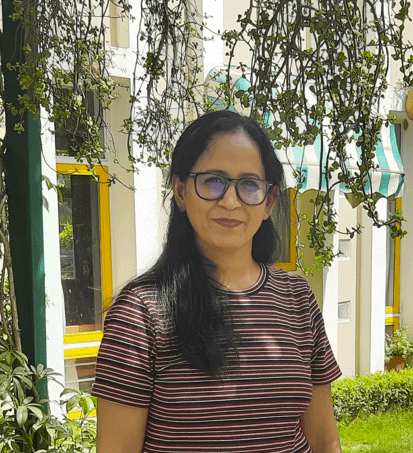
Meet Suchita Arora — Founder, Boundless Maths
Mathematician, educator, and the specialist behind every Applied Maths resource, coaching session, and question bank at Boundless Maths.
Applied Maths Coaching — Gurugram & Online India
Specialist CBSE Applied Mathematics coaching for Class 11 and 12 students — in Gurugram (offline), hybrid, and fully online across India. Small batches, conceptual depth, Vedic Maths techniques, and exclusive exam resources. Taught by Suchita Arora, 12+ years of Applied Mathematics teaching, 500+ students helped.
Offline — Gurugram
In-person Applied Maths coaching in Gurugram. Small batches for individual attention. Suited for students from DPS 45, Amity International, KV Sangathan, MRIS, Heritage, and other Gurugram schools offering CBSE Applied Mathematics.
Hybrid — Never Miss a Class
Can't come in one day? Join the same live Applied Maths class online. Every session is available both in-person and via live stream — so travel, illness, or schedule conflicts are never a reason to miss Applied Maths coaching.
Fully Online — All India
Live interactive Applied Mathematics coaching from anywhere in India. Same conceptual depth, same resources, same teaching style — just from your home. Students from Mumbai, Delhi, Bengaluru, Hyderabad, and beyond attend every batch.
Vedic Maths in Every Class
Vedic Maths techniques for fast, accurate computation are woven into every Applied Maths session — especially valuable for multi-step financial calculations, compound interest, annuity problems, and time-sensitive board exam questions.
Deep Conceptual Clarity
Most coaching centres teach you to pass. We teach you to understand. Applied Maths concepts are connected to real business decisions, your commerce subjects, and long-term career skills — not just exam patterns and shortcuts that fade after the test.
Mindfulness for Exam Stress
Breathing techniques, focus exercises, and exam-day stress management are embedded in every Applied Maths batch. Students who manage exam anxiety consistently outperform those with equal knowledge but poor exam-day composure.
What Applied Maths Students & Parents Say
5.0 on Google · 100+ verified reviews · every word real and publicly visible
I had a very good learning experience studying Class 11 and 12 Applied Maths under Suchita Ma'am. Her teaching approach made even difficult concepts much easier to understand. The Applied Maths Formula Deck was extremely helpful for quick revision before exams, and the Class 12 Question Bank gave great practice with a wide variety of questions similar to exam patterns.
As a parent, I had a really good experience with my son preparing for Class 12 Applied Maths. The formula deck helped him a lot with quick revision, and the question bank and mock tests gave him good practice before the exams. The YouTube videos and doubt sessions made difficult topics much easier. Boundless Maths really helped improve his confidence for the board exams.
Boundless Maths is the best place for Applied Maths for Class 11 and 12. The Formula Card and Question Bank are superb. The YouTube videos not only help in getting conceptual clarity but also confidence. Practice questions contain great variety — MCQs, assertion reasoning and PYQs. Would highly recommend!
My son used both the Formula Deck and Question Bank for his Class 12 Applied Maths boards. The Formula Deck has all formulas for the complete syllabus organised clearly — great for quick revision. The Question Bank is comprehensive with unit-wise concepts, common mistakes to avoid, PYQs, and full mock tests. Together they cover both revision and practice perfectly.
I've studied under Suchita Ma'am for my Class 12 CBSE Applied Mathematics and had a very positive experience. She has a great way of explaining maths concepts clearly and logically. The study material — question banks, mock papers, formula deck — helped me a lot in practice. I've gained a lot more confidence in maths since joining, and would highly recommend this class!
I took classes with Suchita Ma'am for Class 11 and 12 Applied Maths and had a good experience. She explains mathematical concepts in a simple and structured way, making them easier to grasp. The study resources — question banks, mock tests, and the formula deck — were very helpful for practice. I would definitely recommend her classes.
Opens Google — all reviews are real, unedited and publicly visible
Applied Maths — Every Common Question, Answered
Ready to Make Applied Maths Your Strength?
Whether you're a Class 11 student starting your Applied Maths foundation, a Class 12 student targeting 90+ in boards, or a parent helping your child make the right subject decision — your next step is below.
Applied Maths Class 11 — Free Resources
Complete 2026-27 syllabus, unit-wise free practice questions, school exam papers, and Formula Deck. Everything to build a strong Class 11 foundation.
Applied Maths Class 12 — Board Resources
200+ free questions, CBSE papers, and AI Q-Bank. Target 90+ in your Applied Maths board exam.
Expert Applied Maths Coaching — Gurugram & Online
Live coaching for Class 11 and 12 Applied Mathematics. Offline in Gurugram, hybrid, or fully online. Small batches, Vedic Maths, deep conceptual clarity.