
Where Mindful Learning Begins
Where Mindful Learning Begins
Every chapter of NCERT's new Class 9 Maths textbook, Ganita Manjari — Part I (Chapters 1–8) and Part II (Chapters 9–14) — with a short note on what each chapter covers and a link to its free NCERT solutions. From here you can also reach the CBSE syllabus and marks, lab practical activities for teachers, and the optional Advanced Maths module.
Last updated: 3 October 2026
NCERT has replaced the old "Mathematics: Textbook for Class IX" with a renamed, restructured book — Ganita Manjari — for 2026-27, published in two parts: Part I (Chapters 1–8) and Part II (Chapters 9–14). Its chapter names are curiosity-led and story-driven, built around reasoning and proof rather than rote procedure. Tap any chapter to open its solutions.
Chapters 1–8 · Competency-based, real-life application, and Indian Knowledge System integration
Looking to get the Class 9 Maths Ganita Manjari Part I textbook? Order the printed NCERT book on Amazon, download the official Ganita Manjari Part I PDF free from NCERT, or open our free step-by-step NCERT solutions for Class 9 Maths Ganita Manjari Part I (Chapters 1–8) — every exercise, Think and Reflect box and end-of-chapter question, solved the way you would write it in the exam.
Chapters 9–14 · 6 chapters, confirmed from NCERT's own Table of Contents
Looking to get the Class 9 Maths Ganita Manjari Part II textbook? Order the printed NCERT book on Amazon, download the official Ganita Manjari Part II PDF free from NCERT, or open our free step-by-step NCERT solutions for Class 9 Maths Ganita Manjari Part II (Chapters 9–14) — propositions, data, algorithms, quadrilaterals, linear equations and surface area and volume, with every step shown.
Prefer a printed copy for school and home study? Both parts of the Class 9 Maths textbook are available on Amazon.
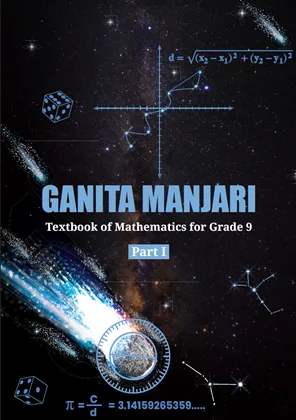
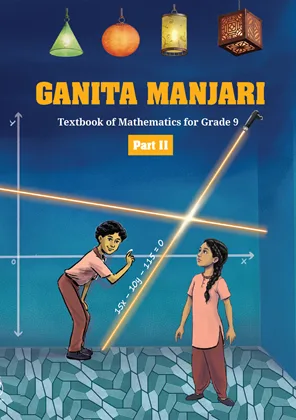
Affiliate disclosure: these are Amazon affiliate links. If you buy through them, Boundless Maths may earn a small commission at no extra cost to you. As an Amazon Associate we earn from qualifying purchases.
Need the textbook itself? Both parts are free to download as PDFs from NCERT's official website, ncert.nic.in (opens in a new tab) — choose Class IX → Mathematics → Ganita Manjari.
Wondering how these chapters line up with CBSE's syllabus? See the syllabus mapping →
A compact, printable Formula Card covering every formula and concept from Number Systems through Sequences, Circles and Mensuration — organised the way a student revising should encounter them.
View Maths Formula Cards →36 exam-pattern worksheets with step-by-step answer keys, covering all 14 chapters — MCQs, Assertion–Reason, short and long answers, HOTS and a case study in every chapter. Use them as practice or as timed test papers, then check your mistakes against the key.
View Practice Worksheets →6 units · 80 theory marks + 20 Internal Assessment marks
The Lab Practical carries 5 of the 20 Internal Assessment marks, and the NCERT lab manual's activities were written before Ganita Manjari. Our guide matches every manual activity to its chapter, suggests substitutes where there's no match, and — for teachers setting the theory paper too — explains how our 80-mark mock paper was built and marked.
Lab practical activities for all 14 chapters, plus paper construction and marking
From 2026-27, CBSE has introduced an Advanced Level in Maths alongside the standard course for Class 9 (extending to Class 10 in 2027-28). It is entirely optional — students may choose to appear for the Advanced exam in addition to, not instead of, the mandatory Standard Maths paper. It is based on its own separate textbook and is aimed at students who want to go beyond the standard syllabus with HOTS-style questions.
Download the Advanced Maths Textbook (CBSE PDF) → (opens in a new tab)Separate optional paper, on top of the mandatory Standard Maths exam — not a replacement for it
The Advanced module introduces topics like sets, logarithms, functions and combinatorics a full year or more before most students would otherwise meet them. It suits students who are already comfortable with the Standard syllabus and want an extra academic challenge — not a substitute for strengthening core fundamentals first.
Personalised, concept-first coaching for CBSE Class 9 Maths — in Gurugram or fully online, pan-India.
Expert CBSE Coaching · Class 9–12